
THE COURAGE TO LEAD
CASE STUDY 005
HOW COULD THEY NOT KNOW?
Power • Trust • Systems • Moral Injury
DOWNLOAD CASE STUDY 005
The question behind the case study
“How could they not know?” is one of the most important questions in leadership. It is tempting to treat organisational failure as a problem of missing information or one bad decision.
This case study takes a different view. It asks how leaders can become disconnected from the reality experienced by the people they lead — even when complaints, rumours, workforce data, psychological injury, turnover and other warning signs exist around them.
The central argument is that leadership failure is often less about the total absence of information and more about the way power, hierarchy, reputation and trust determine whether uncomfortable information can travel upwards.
If we think of today’s world at a local, state, federal and even international level there are a myriad of examples of entities being subject to corruption, mismanagement, bullying, harassment, poor or non-existent leadership and a blame game that it is someone else’s fault. These alarm bells, early warning signs or in some cases fog horns before the tsunami hits, are ignored by the leaders of these entities.
There are some current examples where current day leaders are heard to say, “It’s a big fat nothing burger,” despite contrary evidence. When this is dissected the issue of “How could they not know?” has a familiar and similar structure to it.
Bad news, or news contrary to what leaders want to happen is ignored, or if persistent, persecuted and eradicated by informal workplace mechanisms, normally exclusion or bullying, or formal mechanisms like redundancy or procedurally unfair disciplinary processes which cause harm or separation.
Rather than pinpoint any current live examples of this let’s look at something more historical in the Wells Fargo Banking fiasco. The Wells Fargo story is a leadership failure almost a decade ago that remains one of the clearest examples of what happens when performance targets become more important than listening to people, challenging bad news and protecting organisational integrity.
Wells Fargo’s leaders were confronted with a myriad of warning signs that something was seriously wrong: escalating customer complaints, employees being disciplined or terminated for refusing to meet unrealistic sales targets, whistleblower reports, internal investigations and thousands of staff being dismissed for sales misconduct. Yet senior leaders continued to treat these as isolated employee failures rather than evidence of a systemic problem. By maintaining relentless performance targets while discounting information that challenged the sales culture, leadership allowed the pressure to continue until millions of unauthorised customer accounts had been created.
The company lost its reputation and ultimately the accountable leaders were forced to repay unjustified separation bonuses once the level of “how could they not know?” was established. It is a great example of the leadership team having their own groupthink, blindness and deafness to what was happening.
The Wells Fargo story is best summed up in this subsequent Congressional Hearing quote by US Senator Elizabeth Warren questioning Wells Fargo CEO John Stumpf at the Senate Banking Committee in September 2016.
“You know, here’s what really gets me about this, Mr Stumpf. If one of your tellers took a handful of $20 bills out of the cashdrawer, they’d probably be looking at criminal charges for theft. They could end up in prison. But you squeezed your employees to the breaking point so they would cheat customers, and you could drive up the value of your stock and put hundreds of millions of dollars in your own pocket. And when it all blew up, you kept your job, you kept your multimillion-dollar bonuses, and you went on television to blame thousands of $12-an-hour employees who were just trying to meet cross-sell quotas that made you rich. This is about accountability. You should resign. You should give back the money that you took while this scam was going on, and you should be criminally investigated by both the Department of Justice and the Securities and Exchange Commission.”
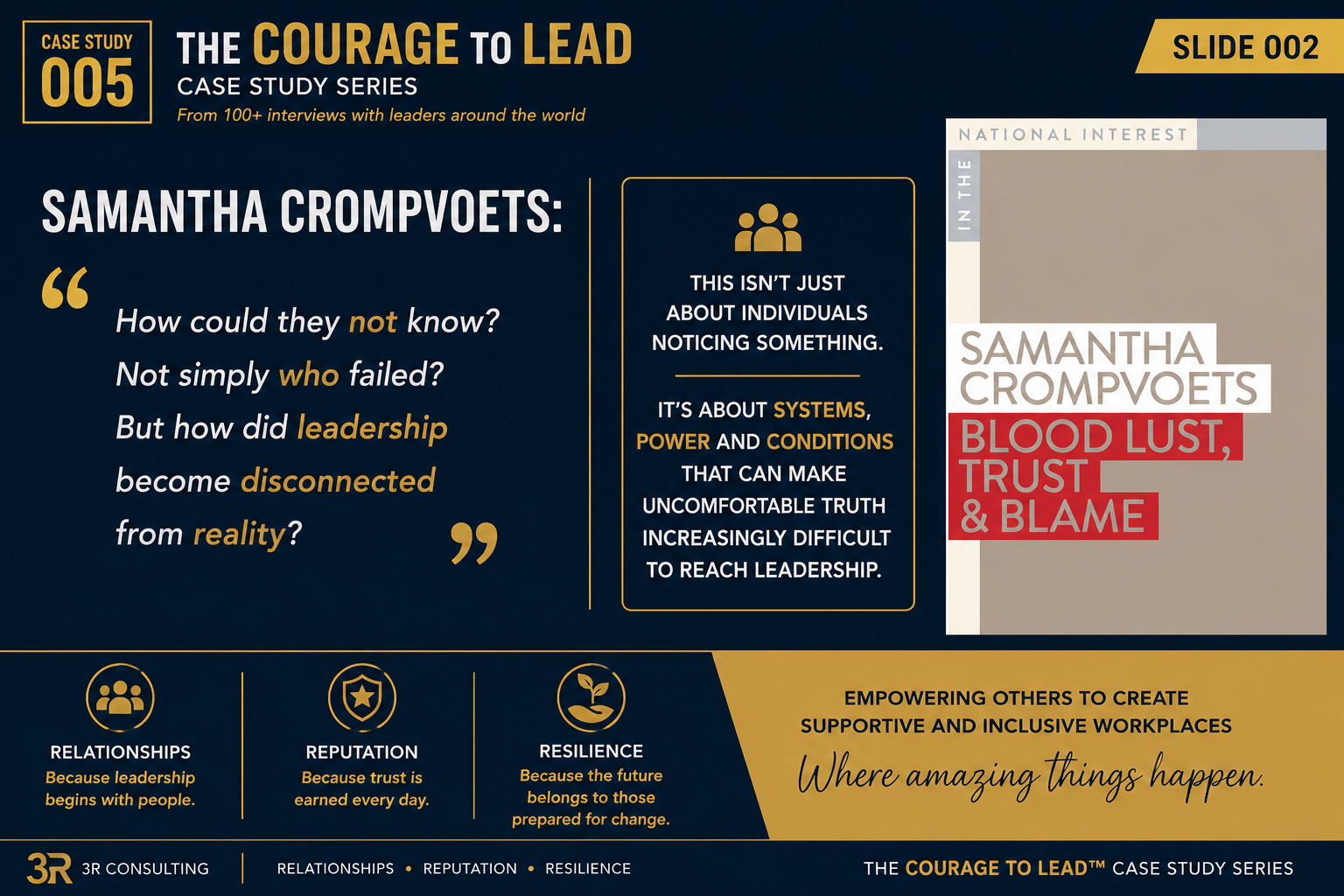
Samantha Crompvoets: An esteemed and valued researcher who by doing her job became the target of death threats, vitriol and hate
Samantha Crompvoets has a lengthy CV with impressive reviews of how organisations end up in a position that you end up asking, “how could they not know.” Whilst she has an extensive level of experience in this field across several years, perhaps she is best known for her report on the Australian Special Forces conduct during the Afghanistan war.
This report led to the Australian Defence Force, the Brereton Inquiry and the Australian Federal Police conducting investigations into alleged war crimes. I read widely to understand the history of things and how things end up where they are. Without making any comment about that enquiry as its outcomes are currently before our judicial system, the works and reports of Crompvoets are, in my view, riveting reading about how organisations fail.
I could not put her book “Blood Lust, Trust and Blame” down as it is far more than a book about war. It shows where the gaps are for any organisation if you look at her works in that context.
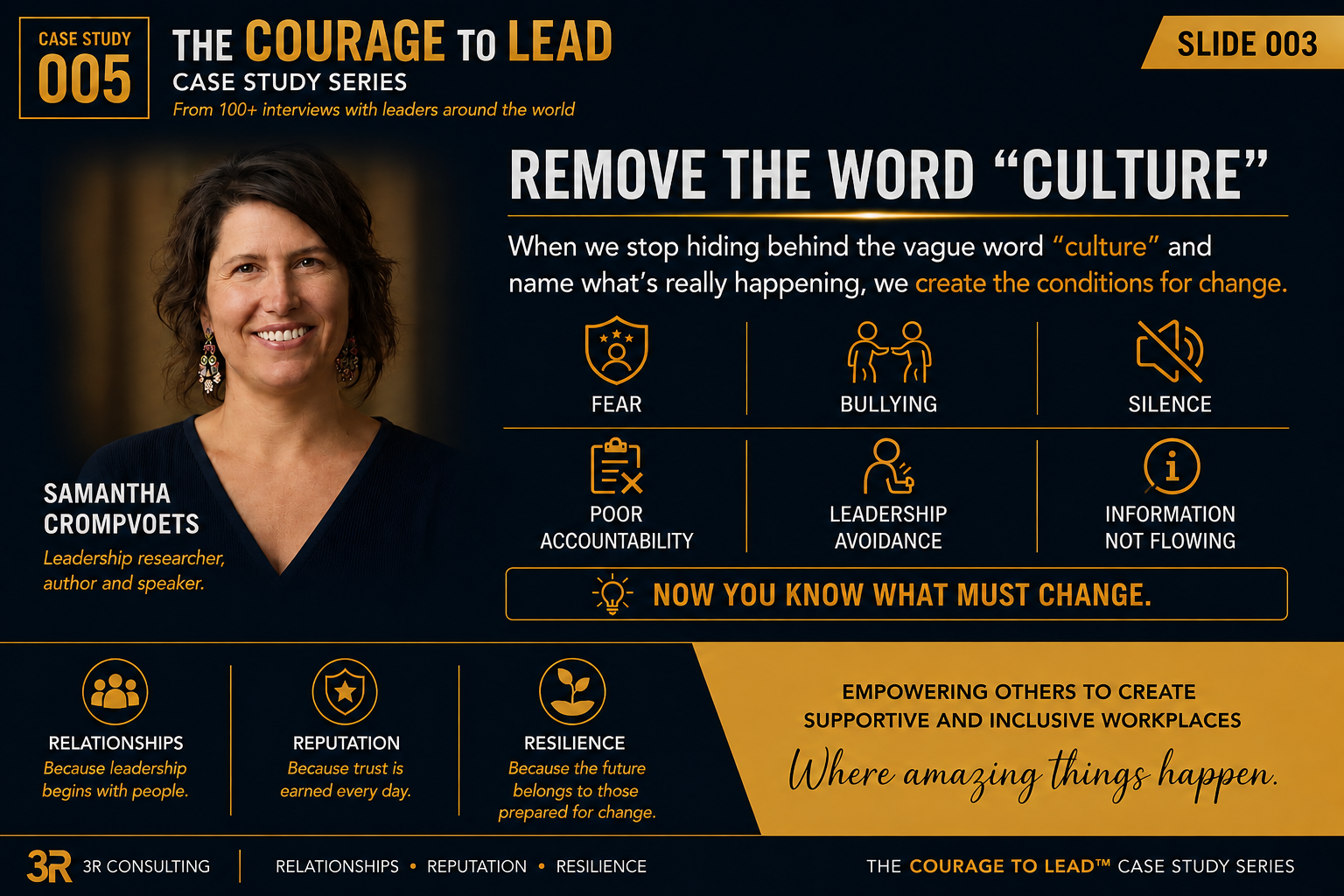
Remove the word “Culture”.
Samantha Crompvoets’ work provides the first lens. Instead of allowing the broad word “culture” to become an explanation for everything, her works suggest replacing “culture” with the behaviours underneath it: fear, bullying, silence, poor supervision, abuse of power, broken trust, poor accountability, leadership avoidance, information not flowing and poor decision-making.
Naming the behaviour matters because vague language can protect systems from scrutiny. Once the problem is described precisely, leaders can ask who speaks, who remains silent, who is believed, who is protected, who is promoted and who is held accountable. Culture follows power; leadership determines how power is exercised.
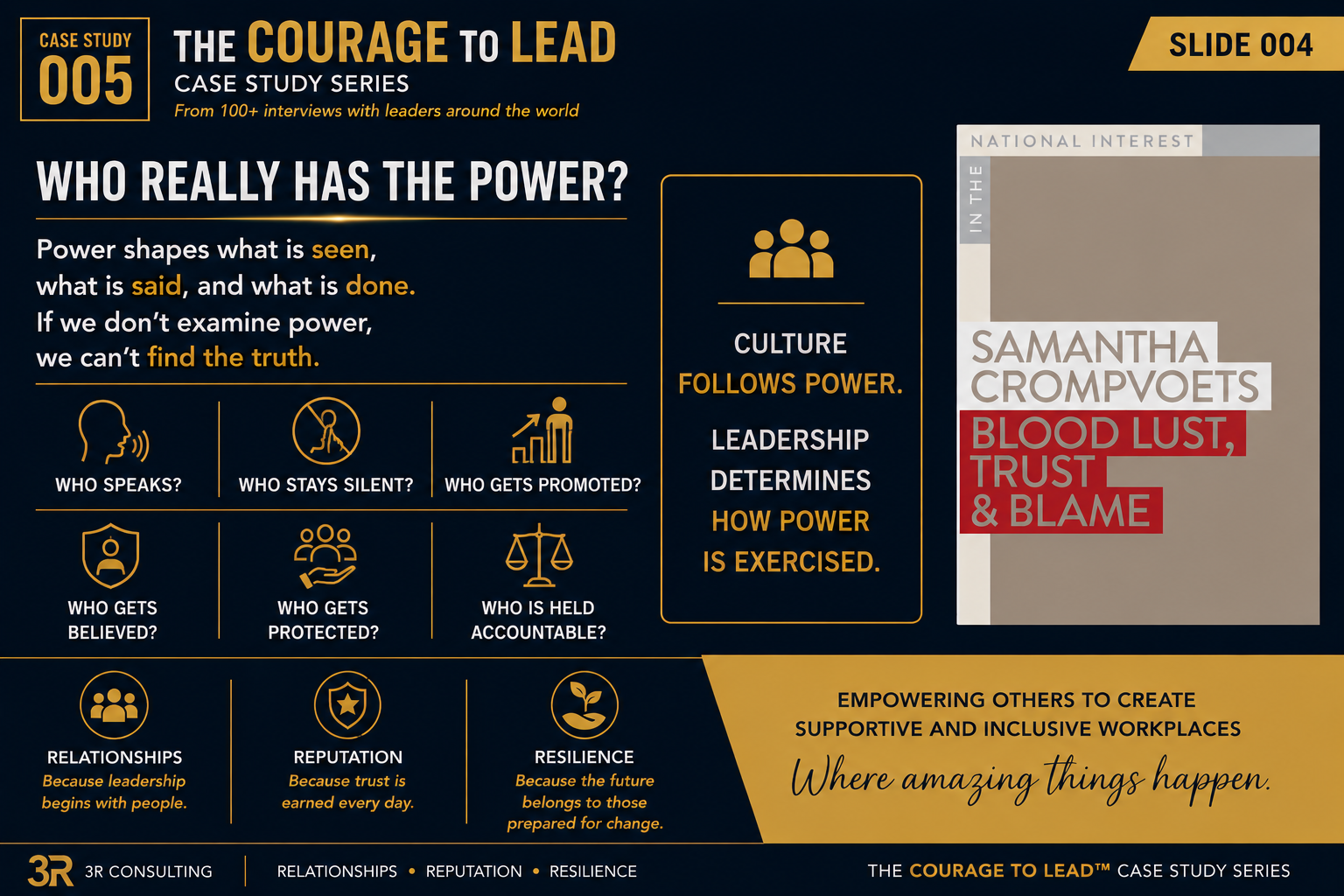
Who really has the power?
Think about any current workplace issue. Think of the most annoying thing in your workplace that makes no sense. Then think who lobbied for that to happen? How did management implement that annoying senseless thing that causes the workplace or workforce pain, stress and disengagement? Who let it happen? Who protects it staying exactly the way it is? Who punishes anyone who questions the status quo?
When I think of issues that I know exist within workplaces, it is not always the boss who is responsible. The boss works within a system that protects the status quo, it takes a movement, no matter how much evidence exists that that change should occur. The entity protects itself against change.
Conversely in organisations that are thriving, exactly the opposite is occurring. Creativity is encouraged; support and inclusion are the norm and leaders at all levels are empowered to create the strategies for the change that is occurring around them.
Which workplace do you work in?
One where power is used to keep the status quo, or one where leaders at all levels are empowered to create the future.
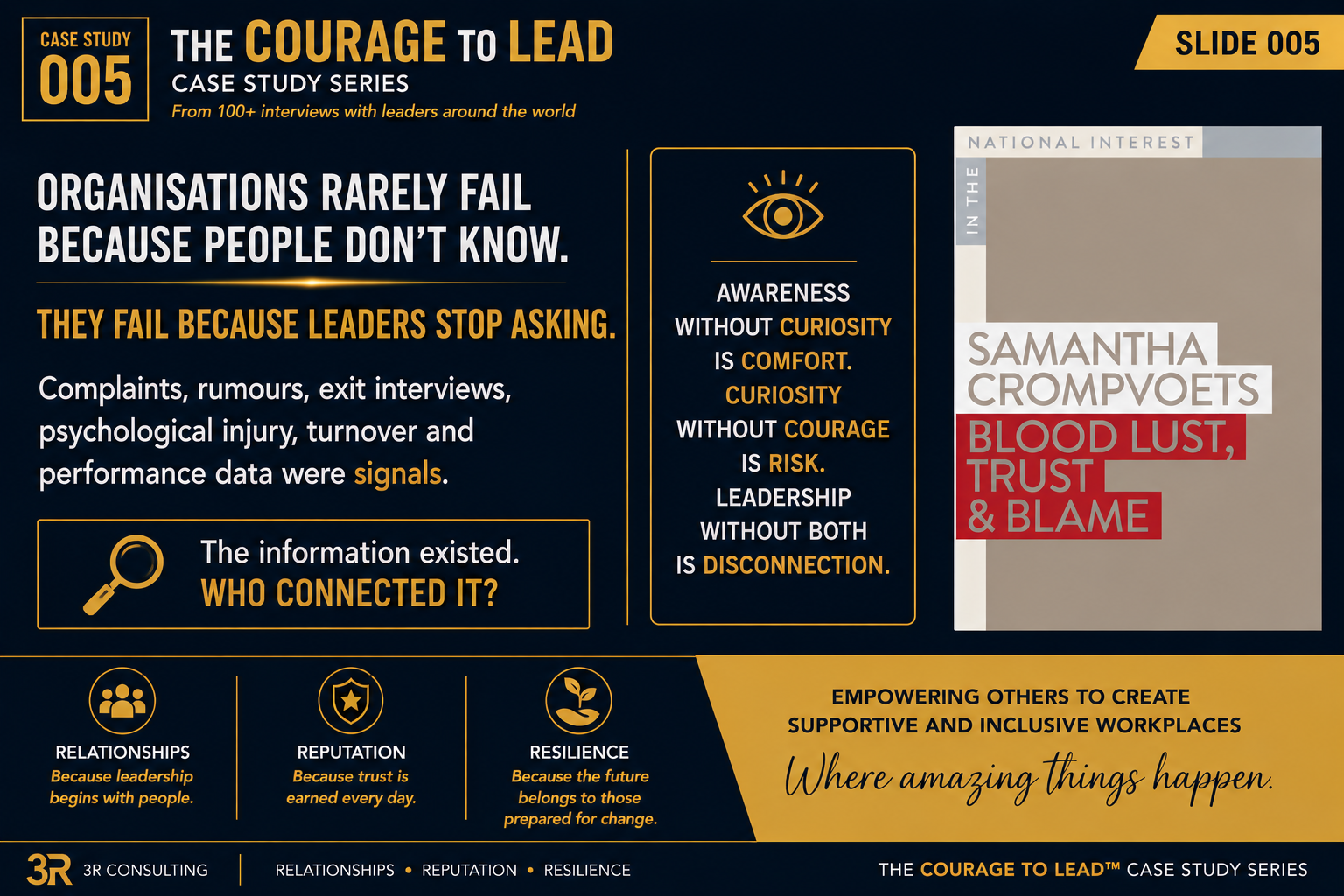
When leaders stop asking.
Organisations rarely fail simply because nobody knew anything. They can fail because leaders stop asking, stop connecting information, or become comfortable with reassuring explanations. Awareness without curiosity can become comfort. Curiosity without courage can become risk avoidance. Leadership without both becomes disconnection.
The practical lesson is to connect the signals. Complaints, exits, injuries, workforce movements, performance data and informal stories should not live in separate organisational silos. Leaders need mechanisms that join them together and then ask what pattern they reveal.
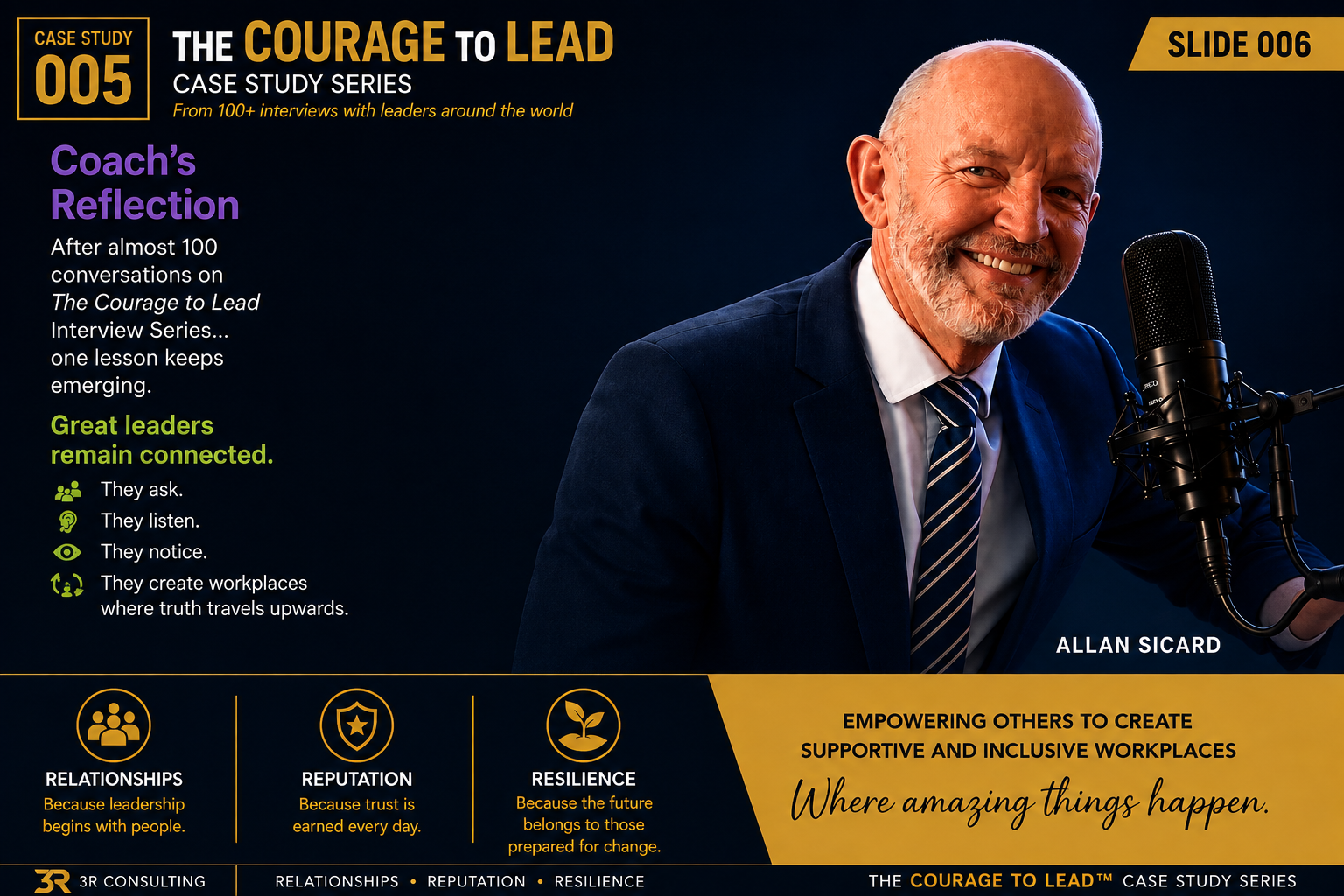
Coach’s reflection
Across The Courage to Lead conversations, a recurring lesson is that great leaders remain connected. They ask. They listen. They notice. Most importantly, they create workplaces where truth can travel upwards. Connection is not simply visibility.
It is the quality of the relationship between leaders and the people who hold information the leader needs. If staff believe speaking up will damage their career, reputation or wellbeing, the formal reporting system may exist while the real information system has already failed.
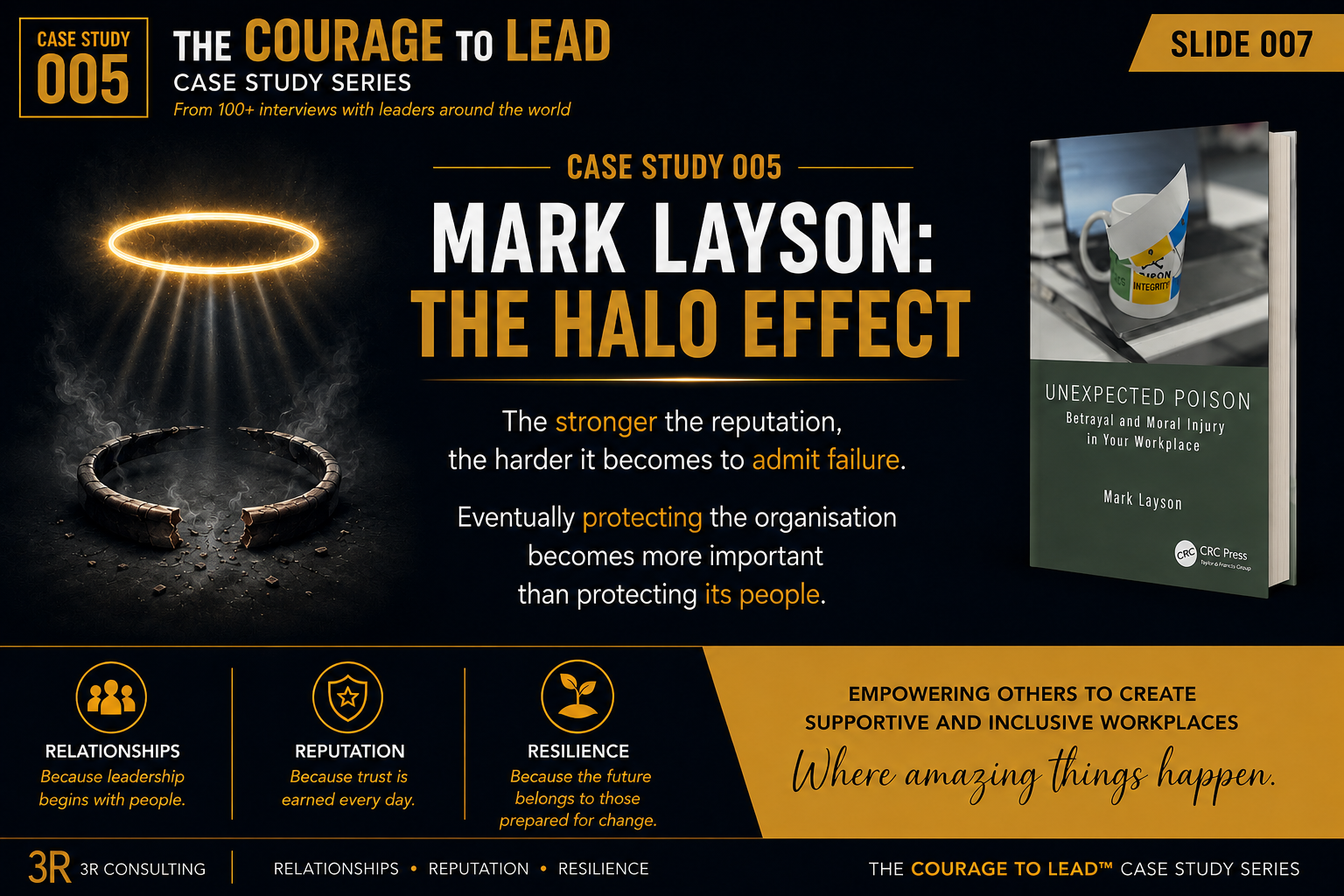
Mark Layson: the Halo Effect
Unexpected Poison – Betrayal and Moral Injury in the Workplace
Mark Layson’s work on betrayal and moral injury adds a second lens: the stronger an organisation’s reputation becomes, the harder it can be to admit failure. The organisation’s public identity can become something leaders feel compelled to defend.
That is the Halo Effect explored here. Protecting the institution’s image can gradually become more important than protecting the people inside it. When that happens, reputation stops being the result of trustworthy behaviour and becomes an object to be defended.
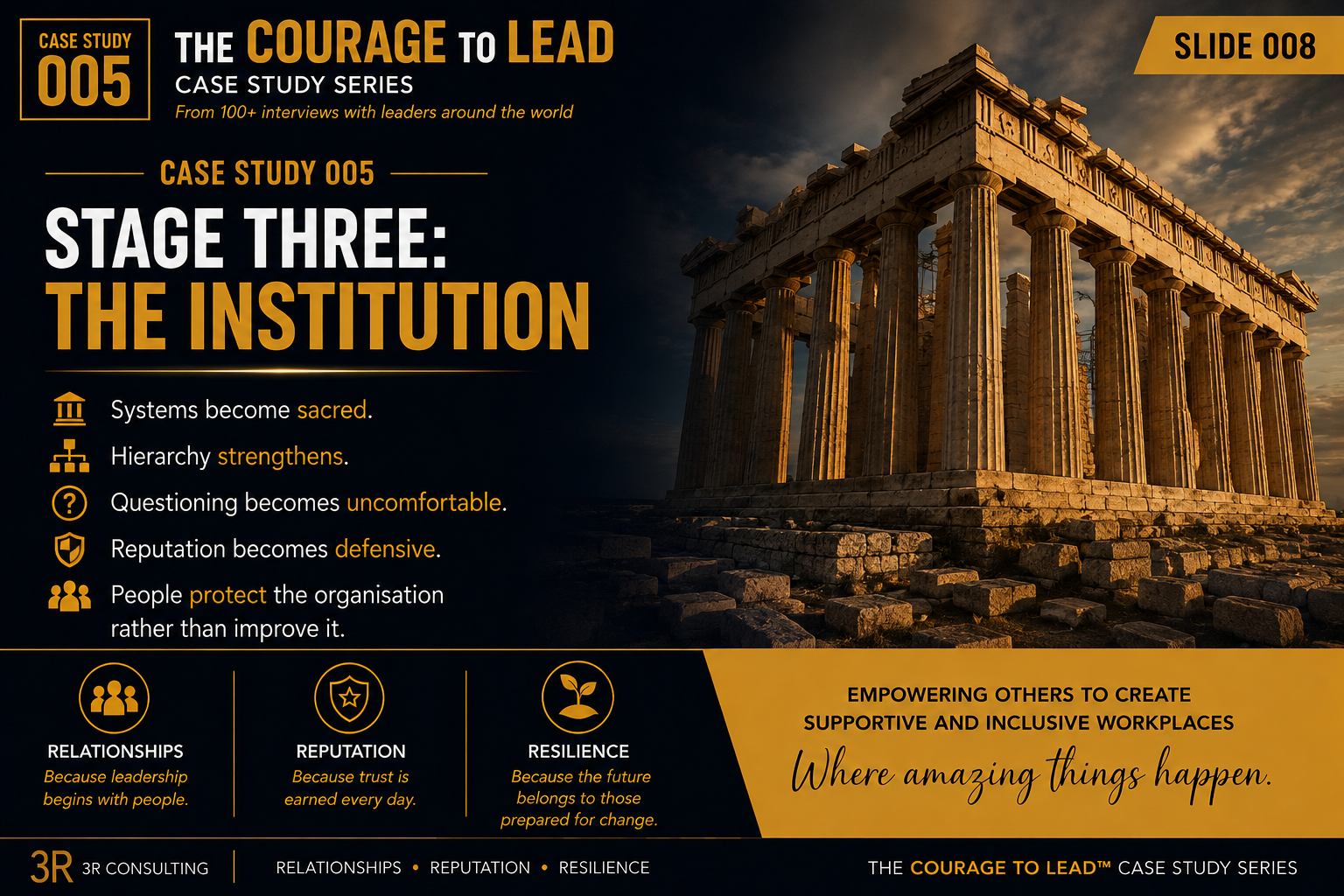
Stage Three: The Institution (From Mark Layson’s book – Unexpected Poison)
There are 4 stages of an organisation.
Stage 1 is a Movement,
Stage 2 is an Organisation,
Stage 3 is an Institution and
Stage 4 is a Museum.
At the institutional stage, systems become sacred, hierarchy strengthens, questioning becomes uncomfortable and reputation becomes defensive. People can begin protecting the organisation rather than improving it.
This is where process can overtake purpose.
Rules, reporting lines and traditions may still look impressive from the outside, while internally they make challenge slower, riskier and less welcome.
If we think about this for a moment.
Do you know a large organisation in Australia or even globally that has entered the Institution phase, be it a long-standing traditional brand, a political party, a media organisation, a government department, a charity.
Does the process overtake purpose? Are its traditions and external image more important than what is occurring internally? What happens to anyone questioning the internal machinations? Are they welcomed or are they eradicated?
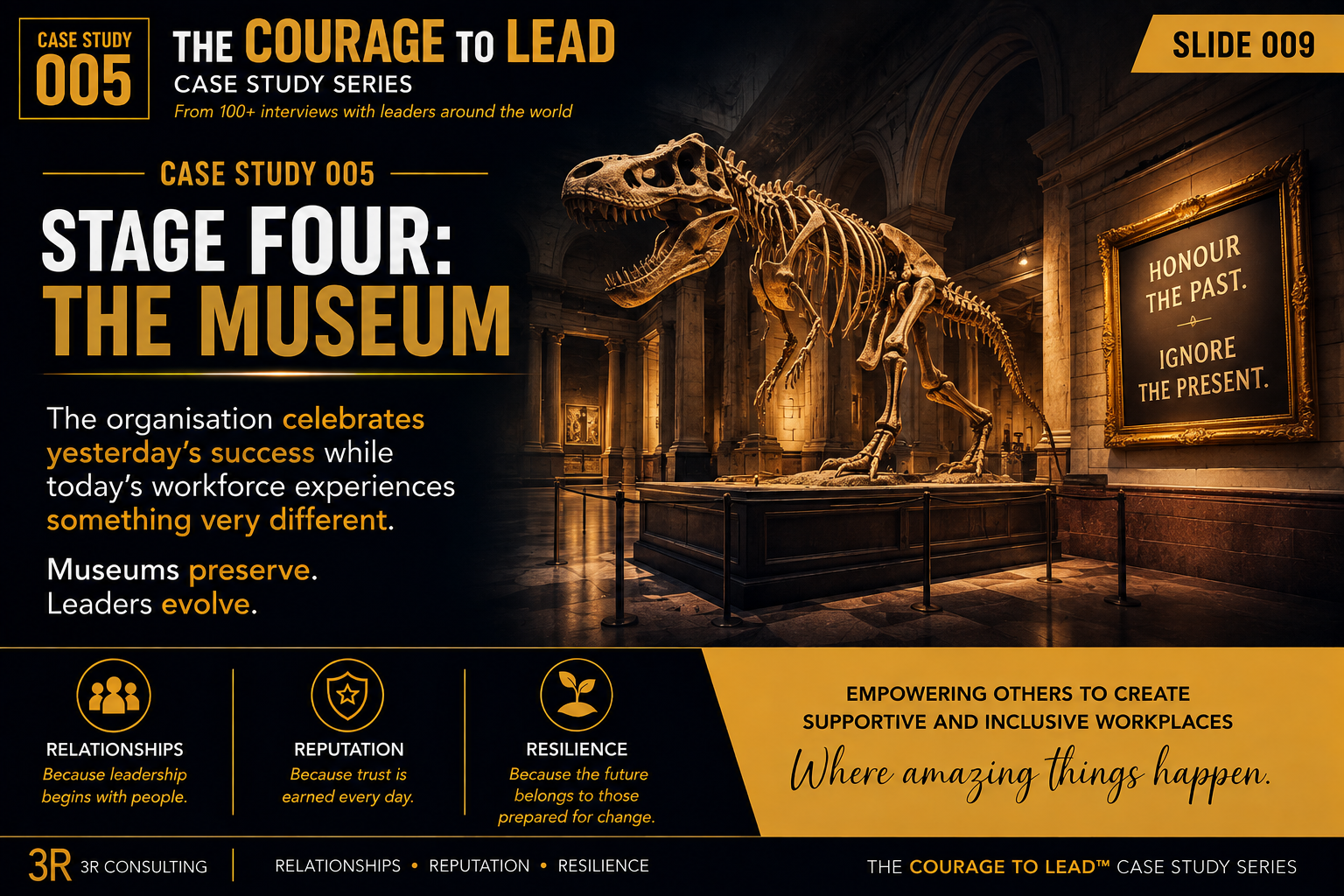
Stage Four: The Museum
(From Mark Layson’s book – Unexpected Poison)
The museum metaphor describes an organisation that celebrates yesterday’s success while today’s workforce experiences something very different. Museums preserve. Leaders evolve.
History and tradition can be sources of identity and pride, but they become dangerous when past achievement is used to dismiss present evidence. The leadership task is to honour the past without allowing it to become an excuse for avoiding current challenges.
Again, ask yourself is your organisation: or workplace clinging onto traditions, structures, systems and power because that’s how it has always been done?
Does your workplace or organisation blame everyone, and everything else for their predicament rather than look inwards to what they could do if they changed the way they did business?
Do you work for leadership that clings to the past and will not change, or do you work for leaders who encourage you and the whole workplace to continually evolve?
I know I’ve worked for a few dinosaurs in my lifetime. How about you?
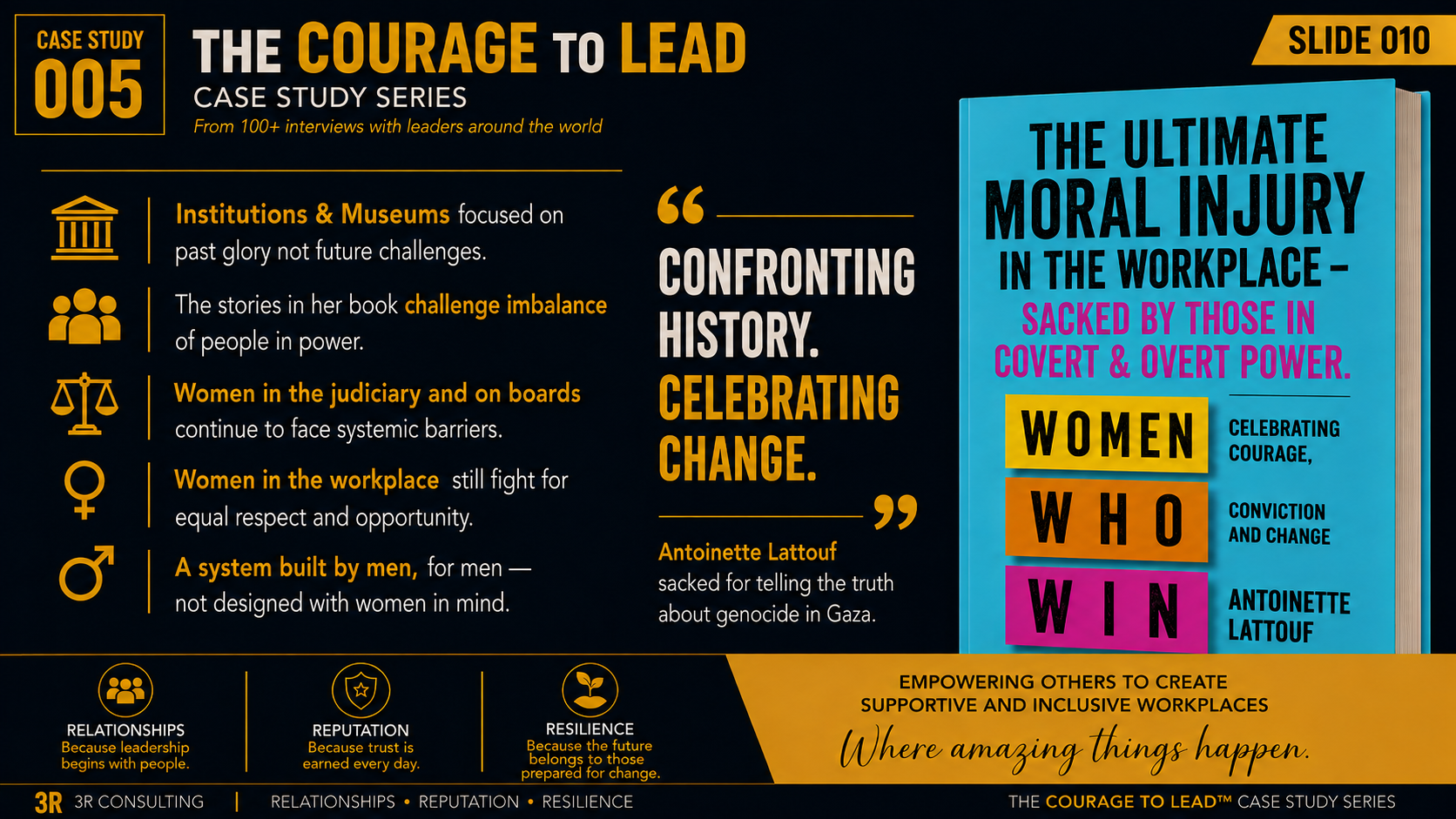
Antoinette Lattouf: confronting power
As I said I read widely and different content to get an understanding of “why did that happen?”
I must declare that I listened to Antoinette Lattouf, when she was on ABC Radio Sydney, the day she was terminated. I loved her show, she was funny, engaging, educated, inclusive, everything I want when I listen to talk back radio.
Then she was sacked, for saying in her own social network, for repeating a Human Rights Watch post (see link) that what was happening in Gaza, was using starvation as a weapon of war. What was interesting was that the content of the Human Rights Watch post had already been reported by ABC News and an almost identical headline appeared on the ABC website. Then within 24 hours Lattouf was told she no longer had a job because the ABC was lobbied by external sources that what she said was inflammatory or worse.
What happens next, court hearings up to the Federal Court, where it was found she was unlawfully terminated.
A familiar theme here that I did not expect to find when I first started writing this case study. Someone told someone in power, something they did not want to hear, so they were eradicated and removed from their job for telling a truth.
Antoinette Lattouf starts writing Women Who Win as a deflection and an inspiration to herself whilst she is amid this court battle. She researches other Australian women throughout our history who have questioned why do we do it that way for? There is nothing radical about the issues highlighted in this book but it is simply women questioning the powers that be why can’t I work as a labourer at the steel mill, why do I have to wear a dress when I am climbing a ladder, when men can wear pants, why can’t I be a lawyer when I have passed my lawyer exams, why can’t my name be on a scientific paper when I authored it and did all the experiments when I am a woman.
There are countless other examples in this excellent book, but they all have the same theme.
The simplest of changes, and the simplest of questions take decades, sometimes a century to change.
The system, the law and the power surrounding the concept, i.e. that women should have equal pay, equal opportunities and equal participation in all workplaces, takes decades to change and still remains at risk of reverting back to how it was.
Antoinette Lattouf’s book broadens this case study from organisational self-protection to the long history of people confronting established power. The book profiles Australian women who challenged barriers across law, public life, workplaces and institutions.
The leadership connection is not that every struggle is identical. It is that systems built around existing power rarely change simply because change is reasonable.
Truth-tellers and challengers often carry the personal cost of forcing institutions to confront what they would rather preserve. This case study therefore frames the issue as confronting history while celebrating change.
The exact opposite of this occurs if leadership encourages and empowers leaders at all levels to be creative in what they see happening in the future and create resilience and change to accommodate that future as change is constant.
A great example of this is a recent guest on Episode 99 of The Courage to Lead Interview Series, Brett Simpson, the Ambulance Commander who attended both the Bondi Westfields Mass Casualty event and then the Bondi Beach Mass Casualty event. What Brett learned from event 1 to event 2 made the difference.
Similarly, Episode 74, Debbie Wallace and Case Study 3 highlight the same concept when the front-line staff are asked what they would do to shut down how outlaw motorcycle gangs operate. Leaders listened, front line staff implemented, outlaw motorcycle gangs are effectively shut down from operating how they traditionally operated in New South Wales.
I recently watched a TV Series called Lessons in Chemistry about a fictional female scientist who could have jumped out of one of the chapters of Lattouf’s book. The main character of that series, Elizabeth Zott had this saying,
“Courage is the root of change. And change is what we’re chemically designed for.” Elizabeth Zott, Episode 8.
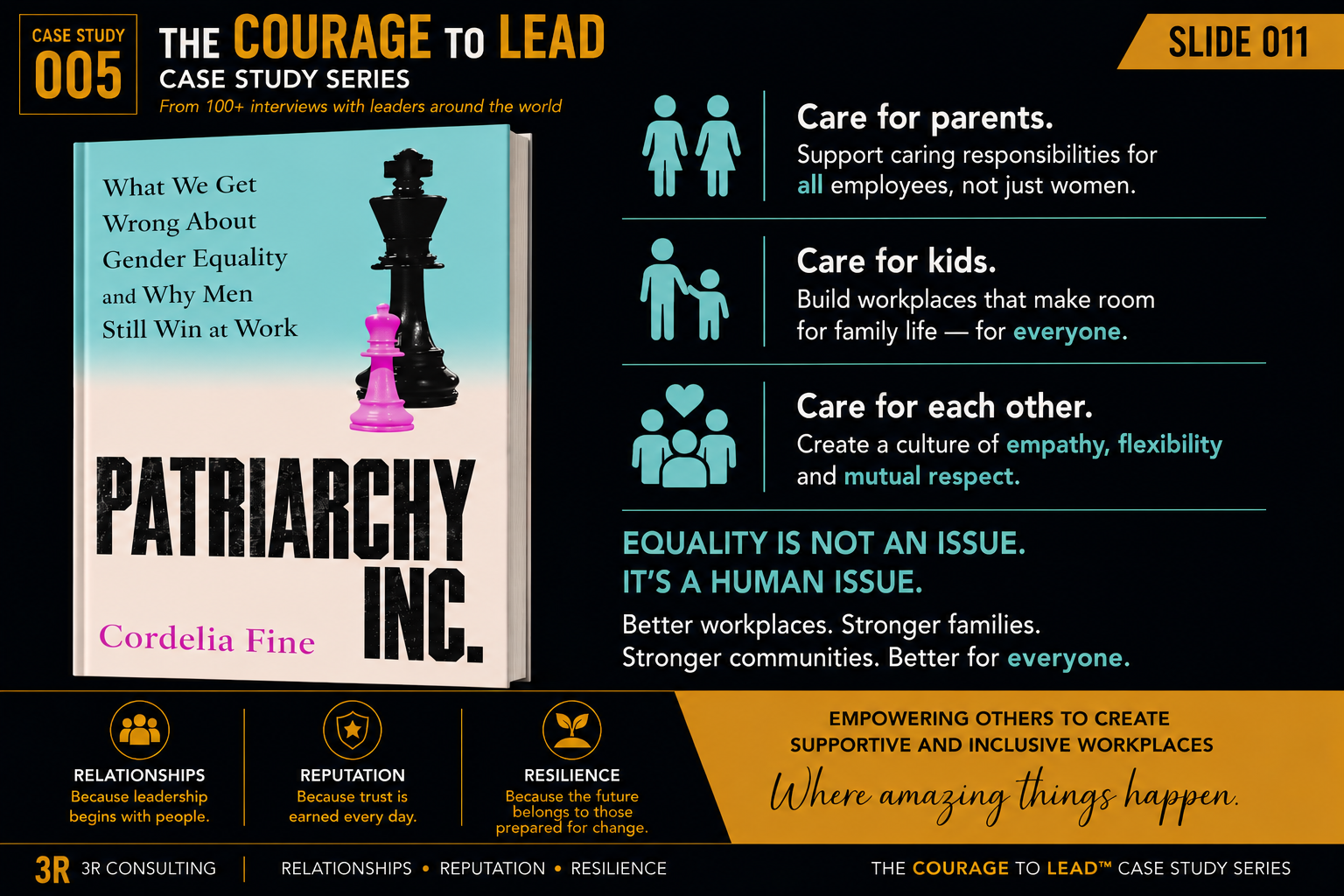
Cordelia Fine: Redesign the system
Cordelia Fine’s Patriarchy Inc. shifts the question again: what if the problem is not only individual attitudes, but the design of work itself?
Equality is a human issue.
Workplaces need to make room for the whole person — women and men — including care for parents, care for children and care for each other.
What is Cordelia Fine talking about?
WHAT WALKS THROUGH THE DOOR WITH YOUR PEOPLE?
The person who arrives at work is carrying much more than their job title.
THEIR CHILDREN
1 in 9 Australian children under 15 lives with disability.
Autism affects approximately 1 in 23 children aged 5–14.
Behind many of those children is a working parent managing appointments, therapies, assessments, schooling, and care.
THEIR PARENTS
Around 459,000 Australians are living with dementia in 2026.
80% of Australians aged 65+ live with at least one chronic health condition. For many employees, caring for ageing parents increasingly becomes part of everyday life
THEIR OWN LIFE
21.5% of Australians aged 16–85 experienced a mental disorder in the previous 12 months.
19.6% have experienced a substance-use disorder during their lifetime.
More than 47,000 divorces occurred in 2024.
1 in 4 households were struggling to make ends meet in 2025.
A simple example. A married couple both working with a 2-year-old child. Their separate employers allow them to work one day a week from home. This represents an $8,000+ savings per year.
Then add stroke, acquired brain injury, illness, grief, and other unexpected life events.
THEIR FAMILY SOMEWHERE ELSE
About one third of Australians were born overseas.
Almost 48% have at least one parent born overseas.
For some employees, war, terrorism, political upheaval, famine, earthquakes and natural disasters are not events happening on television.
Their family may be there.
They may arrive at work after spending the night trying to contact a parent in Iran, a relative in Israel or Gaza, family in Ukraine, or loved ones affected by an earthquake or disaster in Nepal or elsewhere.
CORDELIA FINE’S LENS
What assumptions are we making about the person standing in front of us?
The employee who appears distracted may not be disengaged.
The employee who needs flexibility may not lack commitment.
The employee whose performance has suddenly changed may not have become a poor employee.
Something may have changed in their life.
THE LEADERSHIP QUESTION
You don’t need to know everything about your people.
But have you created the relationship and trust that allows them to tell you when something matters?
HOW COULD THEY NOT KNOW?
A genuinely inclusive workplace does not assume that the ideal worker has no responsibilities outside work. Better systems support caring responsibilities, flexibility, mutual respect and family life for everyone.
There have been several guests on the Courage to Lead Interview Series that explore this issue of the whole person coming to work. These include Michelle O’Keeffe, Rebecca Pinkstone, Mike Wassing, Brett Simpson, Matt Lahood, John Foong and Belinda Sinclair. Cordelia Fine is a two-time guest on the podcast.
The evidence indicates that workplaces that acknowledge this and support this are being highlighted as Great Places to Work.
Their performance, their culture, their retention rates, their satisfaction rates are all positive. Conversely workplaces that cling to their policies, protect the institution and do not value their people have exactly the opposite occurring.
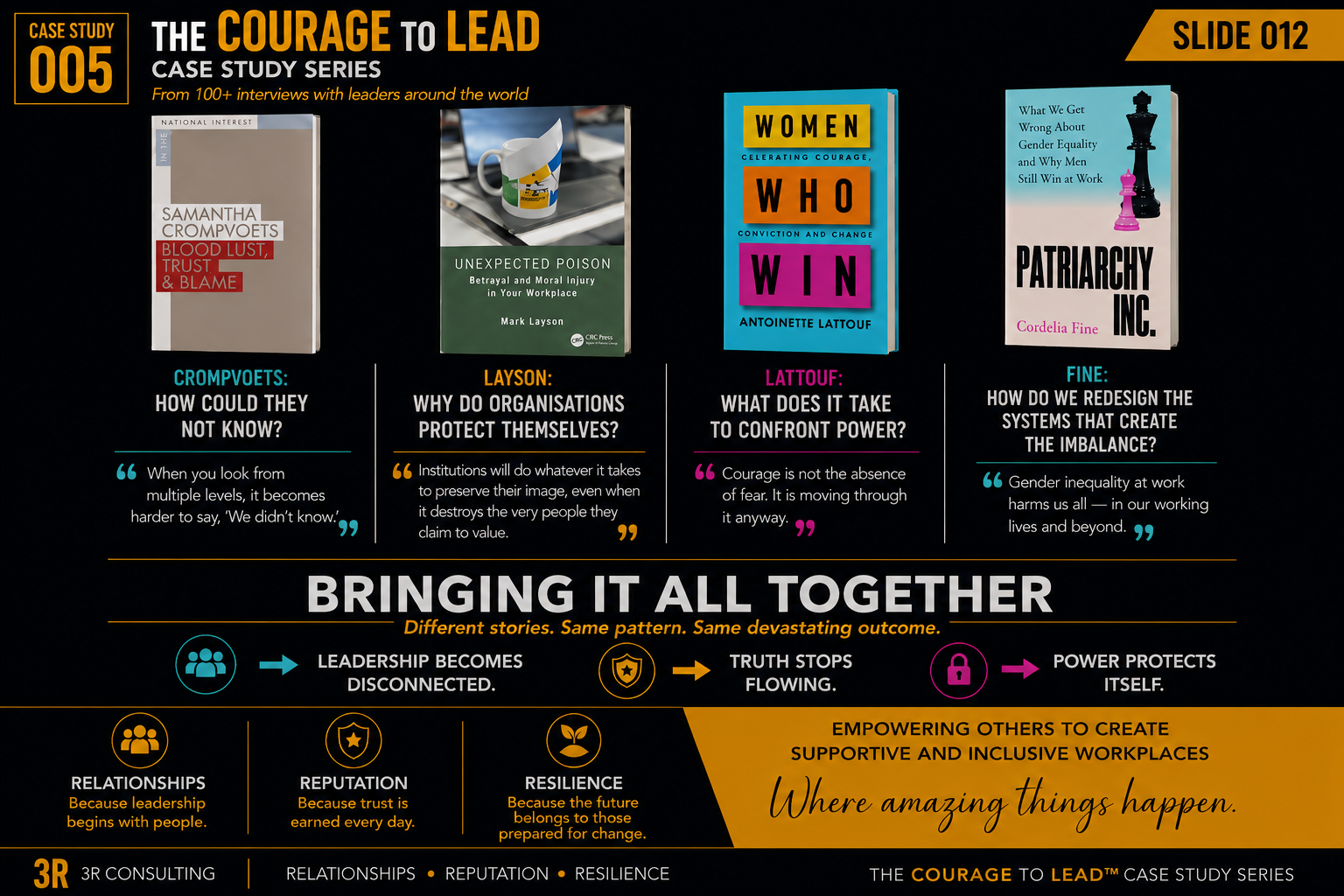
Bringing the four lenses together
Crompvoets asks how leaders could fail to know.
Layson asks why organisations protect themselves.
Lattouf shows what it can take to confront power.
Fine asks how systems should be redesigned so they work for the whole person.
Different stories reveal a common pattern: leadership becomes disconnected, truth stops flowing and power begins protecting itself. The result can be moral injury, declining trust, institutional defensiveness and a widening gap between what an organisation says it values and what its people experience.
What does a leader need to understand about the organisation, the institution and the human beings inside it before they can lead them well?
The four lenses give us a genuinely useful way of interrogating that question. Crompvoets challenges what we think we know about the system. Layson challenges what an organisation believes about itself. Lattouf exposes what can happen when judgement, pressure, reputation and institutional decision-making collide. Fine challenges what we think we know about the individual.
Then underneath Fine’s lens is something leadership literature can easily sanitise away: people have lives.
The person sitting in a performance meeting may have spent the previous night with a neurodivergent child. The executive who seems distracted may be organising care for a parent with dementia. Someone’s marriage may have collapsed. Someone may be struggling financially or psychologically. Another employee may be refreshing their phone waiting to learn whether relatives thousands of kilometres away are safe.
None of that means standards disappear. Compassion and accountability aren’t opposites. It means good leadership seeks to understand what is driving a change in behaviour before deciding what that behaviour tells us about the person.
And that leads to a proposition I think is worth retaining for the eventual book:
Curiosity before judgement.
Before asking, “What is wrong with this person?” ask, “What might I not know?”
Coming back to the Case Study Title:
How could they not know?
And one answer is that organisations have enormous amounts of information about their people, but too often leaders look at data primarily to ask:
“Are we meeting the target?”
rather than:
“What is this telling me about where my people need help?”
For example, rising sick leave, overtime, workers’ compensation, resignations, complaints, vacancies, unfinished work, declining productivity or repeated mistakes can all be treated as performance problems.
But viewed through another lens, the same data can be early warning signs:
Something is happening here.
This team might be struggling.
This leader might need help.
These people might be overloaded.
We should become curious before the damage becomes visible.
In workplaces where this occurs, people see that leaders care.
When this is the normal way of doing things a caring, supportive and inclusive culture evolves without effort. Leaders see their people, people trust their leaders and together they prepare for future challenges.
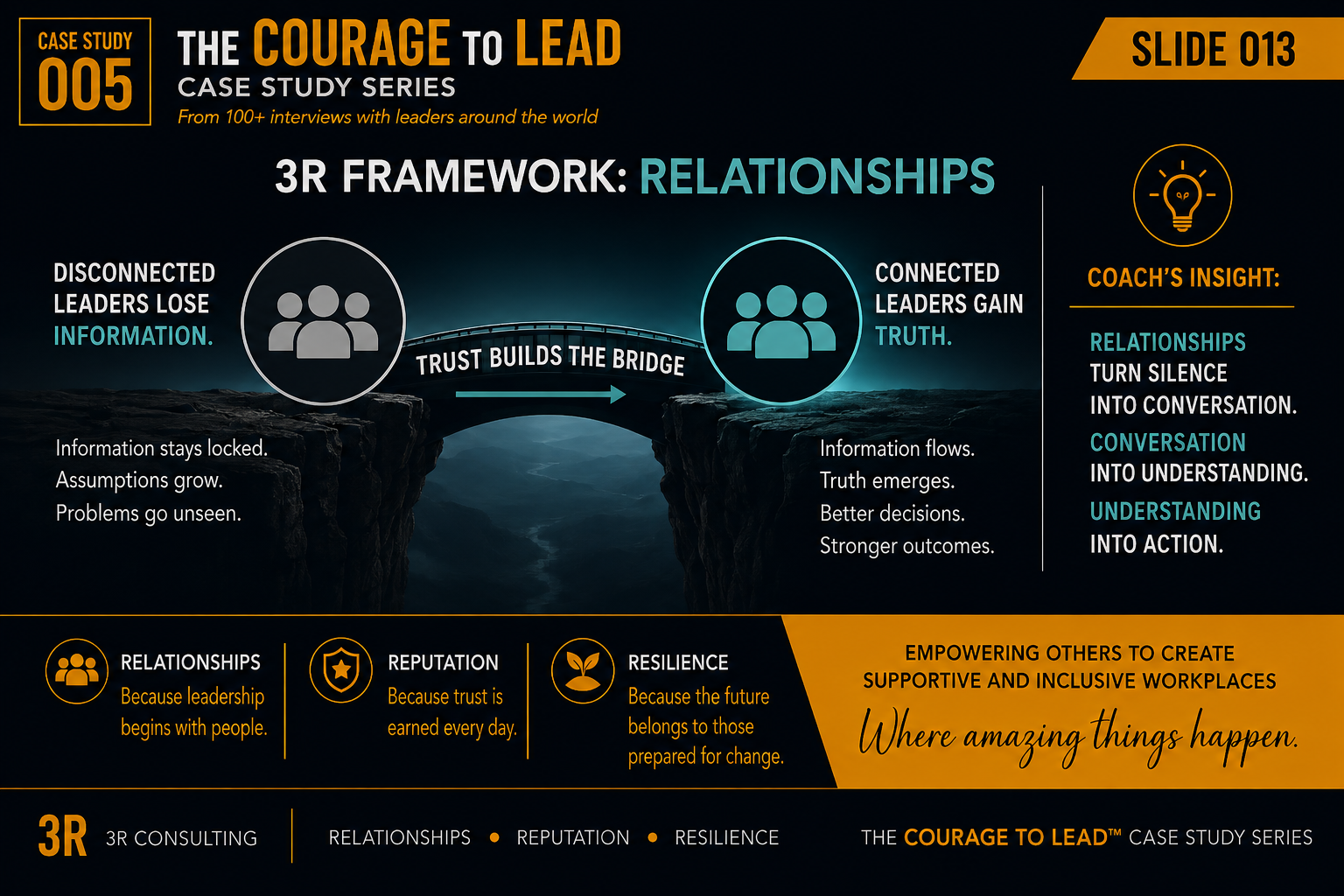
The 3R Framework
RELATIONSHIPS
Disconnected leaders lose information. Connected leaders gain truth. Trust determines whether people tell leaders what they need to hear.
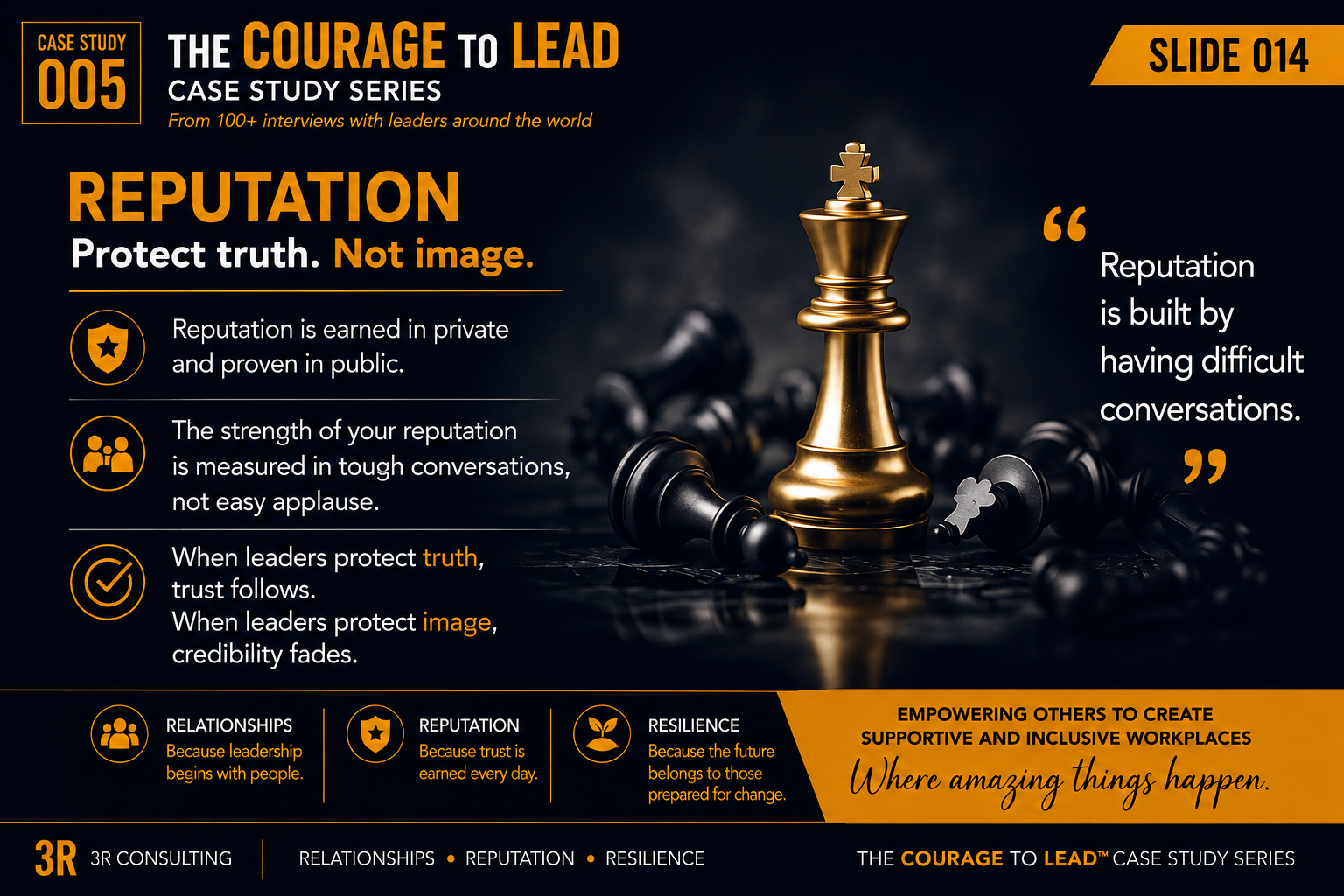
REPUTATION
Protect truth, not image. Reputation is earned in private and proven in public. Its strength is measured in difficult conversations, not easy applause.
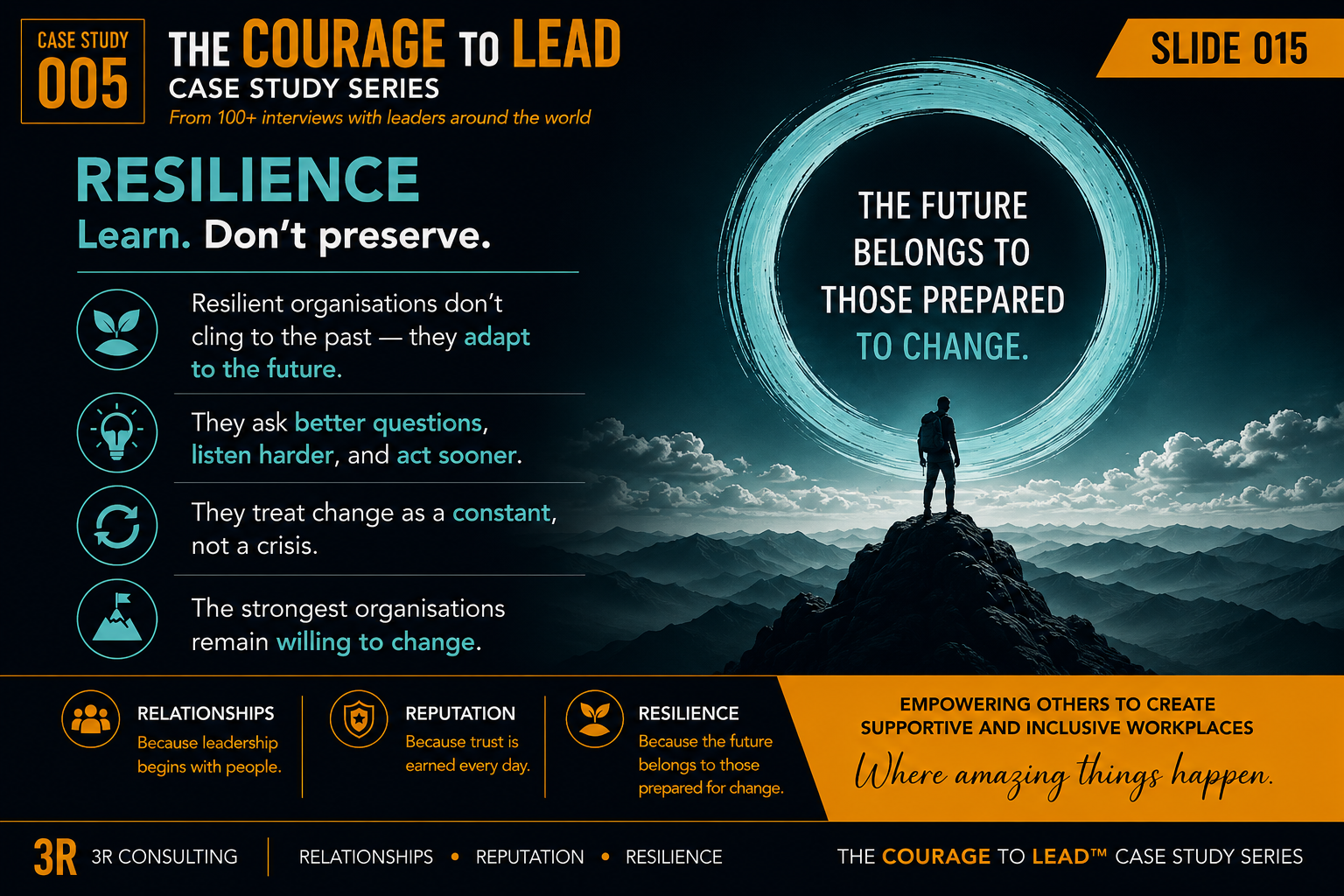
RESILIENCE
Learn; don’t preserve. Resilient organisations do not cling to the past. They ask better questions, listen harder, act sooner and remain willing to change.
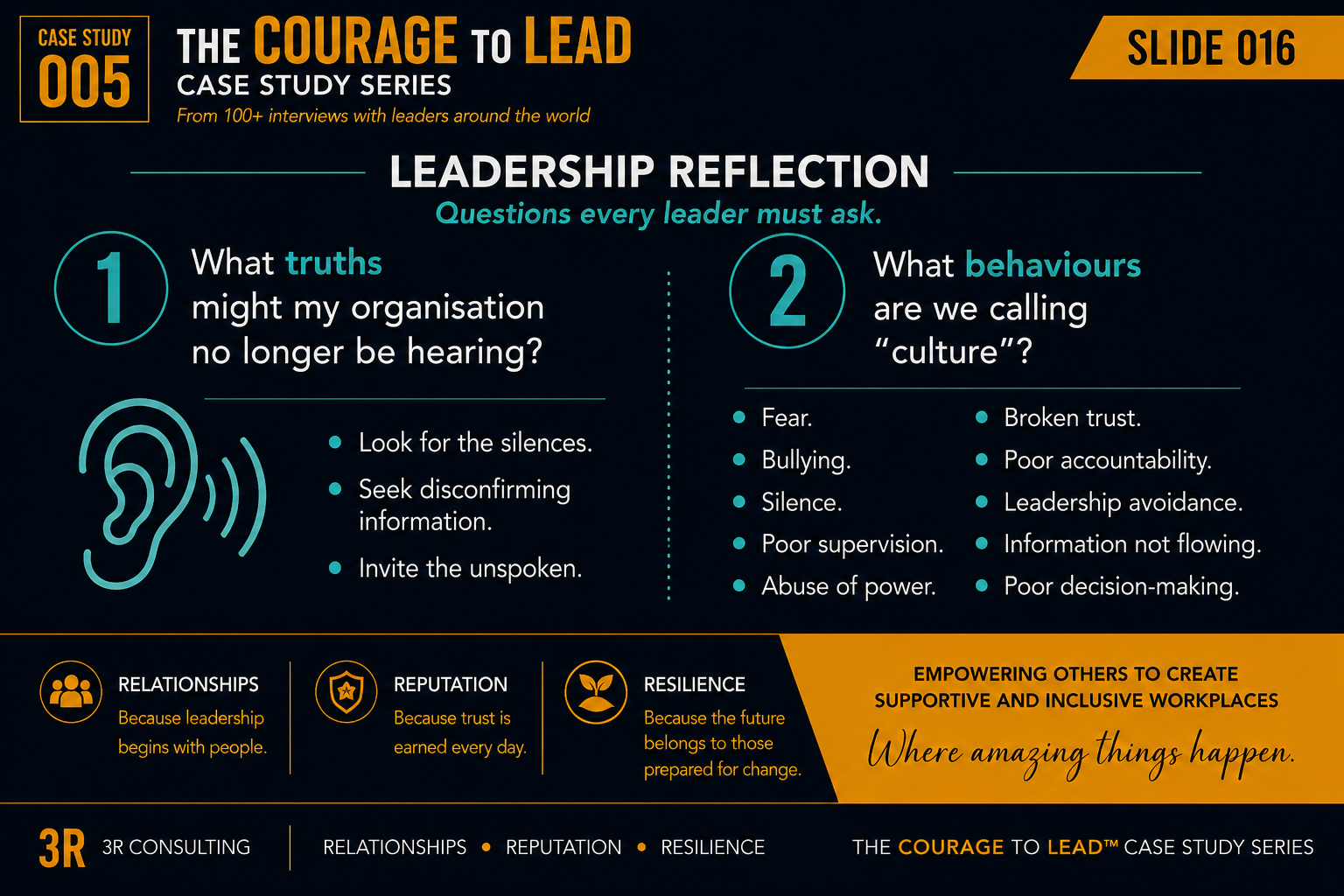
Leadership reflection
- What truths might my organisation no longer be hearing?
- What behaviours are we calling “culture”?
Look beneath the label for fear, bullying, silence, poor supervision, abuse of power, broken trust, poor accountability, leadership avoidance, information not flowing and poor decision-making.
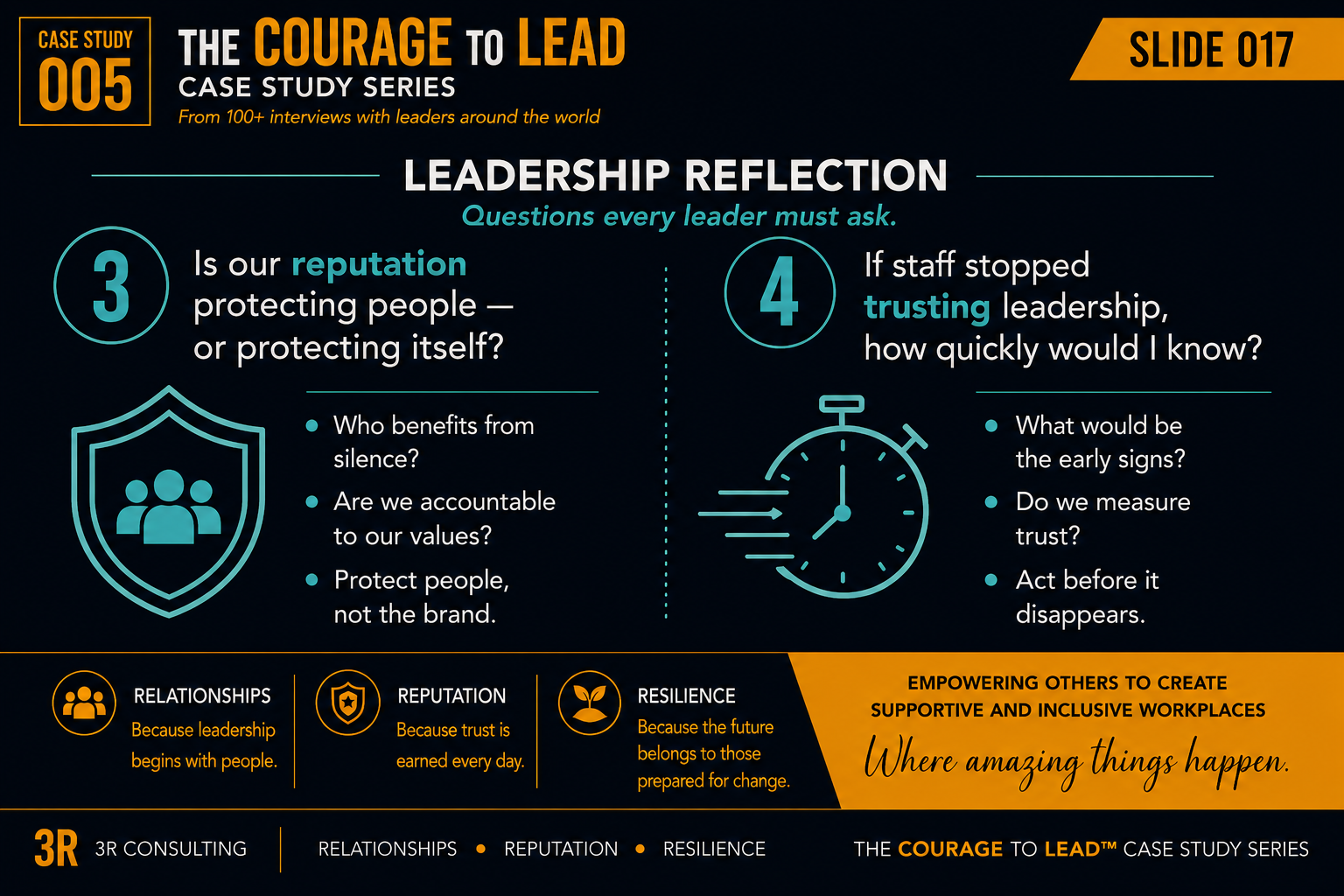
Leadership reflection
- Is our reputation protecting people — or protecting itself?
- If staff stopped trusting leadership, how quickly would I know?
The leadership challenge
The question “How could they not know?” should not be asked only after a crisis.
It belongs in the routine practice of leadership.
The better question is:
What have we built today that makes it safe, useful and worthwhile for people to tell us tomorrow what we may not want to hear?
The Courage to Lead™ Case Study Series | 3R Consulting