
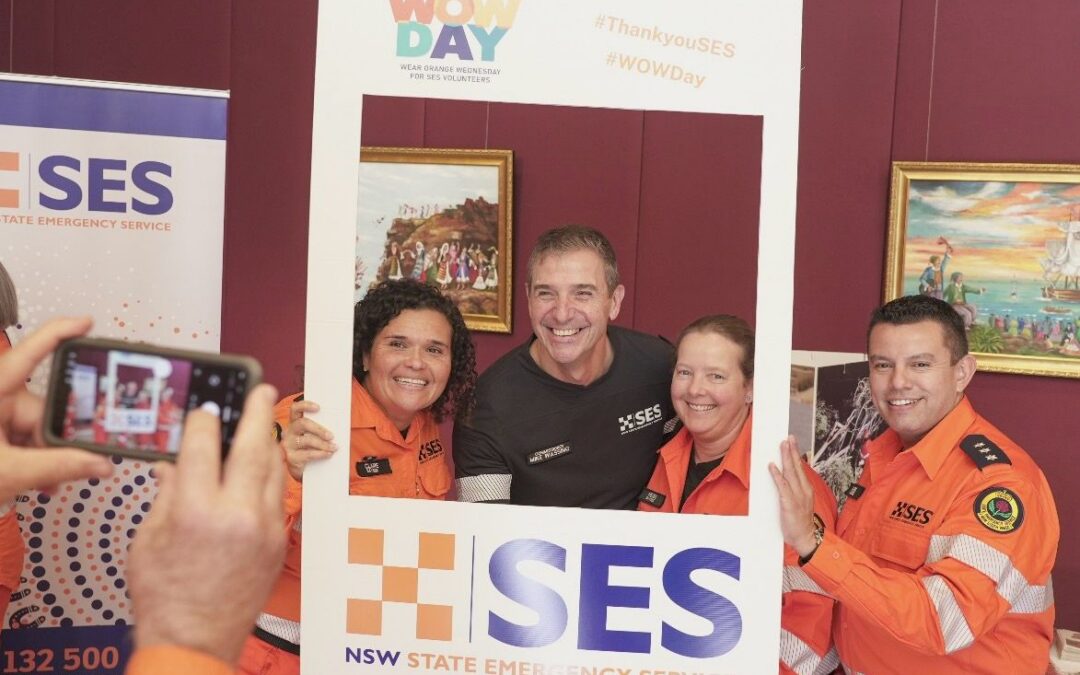
Leadership Is Not About Rank – Mike Wassing
There are some leaders who impress you because of their title. Then there are leaders who impress you because of how they think, how they treat people, and how they make others feel. Mike Wassing falls firmly into the second category.
From the moment this conversation began on The Courage to Lead Interview Series, it became obvious this was not going to be an interview about rank, hierarchy or authority. It was going to be a conversation about people.
And perhaps that is exactly why Mike has become such an influential leader in emergency management across Australia.
At face value, Mike’s role is enormous. He leads more than 11,100 volunteers across 262 SES units throughout New South Wales, supported by over 600 staff. The NSW SES is responsible for floods, storms and tsunamis across the state — before, during and after disasters.
But as Mike explained throughout the interview, emergency management is not fundamentally about disasters.
It is about human beings.
It is about relationships.
It is about trust built long before the floodwater rises.
“People Matter Most”
One of the most powerful moments in the conversation came when Mike Wassing described the NSW SES as a “mirror image of the community.”
Within the orange uniforms are tradespeople, defence personnel, politicians, parents, carers, business owners and everyday Australians who volunteer their time not for recognition or reward, but because they want to help others.
That understanding of community connection runs deeply through Mike’s leadership philosophy.
He repeatedly returned to one central idea:
“People matter most.”
Not systems.
Not rank.
Not ego.
People.
What made this interview particularly compelling was hearing how early Mike learned that lesson.
As a young officer in Victoria, he was rapidly promoted into a senior leadership role at just 24 or 25 years of age. One senior volunteer bluntly told him:
“You’re too young for this role. I don’t know how you got it. But we’ll support you.”
Many young leaders would have reacted defensively.
Mike did the opposite.
He went to the volunteer’s home, sat down, listened, stayed for dinner and built a relationship.
That one interaction became a defining leadership lesson that still shapes how he leads today.
Mike Wassing – The Power of Being Present
Throughout the interview, Mike Wassing continually returned to the importance of “being present.”
Not performative leadership.
Not leadership through email.
Not leadership from behind closed doors.
Real presence.
The kind where people feel seen, heard and valued.
He explained that sometimes people do not actually need immediate solutions. Often, they simply need someone willing to genuinely listen.
Behind frustration is usually passion.
Behind anger is often pride and care spilling over.
That level of emotional intelligence does not happen by accident.
It is built through experience, humility and reflection.
And Mike openly acknowledged he did not get everything right early in his career.
One story stood out.
As a young officer attending a fire operation, Mike arrived believing his rank meant he needed to immediately take charge. He put the vest on, started directing people and assumed command.
The volunteers largely ignored him.
The following day, his senior officer challenged him directly:
“Did you actually stop and listen to what was already happening?”
That moment changed Mike’s understanding of leadership forever.
He realised command was not about dominating a situation.
It was about supporting capable people already doing the work.
That distinction may sound subtle, but it is profound.
Too many organisations still confuse authority with influence.
Mike’s leadership style demonstrates the opposite.
Influence is earned through trust, respect, consistency and genuine care for people.
Black Saturday and the Weight Leaders Carry
Another incredibly powerful part of the interview was Mike Wassing’s reflections on the Black Saturday fires in Victoria – both the crisis itself and the aftermath.
As he described the devastation, the loss of life, the scrutiny and the subsequent Royal Commission, you could hear the emotional weight those experiences still carry.
But what stood out most was his honesty.
Mike openly spoke about the psychological scars emergency workers carry.
He did not pretend leaders are immune from trauma.
He did not hide behind bravado.
Instead, he described the importance of family, peer support, professional help and honest conversations.
One analogy he used was particularly moving.
He explained that if someone breaks their leg, the injury may heal but leave a scar. Mental health injuries can be similar. The scar remains, but it does not mean the person is broken or incapable.
That perspective matters enormously in leadership.
Especially in emergency services, policing, defence and high-pressure professions where vulnerability has historically been misunderstood as weakness.
Mike’s willingness to discuss these issues openly sends an important message to others:
You can still lead while carrying scars.
In fact, those experiences often deepen empathy.
Preparing the NSW SES for the Future
As the interview progressed, it became increasingly clear that Mike Wassing is not simply maintaining the NSW SES.
He is helping reshape it for the future.
His ADAPT 2030 strategy is not just about equipment, vehicles or operational systems.
It is about creating an organisation capable of responding to a rapidly changing world.
Climate change.
Community expectations.
Artificial intelligence.
Demographic shifts.
Complex disasters.
Volunteer sustainability.
All of these challenges require a different type of leadership.
Mike spoke extensively about culture, describing it as lived behaviour through the lens of values.
Not slogans.
Not posters on walls.
Real behaviours lived every day.
He also emphasised that culture is never “finished.”
It requires constant attention, reinforcement and reflection.
That level of thinking reflects a leader who understands that future readiness is not just operational.
It is cultural.
The Community Are the True First Responders
Perhaps the most fascinating part of Mike Wassing’s vision is his focus on communities themselves.
One of the strongest ideas he shared was that the true first responders are often not the people in uniform.
They are neighbours.
Families.
Local leaders.
Ordinary community members who act before emergency services even arrive.
Rather than resisting that reality, Mike is embracing it.
The NSW SES is now actively exploring ways to better integrate spontaneous volunteers and community-led responses into disaster management models.
That is a remarkable cultural shift.
Historically, many organisations would see unofficial community responses as something to control or minimise.
Mike sees them as strength.
As resilience.
As capability.
That perspective says a great deal about the type of leader he is.
He does not lead through fear of losing control.
He leads through empowerment.
Mike Wassing – Humility, Empathy and Courage
Toward the end of the interview, Allan Sicard asked Mike Wassing for the three words that define his leadership.
His answer was immediate:
Humility. Empathy. Courage.
But perhaps the most insightful part of his response was what came next:
“Sometimes you need courage to be empathetic and humble.”
That line perfectly captures the essence of this interview.
Because real leadership is rarely about appearing strong.
Real leadership is having the courage to listen.
The courage to learn.
The courage to admit mistakes.
The courage to support others.
And the courage to keep growing.
Mike Wassing’s story is not just about emergency management.
It is about the evolution of leadership itself.
And if this conversation proves anything, it is that the leaders who will shape the future are not necessarily the loudest people in the room.
They are the ones who make other people stronger.
This is a wonderful conversation about modern leadership, culture, service and having the courage to empower his people to “have a crack.”