
The Courage to Lead Interview Series | Allan Sicard
What happens when ordinary people are confronted with extraordinary circumstances? How do leaders respond when there is no playbook, when events unfold faster than anyone can prepare for, and when the wellbeing of an entire community suddenly depends on people stepping forward?
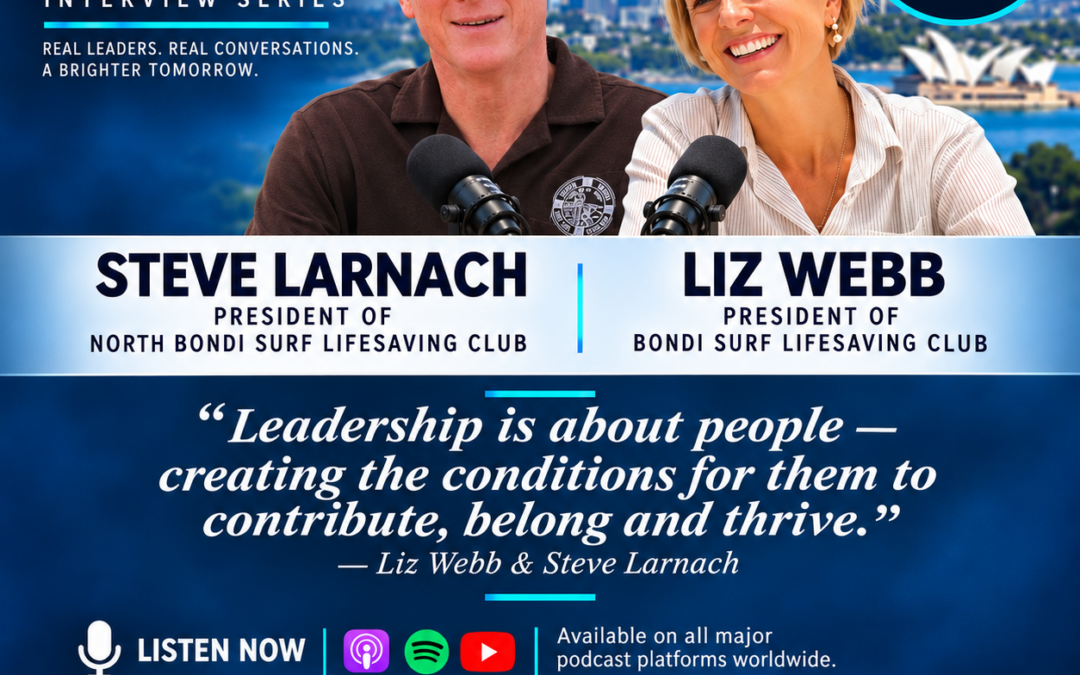
In this episode of The Courage to Lead Interview Series, I speak with Liz Webb, President of Bondi Surf Bathers Life Saving Club, and Steve Larnach, President of North Bondi Surf Life Saving Club, about leadership, volunteerism, courage, compassion and the extraordinary response of their members to the Bondi Beach terrorist attack on 14 December 2025. Their story is about much more than what happened on that terrible day. It is about the relationships built over decades, the preparation that enabled people to respond, and the importance of leaders continuing to care for their people long after the immediate emergency has ended. Above all, it is a story of two leaders, Liz Webb and Steve Larnach and two organisations standing shoulder to shoulder.
Liz Webb and Steve Larnach: Two Very Different Leadership Journeys
Liz Webb and Steve Larnach came to leadership through different pathways. Liz grew up in Griffith, in country New South Wales, and trained as a hydrogeologist. She learned early in her career that knowledge alone is not enough to influence others. Authenticity, humility and understanding what other people know are equally important. She eventually moved to Bondi, joined the surf club and discovered an organisation where volunteering, community and friendship came together.
Steve’s connection with North Bondi began when he was 15. The club gave him friendships, positive role models, a sense of belonging and an opportunity to develop through surfboat rowing. His journey was not without mistakes. He openly discusses being suspended from the club as a young man and the important lessons he learned about responsibility, respect and the value of belonging to something bigger than himself.
Both Liz Webb and Steve Larnach, eventually became presidents of their respective clubs. What is remarkable is that neither describes leadership as something they pursued for status. Their leadership developed through involvement, responsibility, relationships and a willingness to contribute.
Leadership Means Being Comfortable with Uncertainty
One of the most valuable insights comes from Liz’s approach to making decisions. As a hydrogeologist, she learned to make decisions based on incomplete information. You cannot see everything happening beneath the ground. You make an informed assessment, gather additional information and adjust when circumstances change. That approach has shaped her leadership. Liz explains that making a decision is not necessarily about being right every time. It is about recognising when people need direction, being prepared to act and remaining willing to change course when new information becomes available. She also speaks about the importance of helping people become unstuck.
This is a valuable lesson for leaders in every workplace. Uncertainty does not disappear because we hesitate. Sometimes our responsibility is to create enough direction and confidence for people to move forward.
The Strength of a Team Is Found in Its People
Liz Webb and Steve Larnach provide a valuable insight about the strength of a team is found in it’s people. Another powerful theme is understanding the individual strengths of team members. Liz describes how a successful surf lifesaving patrol relies on different people contributing their particular capabilities. Some are exceptional at board rescues. Others are better at radio communication, first aid, organisation or supporting people in distress. A capable leader recognises those differences. Rather than expecting everyone to excel at everything, leadership involves placing people where they can make the greatest contribution while continuing to develop their abilities.
Steve describes a similar approach. He learned the importance of leading by example, understanding the people around him and never asking someone to undertake a task he would be unwilling to do himself. These lessons became particularly important when their clubs were confronted by an event nobody could have anticipated.
Bondi Beach: When Preparation Became Action
On 14 December 2025, members of Bondi and North Bondi surf lifesaving clubs were attending their Christmas functions when gunfire erupted nearby. Steve was at North Bondi Surf Life Saving Club. He initially believed there had been an incident on the beach, perhaps a shark attack. When the reality became apparent, members began ushering frightened people into the clubhouse. Some were injured. Others were separated from family members.
As the shooting unfolded, lifesavers gathered medical supplies and prepared to assist. At Bondi Surf Bathers Life Saving Club, members were even closer to the unfolding tragedy. Liz describes members running into danger to help children and parents trapped in the nearby playground. Others provided first aid, performed CPR and found innovative ways to move injured people towards emergency treatment. Rescue boards, normally used to save swimmers, became improvised stretchers.
The training, trust and teamwork developed through years of volunteering became invaluable. There was no time for lengthy meetings, complicated approval processes or discussions about organisational boundaries. People recognised what needed to be done and acted.
Two Surf Clubs, One Team
Liz Webb and Steve Larnach tell the story that Bondi and North Bondi have a long history of sporting competition and friendly rivalry. But during the emergency, those differences became irrelevant. Members worked together, shared equipment, supported paramedics and helped move injured people.
Steve describes watching ambulance personnel recognise the capabilities of the volunteer lifesavers and supervise their work while lifesavers continued providing emergency care. Liz describes the common language, training and trust that allowed members from different clubs to work seamlessly. For me, this was one of the defining leadership lessons of the interview.
When people understand their shared purpose, organisational boundaries become far less important than the mission.
Liz and Steve continued that approach in the hours, days and months that followed. They shared information, communicated jointly with members and supported one another through decisions neither had ever expected to make. Their relationship became a visible example of the cooperation they wanted their members to experience.
Leadership Does Not End When the Emergency Ends
Liz Webb and Steve Larnach share that the immediate response was extraordinary, but the leadership responsibilities did not finish when the shooting stopped. Members had witnessed horrific scenes. Some had treated severely injured people. Others were struggling with questions about whether they could have done more. Families had been separated. Clubhouses had been closed as part of the investigation. Normal routines disappeared.
Liz and Steve understood that their responsibility now involved helping people recover. They worked to secure appropriate psychological support, including assistance involving the Black Dog Institute, and valued the debriefing and reassurance provided by ambulance personnel. They also recognised that people respond differently to trauma. Some wanted professional counselling. Others needed time with friends, physical activity, familiar routines or simply a place where they could talk. Not every person would recover at the same pace.
This is where compassionate leadership becomes particularly important. It requires listening, remaining available and creating an environment where people can access support without being judged or rushed.
Caring for the People Who Care for Others
Liz Webb and Steve Larnach tell the story that one of the most significant challenges for leaders responding to prolonged crises is recognising their own limits. Liz initially expected to take only a few days away from her professional responsibilities. That became approximately a month. She describes continuing to run each morning to clear her mind and recognising that her pace would eventually have to slow.
Steve speaks about the support of his wife, friends and fellow club members. Both describe the importance of the people around them checking in and encouraging them to take care of themselves. Their experiences reinforce an important point. Leaders cannot assume that because someone appears strong, confident or capable, they do not need support. The people helping others often need someone looking after them as well.
The Return to the Clubhouses: A Step Towards Recovery
Liz Webb and Steve Larnach consider one particularly moving part of the conversation concerns the reopening of the surf clubs. For many members, their club is far more than a building. It is where friendships are formed, where people exercise, where they volunteer, where they belong and where they begin their day. When the clubhouses were finally accessible, returning to those familiar surroundings became an important part of rebuilding routine and connection.
Liz describes the smiles on members’ faces when they could return. Steve describes the importance of raising their flags at half-mast and honouring those affected. These were not simply administrative matters. They were human moments that reminded people their community was still there.
What Liz Webb and Steve Larnach Teach Us About Leadership
Throughout this interview, three messages consistently emerge.
Relationships: The friendships, trust and sense of belonging established long before the tragedy allowed people to support one another when it mattered most.
Reputation: Confidence was not created through titles. It came from years of service, preparation, reliability and demonstrated competence.
Resilience: Recovery involved more than returning to normal operations. It required compassion, adaptability, mutual support and recognition that everyone would find their own way forward.
There is also a powerful lesson about empowering others. Neither Liz nor Steve suggests that their personal intervention was responsible for every extraordinary act. Instead, they speak with enormous pride about their members. People who had trained together, trusted one another and understood their purpose stepped forward and did remarkable things.
Where Amazing Things Happen
Towards the end of our conversation, Steve offers a simple leadership lesson:
“Don’t underestimate yourself.”
Liz encourages leaders to remain authentic, curious and self-aware, and to find their own path.
Both messages reflect something I have come to believe very strongly.
Leadership is not measured simply by what we personally achieve. It is also measured by the people we prepare, support and empower to make a difference. The extraordinary actions of the Bondi lifesavers remind us that preparation, trust and compassion are built through everyday leadership, often over many years. When the unexpected happens, those investments in people matter.
And when the immediate danger has passed, the responsibility to care for those people remains. Thank you, Liz and Steve, for sharing your experiences, for your leadership and for reminding us what can happen when people come together with a shared purpose.
The courage to lead is also the courage to care.
Listen to this episode of The Courage to Lead Interview Series with Allan Sicard.
The Courage to Lead explores leadership that empowers others to create supportive and inclusive workplaces, environments and communities where amazing things happen.