
Hilton Leadership Case Study – How One of the World’s Largest Employers Became the World’s Best Workplace
DOWNLOAD HILTON LEADERSHIP CASE STUDY
 INTRODUCTION – Hilton Leadership Case Study
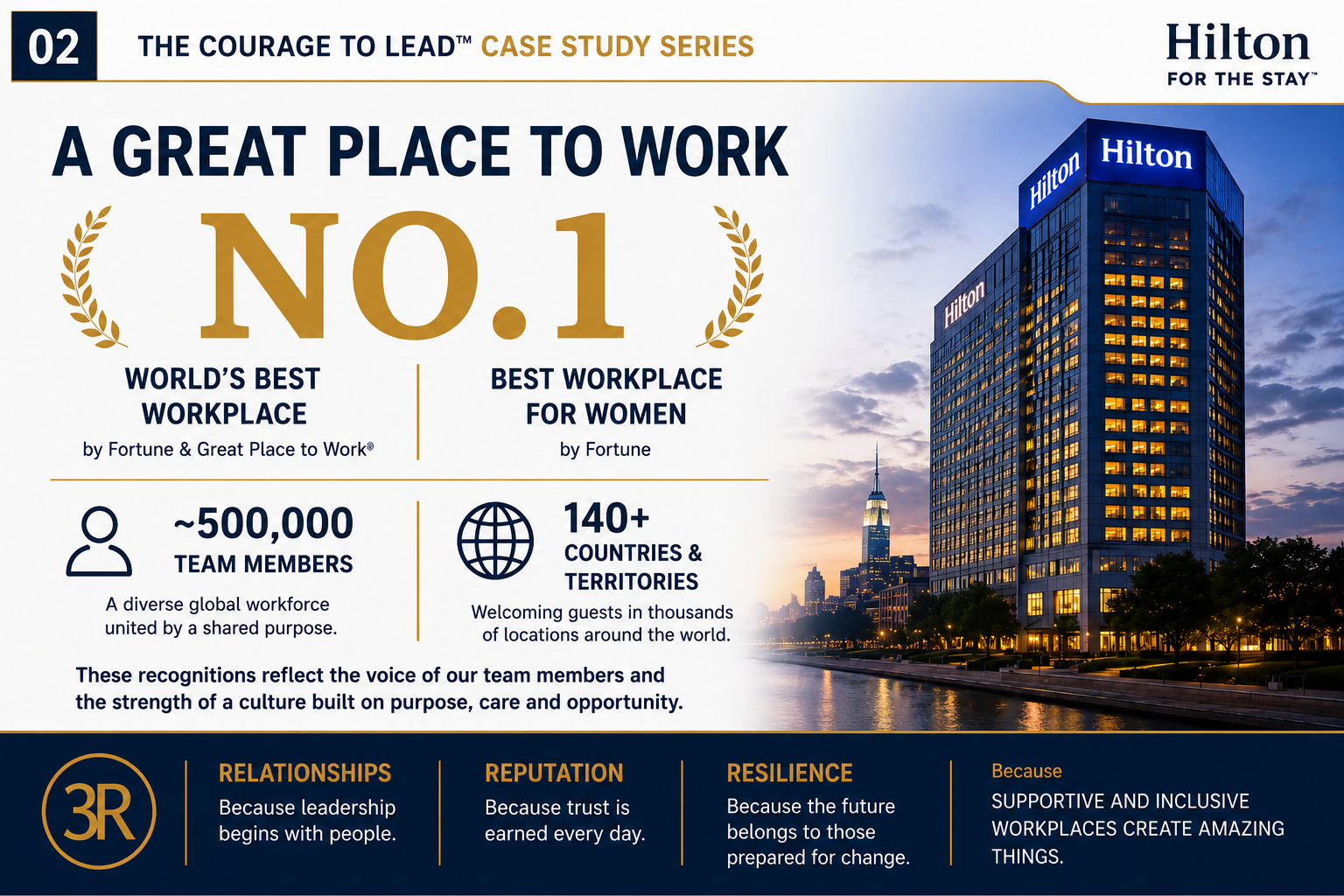
This Hilton Leadership Case Study researches a business that employs almost 500,000 people across more than 140 countries and territories. In an industry renowned for long hours, high staff turnover and relentless customer expectations, Hilton has achieved something few organisations have sustained.
It has repeatedly been recognised as one of the world’s best places to work.
This case study explores the leadership philosophy, cultural practices and investment in people that have enabled Hilton to transform workplace culture into a lasting competitive advantage.
What independent research says about Hilton
Hilton’s recognition as the World’s Best Workplace is not based on marketing campaigns or customer satisfaction surveys. It is based on confidential feedback from hundreds of thousands of employees collected independently by Great Place to Work®, the global authority on workplace culture.
To achieve this recognition, organisations are evaluated using the Trust Index™, which measures employees’ experiences across five critical dimensions:
- Credibility – confidence in senior leadership.
- Respect – whether employees feel supported and valued.
- Fairness – equitable treatment and opportunity.
- Pride – pride in individual work, the team and the organisation.
- Camaraderie – the quality of relationships and belonging.
Companies are also assessed on leadership effectiveness, organisational values, innovation, workforce demographics and the consistency of employee experience across diverse groups.
Hilton has consistently achieved exceptional results across these measures, leading to repeated recognition as:
- No.1 World’s Best Workplace
- No.1 Best Workplace for Women
- Great Place to Work® Certified in more than 67 countries, including 18 No.1 national rankings.
At the time of this case study, Hilton employs almost 500,000 team members across more than 140 countries and territories, making this achievement significant not only because of its quality, but because of its extraordinary scale.
Leadership Insight
Great cultures are not measured by executive opinion.
They are measured by the daily experiences of the people who work there.
Evidence
Great Place to Work® methodology
The World’s Best Workplaces list is determined through one of the world’s largest workplace culture studies. Employees anonymously answer questions about trust, leadership, fairness, respect, pride and camaraderie. Organisations must also demonstrate consistent employee experiences across different countries, roles, genders and demographic groups before being considered for global recognition.
Fortune Magazine
Fortune partners with Great Place to Work® to publish the annual World’s Best Workplaces and Best Workplaces for Women rankings.
Great Place to Work Methodology includes what they term a Trust Index whilst that is proprietary a general guide of these questions is listed below:
Great Place To Work® Trust Index™
Employees respond to 60 statements, together with demographic questions and two open-ended questions, using a five-point consistency scale. The survey measures whether employees consistently experience a high-trust workplace.
The five dimensions are:
- Credibility
Do leaders communicate honestly and inspire confidence?
Employees are effectively evaluating questions such as:
- Do leaders communicate openly?
- Do they keep people informed?
- Do leaders do what they say?
- Are leaders competent?
- Can employees trust senior leadership?
- Respect
Do people genuinely feel valued?
Employees consider:
- Does management care about me?
- Am I supported?
- Am I listened to?
- Am I encouraged to develop?
- Does the organisation care about my wellbeing?
- Am I given the resources I need to succeed?
- Fairness
Is everyone treated fairly?
Employees evaluate whether:
- Promotions are fair.
- Recognition is fair.
- People are treated equally.
- Diversity is respected.
- Ethical concerns can be raised safely.
- Pride
Are people proud of where they work?
Employees reflect on:
- Am I proud of my work?
- Am I proud of my team?
- Am I proud of the organisation?
- Does my work make a positive contribution?
- Camaraderie (Belonging)
Do people enjoy working together?
Employees consider whether:
- People can be themselves.
- New employees are welcomed.
- People celebrate success together.
- Relationships are genuine.
- There is a sense of belonging.
THE CHALLENGE – Hilton Leadership Case Study
Leading people in environments that never stop
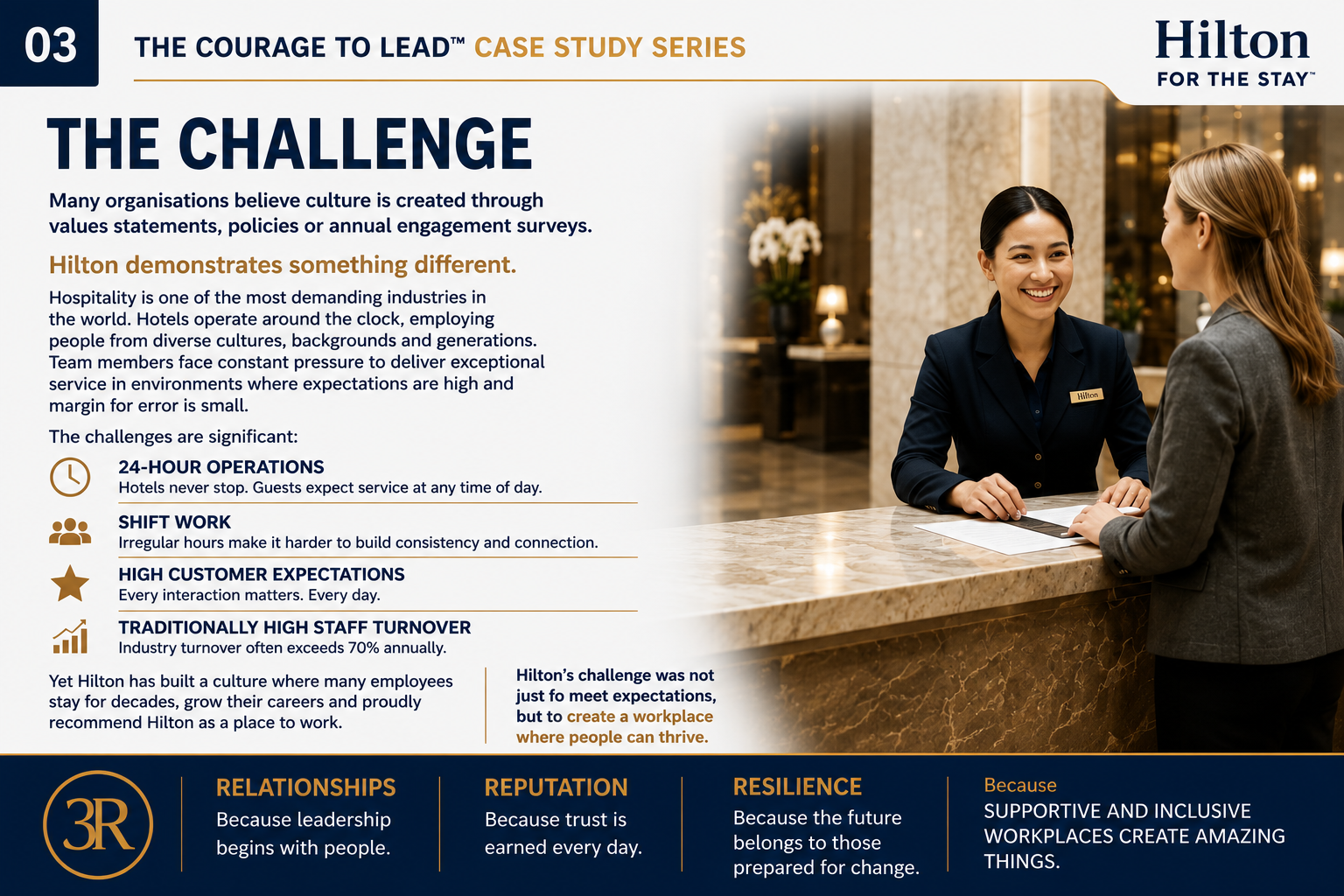
Many organisations believe culture is created through values statements, policies or annual engagement surveys.
Hilton demonstrates something different.
Hospitality operates in one of the world’s most demanding people environments. Like healthcare, policing, ambulance services and aviation, success depends on people delivering exceptional performance around the clock while maintaining trust, teamwork and customer confidence.
Every day, Hilton’s leaders manage workplaces characterised by:
24-hour operations
Hotels never close. Teams hand over responsibility continuously, requiring consistent leadership across every shift.
Shift work
Irregular hours, weekends, public holidays and overnight work can disrupt family life, wellbeing and recovery if leaders do not actively support their people.
High customer expectations
Every interaction shapes the guest experience. Unlike many industries, service quality is visible immediately and poor experiences can be shared globally within minutes.
Large and diverse workforces
Hilton employs almost 500,000 people across more than 140 countries and territories, representing multiple cultures, languages and generations. Creating one consistent culture at this scale requires intentional leadership.
An industry known for high turnover
Hospitality has traditionally experienced some of the highest employee turnover rates of any major industry. Industry reports frequently place annual turnover above 70% in many markets, making retention and leadership capability ongoing challenges.
The Leadership Challenge
Many organisations respond to these pressures by focusing on systems, compliance and operational efficiency.
Hilton chose a different path.
Rather than asking,
“How do we manage nearly half a million employees?”
its leaders asked,
“How do we create an environment where nearly half a million people can thrive?”
That question changed everything.
Leadership Insight
The world’s most demanding industries have more in common than they have differences.
Whether leading a hotel, hospital, police command, fire station or airline, leaders face the same fundamental challenge:
How do you help people perform at their best when the work never stops?
Hilton’s answer was not another policy.
It was a culture deliberately designed around purpose, trust, growth and wellbeing.
THE FOUR PILLARS – Hilton Leadership Case Study
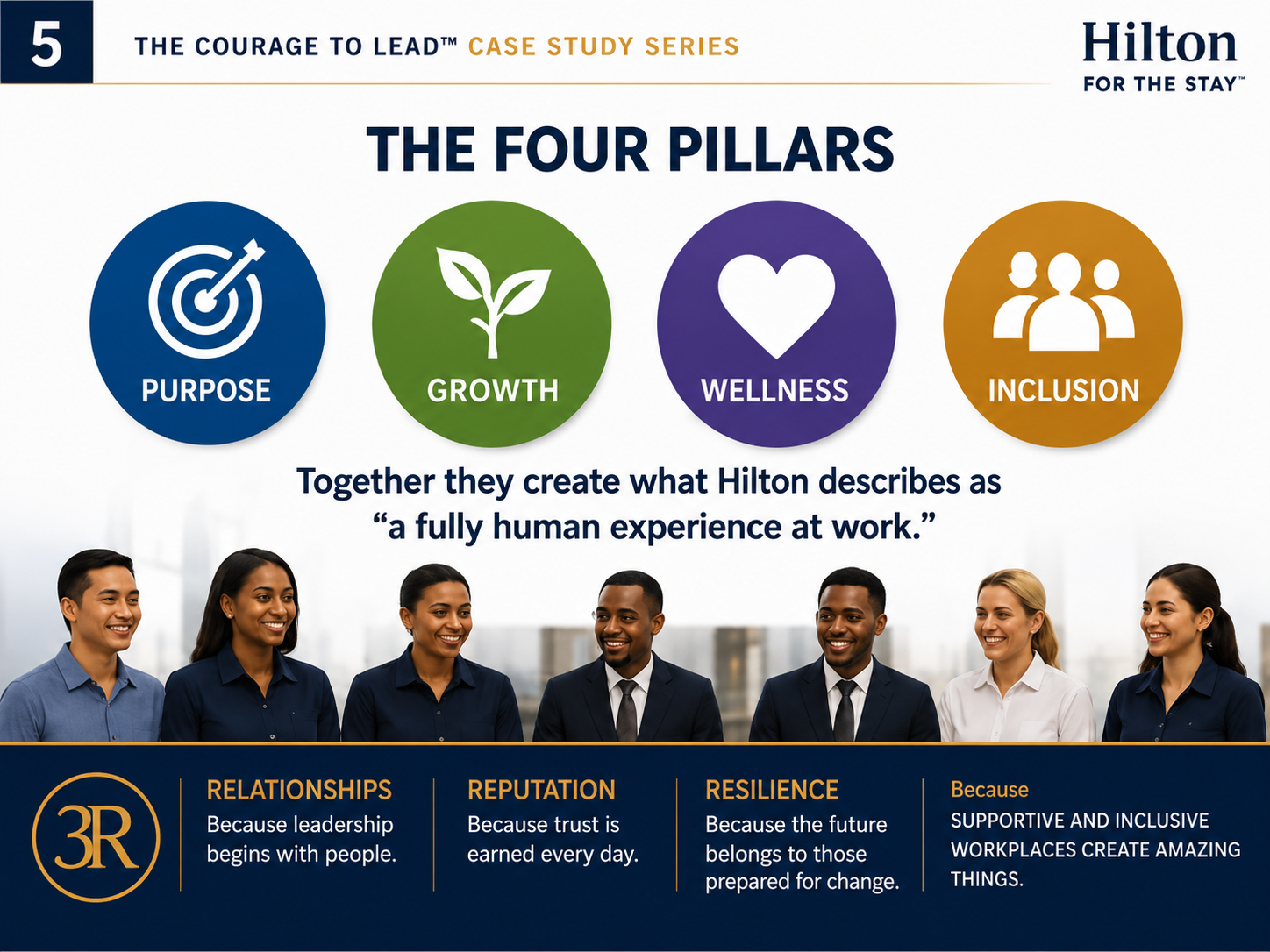
Hilton describes its employee experience through four interconnected pillars:
Purpose
Helping people understand how their work contributes to something bigger than themselves.
Growth
Providing learning, mentoring and career opportunities at every stage of employment.
Wellness
Supporting physical, mental and emotional wellbeing.
Inclusion
Creating an environment where every team member feels welcomed, respected and able to contribute.
Together these four pillars create what Hilton describes as “a fully human experience at work.”
LEADERSHIP STARTS AT THE TOP – Hilton Leadership Case Study
Culture does not grow through occasional announcements.
It is built through consistent, visible leadership communication.
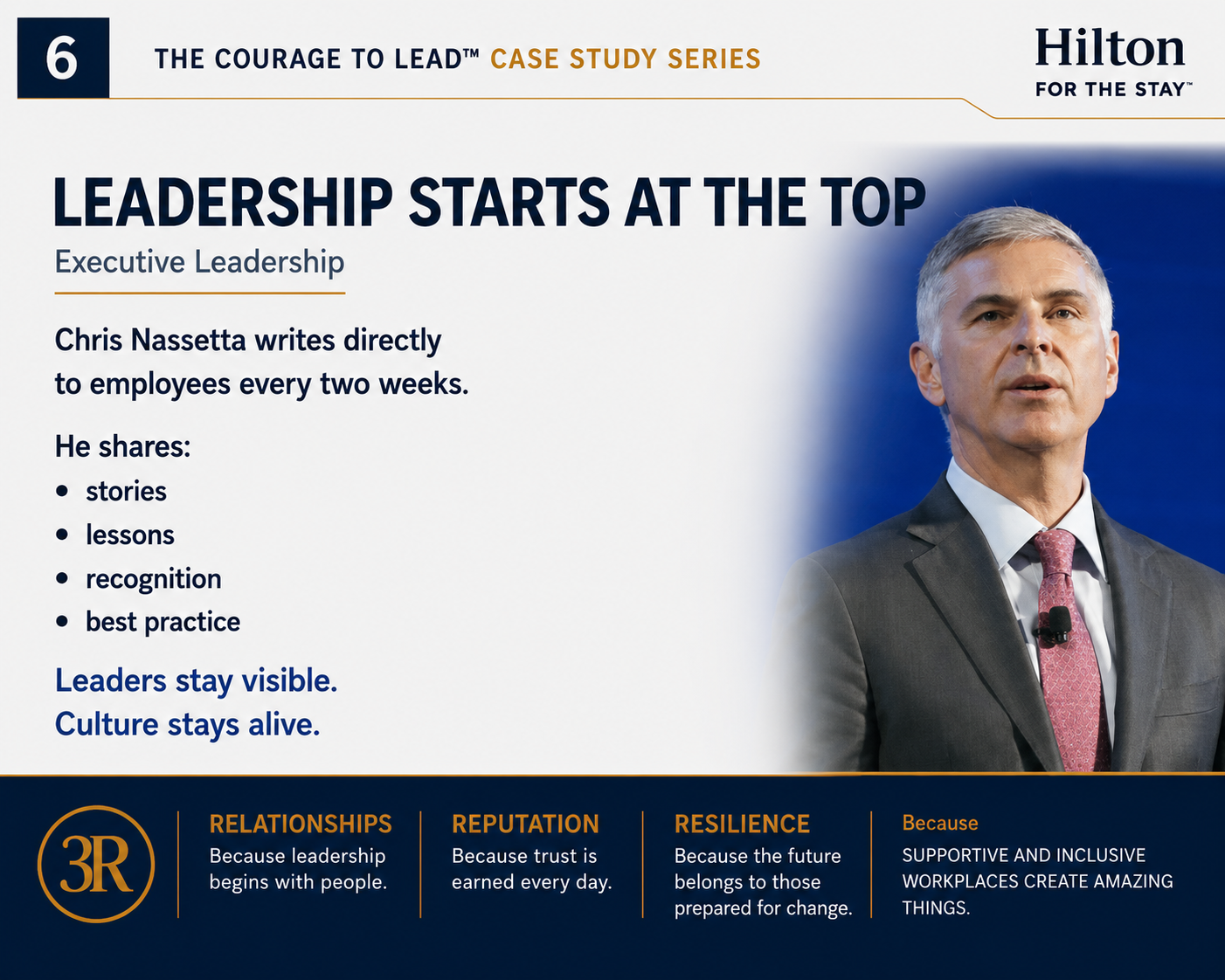
At Hilton, Chief Executive Officer Chris Nassetta writes directly to team members every two weeks.
Rather than relying solely on corporate updates, he shares:
- stories from hotels around the world
- lessons learned
- recognition of outstanding people
- examples of best practice
- reminders of Hilton’s purpose
These regular communications keep nearly 500,000 team members connected to one another and to the organisation’s mission.
Visible leadership keeps culture alive.
The Principle in Practice
This same leadership principle proved invaluable during the merger of the North Sydney and Chatswood Police Area Commands.
In 2017, two large police commands, involving more than 250 staff, had just 90 days to become one organisation.
Previous command mergers had often been difficult, creating uncertainty, rumours and resistance to change.
Drawing on John Kotter’s principle of “Communicate, Communicate, Communicate,” we adopted a simple strategy.
Every week:
- every employee received an update from the project team
- we explained what had been achieved during the previous seven days
- we outlined exactly what would happen during the following week
- every member of staff had access to a one-page implementation roadmap showing the complete change process.
Nobody was left wondering what was happening.
People understood not only what was changing, but why it was changing and where the project was heading.
The Outcome
Despite implementing one of the largest organisational changes undertaken within the command, a subsequent statewide NSW Police leadership survey reported leadership results that ranked among the strongest across the state.
The lesson was simple.
Communication does more than transfer information. It builds trust. It reduces uncertainty. It gives people confidence that they are part of the process rather than subjects of the process.
Leadership Insight
Whether leading 500,000 Hilton team members across more than 140 countries, or 250 police officers and staff through significant organisational change, the leadership principle is the same:
People rarely resist change when they understand it, can see progress, and know their leaders are communicating honestly and consistently.
Leadership Reflection
Every generation has organisations facing significant cultural challenges. Some are responding to cultural reviews. Some are rebuilding trust after public inquiries. Some are leading through restructuring, financial pressure or changing community expectations.
Whatever the catalyst, the leadership challenge is remarkably consistent.
How do you reduce uncertainty?
Hilton’s experience suggests that culture is strengthened when leaders:
- communicate consistently
- reinforce a clear purpose
- recognise people regularly
- share progress openly
- remain visible throughout periods of change
When uncertainty becomes the dominant workplace experience, communication is no longer simply an operational activity.
It becomes a leadership responsibility.
If uncertainty is the foundation of your workplace today, what are your people hearing from their leaders this week?
INVESTING IN PEOPLE – Hilton Leadership Case Study
Building careers, not simply filling jobs
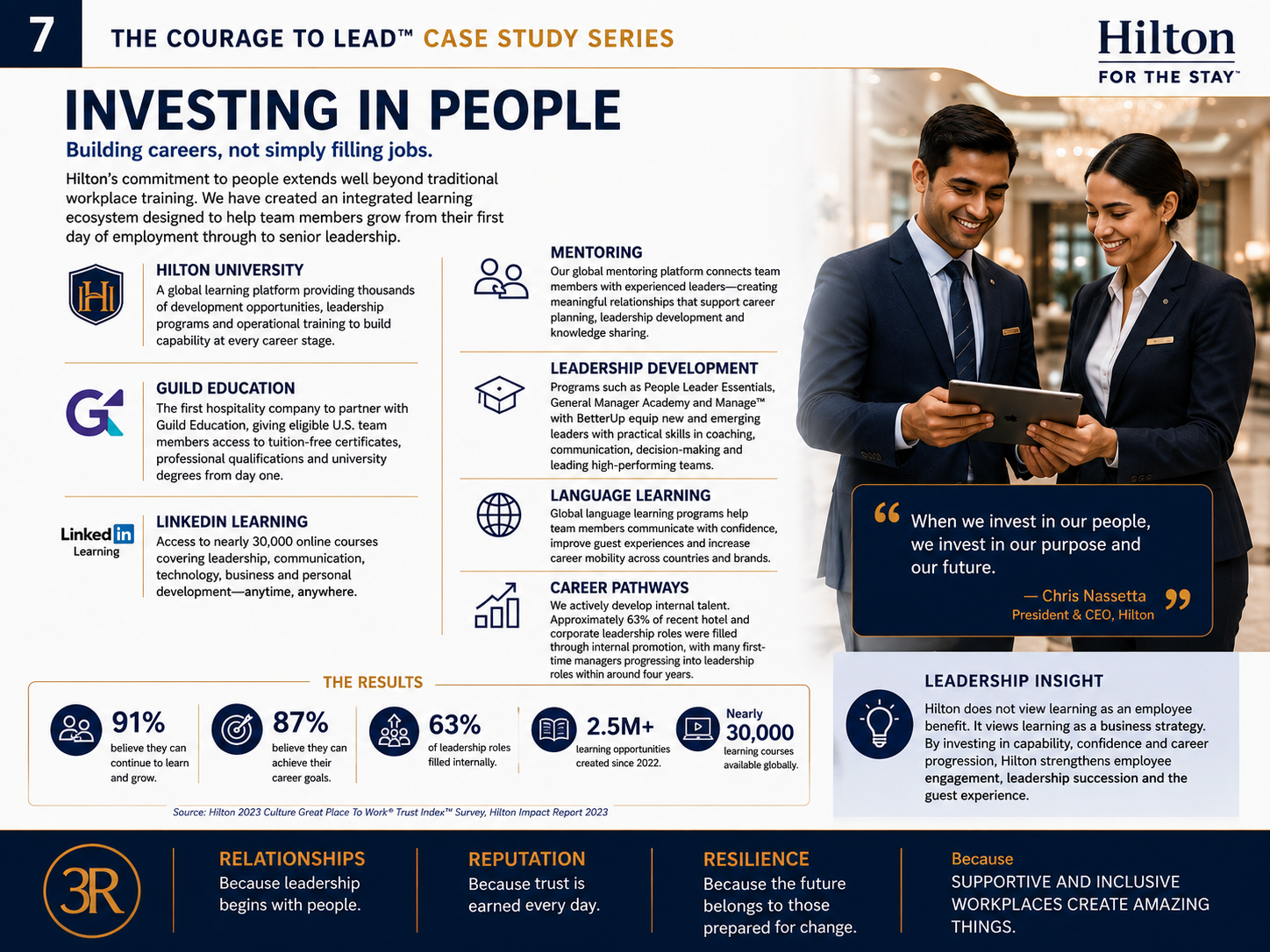
Hilton’s commitment to people extends well beyond traditional workplace training. The organisation has created an integrated learning ecosystem designed to help team members grow from their first day of employment through to senior leadership.
Hilton University
A global learning platform providing thousands of development opportunities, leadership programs and operational training designed to build capability at every career stage.
Guild Education
The first hospitality company to partner with Guild Education, giving eligible U.S. team members access to tuition-free certificates, professional qualifications and university degrees from their first day of employment, removing financial barriers to lifelong learning.
LinkedIn Learning
Access to nearly 30,000 online courses covering leadership, communication, technology, business and personal development, enabling continuous learning at every stage of a career.
Mentoring
Hilton’s global mentoring platform connects team members with experienced leaders, creating meaningful coaching relationships that support career planning, leadership development and knowledge sharing across the organisation.
Leadership Development
Programs such as People Leader Essentials, General Manager Academy and Manage™ with BetterUp equip new and emerging leaders with practical skills in coaching, communication, decision-making and leading high-performing teams.
Global Language Learning
Recognising its international workforce, Hilton provides language learning programs that strengthen communication, improve guest experiences and increase career mobility across countries and brands.
Career Pathways
Hilton actively develops internal talent. Approximately 63% of recent hotel and corporate leadership positions have been filled through internal promotion, with many first-time managers progressing into leadership roles within around four years.
Leadership Insight
Hilton does not view learning as an employee benefit. It views learning as a business strategy. By investing in capability, confidence and career progression, Hilton strengthens employee engagement, leadership succession and the guest experience.
The Results
- 91% believe they can continue to learn and grow.
- 87% believe they can achieve their career goals.
- 63% of leadership roles filled internally.
- 2.5 million learning opportunities created since 2022.
- Nearly 30,000 learning courses available globally.
Almost every program on this slide maps directly to one of the three psychological needs from Self-Determination Theory & the 3Rs:
Relationships (Belonging): Mentoring, leadership development, coaching and collaboration.
Reputation (Autonomy/Trust): Internal promotions, leadership pathways and empowering people to take on greater responsibility.
Resilience (Mastery): Hilton University, Guild Education, LinkedIn Learning, BetterUp coaching and language learning.
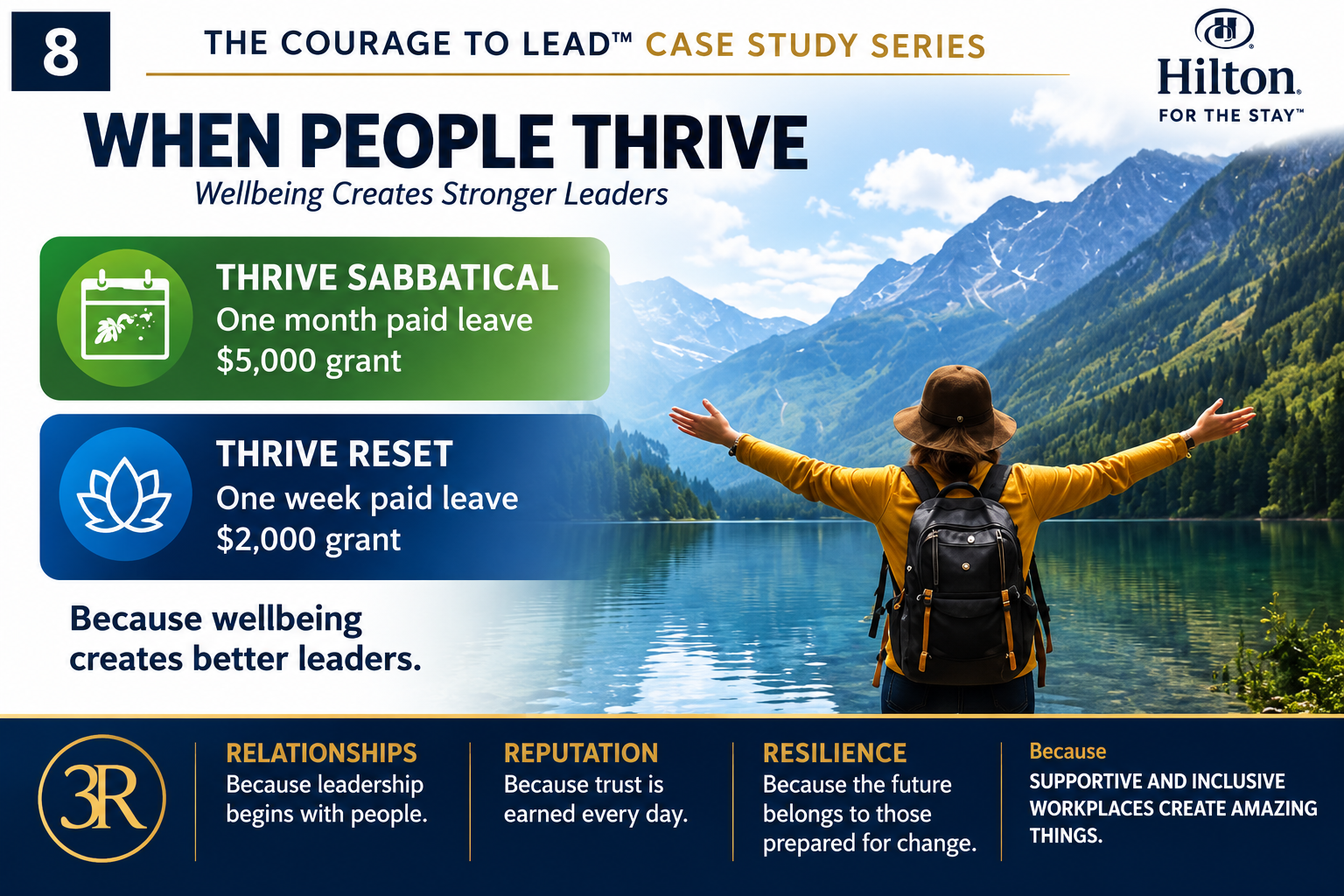
WHEN PEOPLE THRIVE – Hilton Leadership Case Study
Hilton believes that exceptional guest experiences begin with team members who are physically, emotionally and mentally well.
Rather than treating wellbeing as an employee benefit, Hilton has made it part of its leadership strategy through the Thrive at Hilton wellbeing framework. The philosophy is simple: when people have opportunities to rest, grow and reconnect with what matters most, they return to work with greater energy, creativity and resilience.
Thrive Sabbatical
Recognising that long-serving employees occasionally need time to pursue personal goals beyond the workplace, Hilton awards selected team members one month of paid leave together with a US$5,000 grant.
Recipients have used the opportunity to:
- volunteer with community organisations
- travel with family
- pursue personal passions
- complete significant life projects
- invest in their own physical and mental wellbeing.
The objective is not simply to provide leave, but to encourage personal renewal that ultimately benefits both the individual and the organisation.
Thrive Reset
Hilton also recognises that not every employee can step away for an extended period. Through Thrive Reset, eligible team members receive one week of paid leave together with a US$2,000 wellbeing grant to intentionally recharge before burnout develops.
Employees can use the time in whatever way best supports their wellbeing, including:
- spending time with family
- travelling
- improving physical health
- reducing stress
- pursuing hobbies
- reconnecting with personal purpose.
Leadership Insight
Many organisations invest heavily in recovering employees after they become exhausted. Hilton invests in preventing exhaustion before it occurs. This reflects one of the core principles of The Courage to Lead: Healthy people build healthy teams. Healthy teams build great workplaces.
Sources
Hilton — Thrive at Hilton Wellbeing Strategy, Hilton Impact Report (2023/2024), Great Place To Work® — Hilton Case Studies, Hilton Newsroom — Thrive Sabbatical and Thrive Reset announcements
Most organisations spend millions on engagement. Hilton first invests in wellbeing.
From a 3R viewpoint: Relationships — “You matter as a person.” Reputation — “We trust you to use this time well.” Resilience — “Recovery is part of sustained high performance.”
Courageous leaders create sustainable high performance.
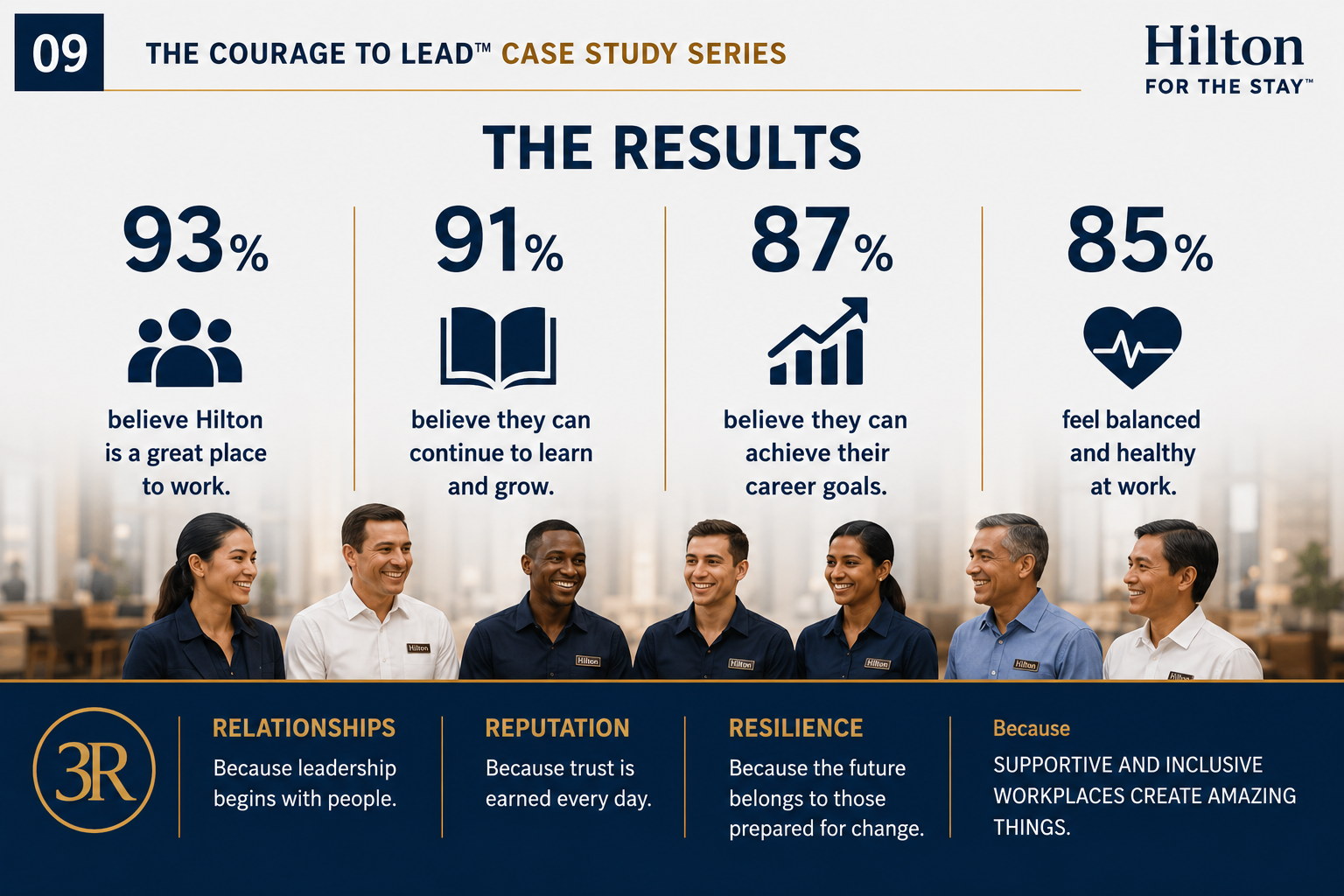
Hilton’s culture produces measurable outcomes.
Internal engagement data shows:
- 93% believe Hilton is a great place to work.
- 91% believe they can continue to learn and grow.
- 87% believe they can achieve their career goals.
- 85% feel balanced and healthy at work.
These results demonstrate that investment in people is reflected in employee experience.
There is not much more to say about this other than, does your workplace reflect the same theme?
If it doesn’t – Why can’t your workplace be a great place to work?
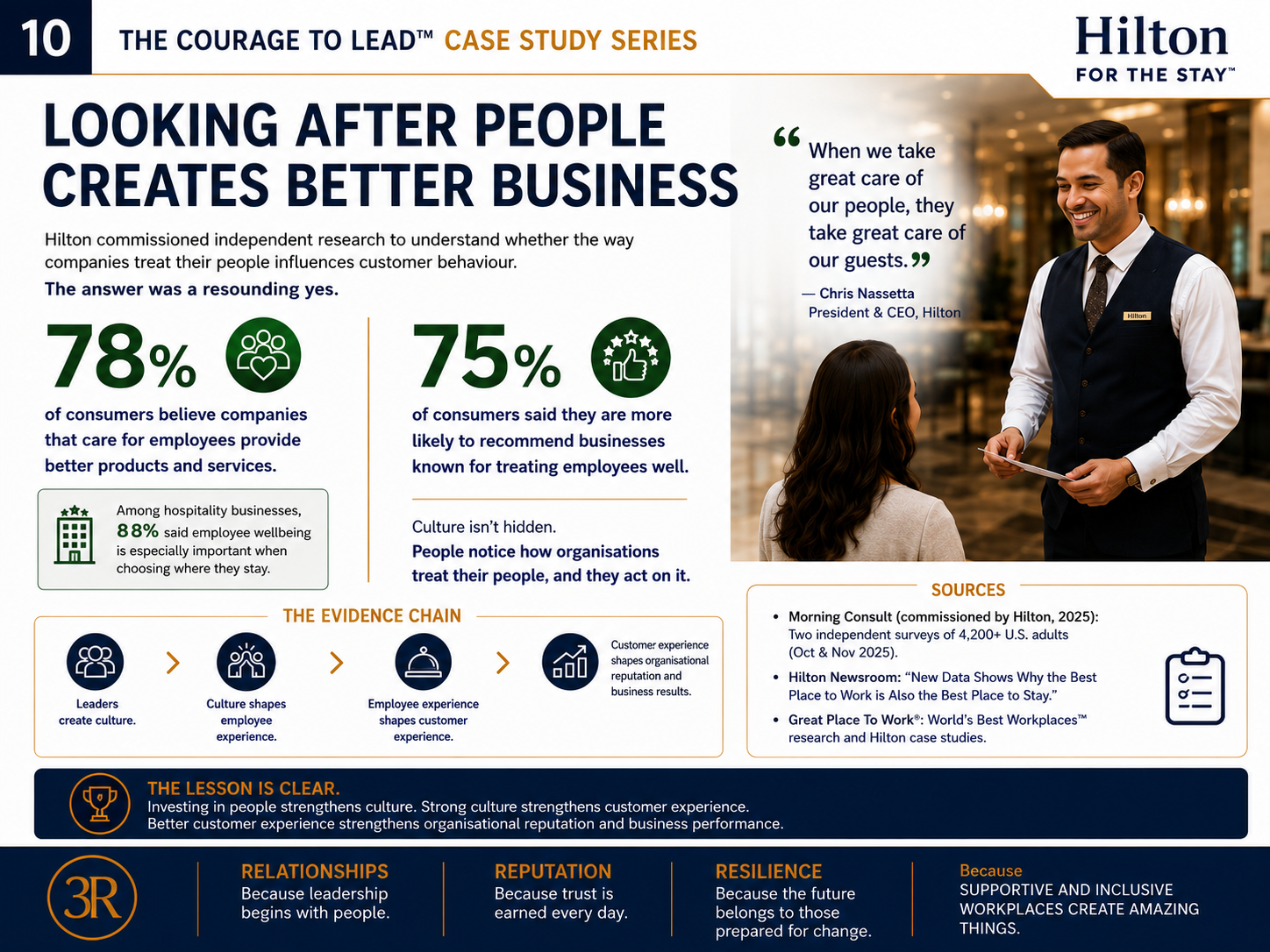
LOOKING AFTER PEOPLE CREATES BETTER BUSINESS – Hilton Leadership Case Study
Hilton also measured the impact of employee experience on customer behaviour. Research found: 78% of consumers believe companies that care for employees provide better products and services. What are the facts or stories behind this content I know there was more please provide a bit more depth and sources 75% are more likely to recommend businesses known for treating employees well. The lesson is clear. People notice culture. Customers experience culture. Strong workplace cultures create stronger brands.
LOOKING AFTER PEOPLE CREATES BETTER BUSINESS
For many years organisations have debated whether investing in employees delivers measurable business returns. Hilton decided to test the question.
Working with Morning Consult, Hilton commissioned independent research involving more than 4,200 U.S. consumers to understand whether workplace culture influences purchasing decisions.
The findings were compelling. Consumers notice how organisations treat their people. 78% believe organisations that take good care of employees provide better products and services.
For hospitality businesses, where service is delivered person-to-person, this figure increased to 88%, with consumers saying employee wellbeing is especially important when choosing where they stay.
Culture influences reputation.
75% of consumers said they are more likely to recommend organisations that are known for treating employees well.
Hilton concluded that employee experience is not simply an internal human resources issue—it is a competitive advantage that customers recognise and reward.
As Chris Nassetta often reminds leaders:
“When we take great care of our people, they take great care of our guests.”
Leadership Insight
This reinforces one of the central ideas of The Courage to Lead.
Culture is rarely experienced first by employees. It is experienced by customers. Every interaction reflects the environment leaders have created behind the scenes. People notice culture. Customers experience culture. Brands become the reputation of their workplace.
Supporting Evidence
Hilton’s internal research complements its external consumer findings.
Among Hilton team members:
- 93% say Hilton is a Great Place to Work.
- 91% believe they can continue learning and growing.
- 87% believe they can achieve their career goals.
- 85% say they feel balanced and healthy at work.
Hilton’s conclusion is straightforward: Investing in people strengthens culture. Strong culture strengthens customer experience. Better customer experience strengthens business performance.
Sources
Morning Consult (commissioned by Hilton, 2025)
- Two independent surveys involving more than 4,200 U.S. adults (2,043 respondents in October 2025 and 2,200 respondents in November 2025).
- Measured consumer attitudes toward organisations that care for employees.
Hilton Newsroom
“New Data Shows Why the Best Place to Work is Also the Best Place to Stay.”
Great Place to Work®
World’s Best Workplaces research and Hilton case studies.
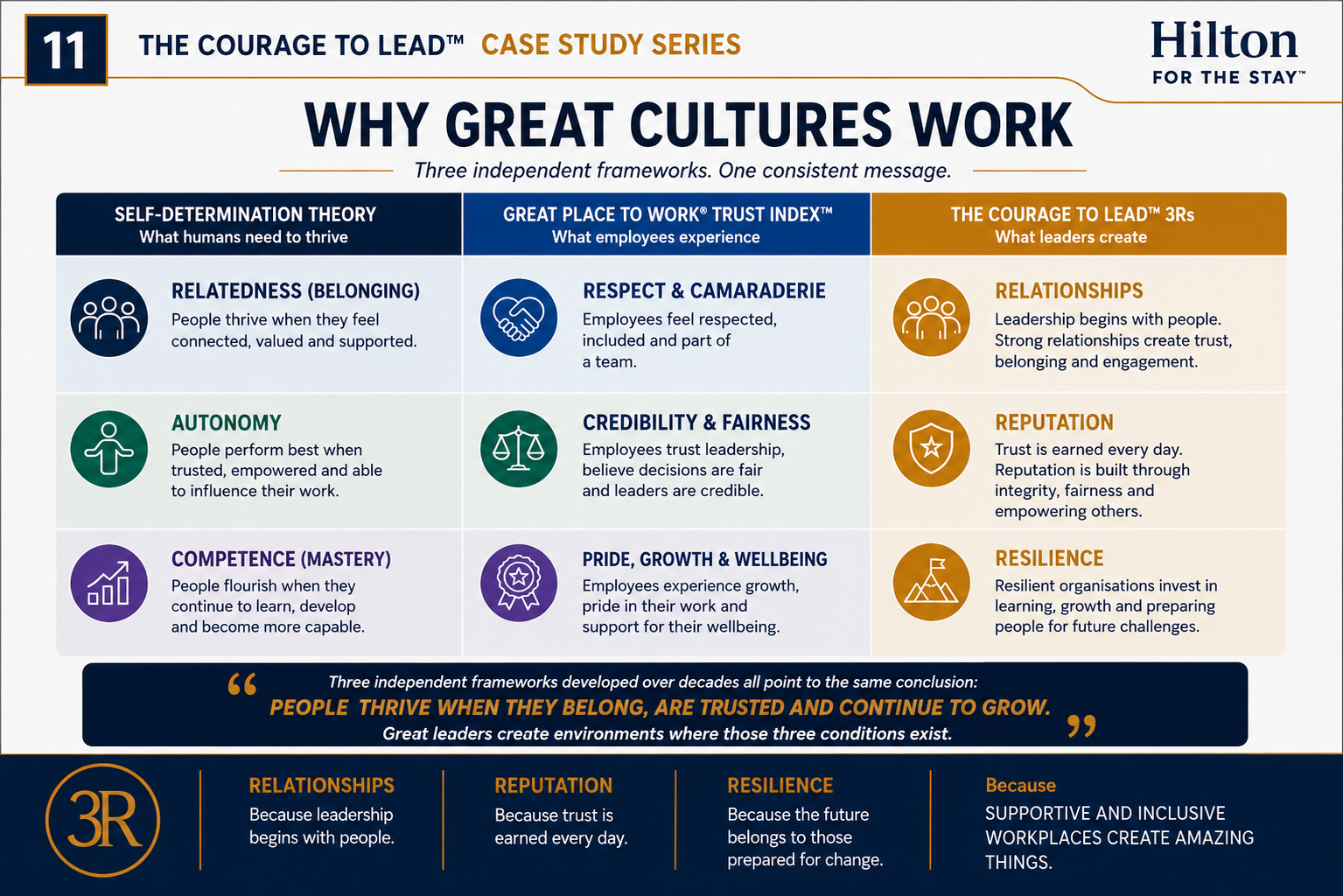
WHY GREAT CULTURES WORK – Hilton Leadership Case Study
Three independent frameworks. One consistent message.
| Self-Determination Theory | Great Place To Work® | The Courage to Lead™ |
| Belonging (Relatedness) | Respect & Camaraderie | Relationships |
| People thrive when they feel connected, valued and supported. | Employees feel respected, included and part of a team. | Leadership begins with people. Strong relationships create trust, belonging and engagement. |
| Autonomy | Credibility & Fairness | Reputation |
| People perform best when trusted, empowered and able to influence their work. | Employees trust leadership, believe decisions are fair and leaders are credible. | Trust is earned every day. Reputation is built through integrity, fairness and empowering others. |
| Mastery (Competence) | Pride, Growth & Wellbeing | Resilience |
| People flourish when they continue to learn, develop and become more capable. | Employees experience growth, pride in their work and support for their wellbeing. | Resilient organisations invest in learning, growth and preparing people for future challenges. |
Leadership Insight
Three independent frameworks developed over decades all point to the same conclusion:
People thrive when they belong, are trusted and continue to grow.
Great leaders create environments where those three conditions exist.
Upon reflection of Hilton, the Self Determination Theory and the 3Rs, it shows that leaders who never stop learning and source many and varied sources other than their own experience, can learn concepts way beyond what they ever thought possible. In the words of much-loved TV Coach Ted Lasso, “Be Curious.”
What do I mean by this:
- behavioural science (Self-Determination Theory),
- organisational research (Great Place To Work®), and
- practical leadership (The 3Rs)
all arrive at essentially the same destination.
People thrive when they belong, are trusted and continue to grow.
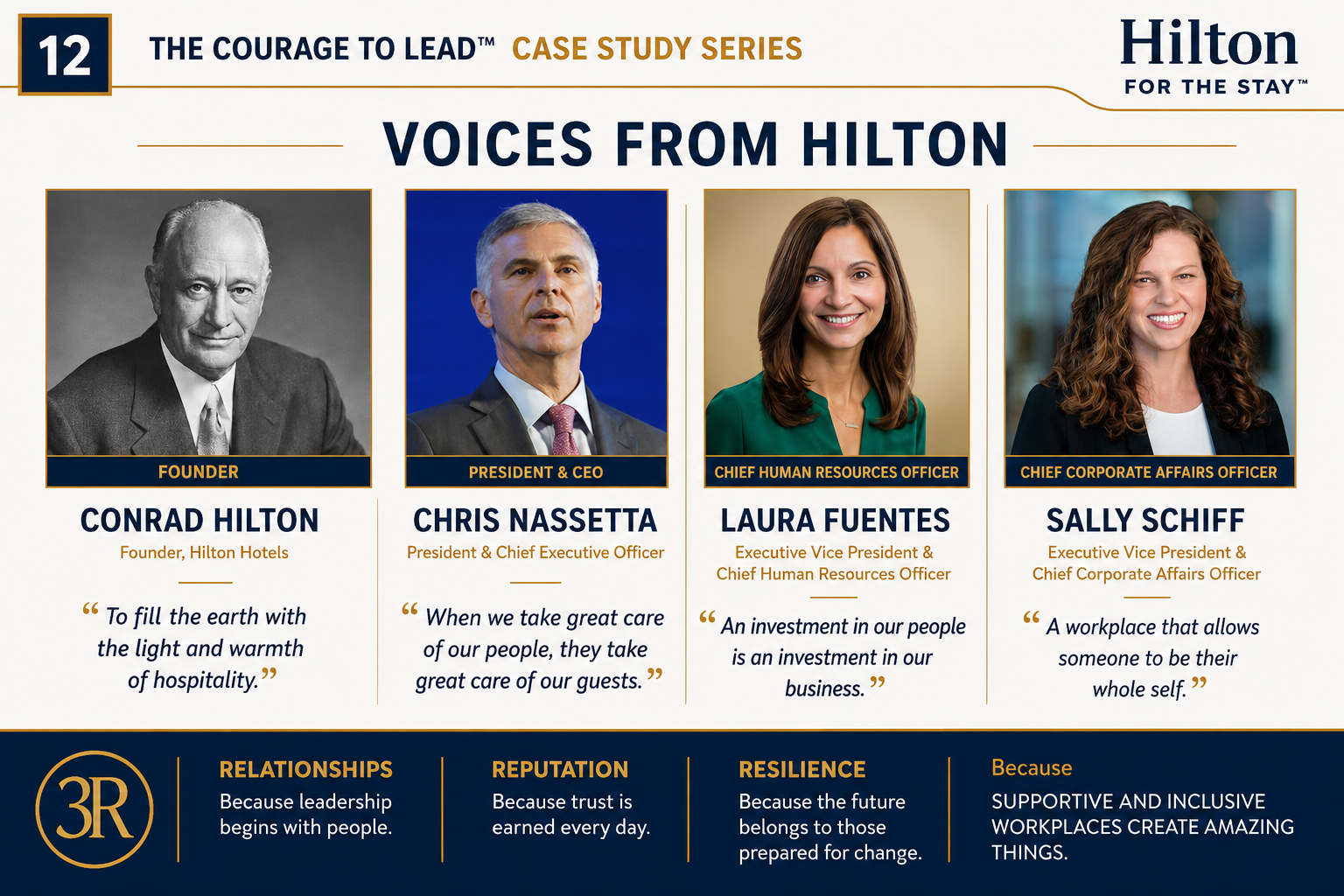
Hilton Leadership Case Study
Conrad Hilton
“To fill the earth with the light and warmth of hospitality.”
Chris Nassetta
“When we take great care of our people, they take great care of our guests.”
“An investment in our people is an investment in our business.”
“We are trying to create a workplace that allows someone to be their whole self.”
Across more than a century, different leaders have expressed the same enduring philosophy: People come first.
Closer to home on The Courage to Lead Interview Series several leaders have said the same thing, especially around the final three statements.
Rebecca Pinkstone: Ep 97, 46 & 11 – The Courage to Lead Interview Series
Her observation,
“People bring their full lives to work.”
Professor Pauline Boss: Ep 69 – The Courage to Lead Interview Series
Her work on ambiguous loss explains why leaders cannot assume everyone arrives at work with the same emotional capacity. Hilton’s Thrive programs acknowledge this reality rather than pretending work and life are separate.
Michelle O’Keeffe: Ep 66 – The Courage to Lead Interview Series
Michelle consistently reinforces that psychologically safe workplaces are created by leaders who genuinely care about people. This aligns almost word-for-word with Laura Fuentes’ statement:
“An investment in our people is an investment in our business.”
Matt Lahood: Ep 81 – The Courage to Lead Interview Series
One of the strongest recurring themes with Matt was that leadership isn’t about hierarchy—it’s about caring enough to create an environment where people succeed. That mirrors Chris Nassetta’s philosophy:
“When we take great care of our people, they take great care of our guests.”
Professor Cordelia Fine: Ep 68 & 36 – The Courage to Lead Interview Series
Much of her work argues that workplaces must recognise people as whole human beings rather than idealised workers without competing responsibilities. Her research on gender, care, bias and organisational systems supports the principle that people arrive at work shaped by the rest of their lives.
“People cannot separate their humanity from their work. Great workplaces recognise the whole person.”
A CULTURE PEOPLE TALK ABOUT – Hilton Leadership Case Study
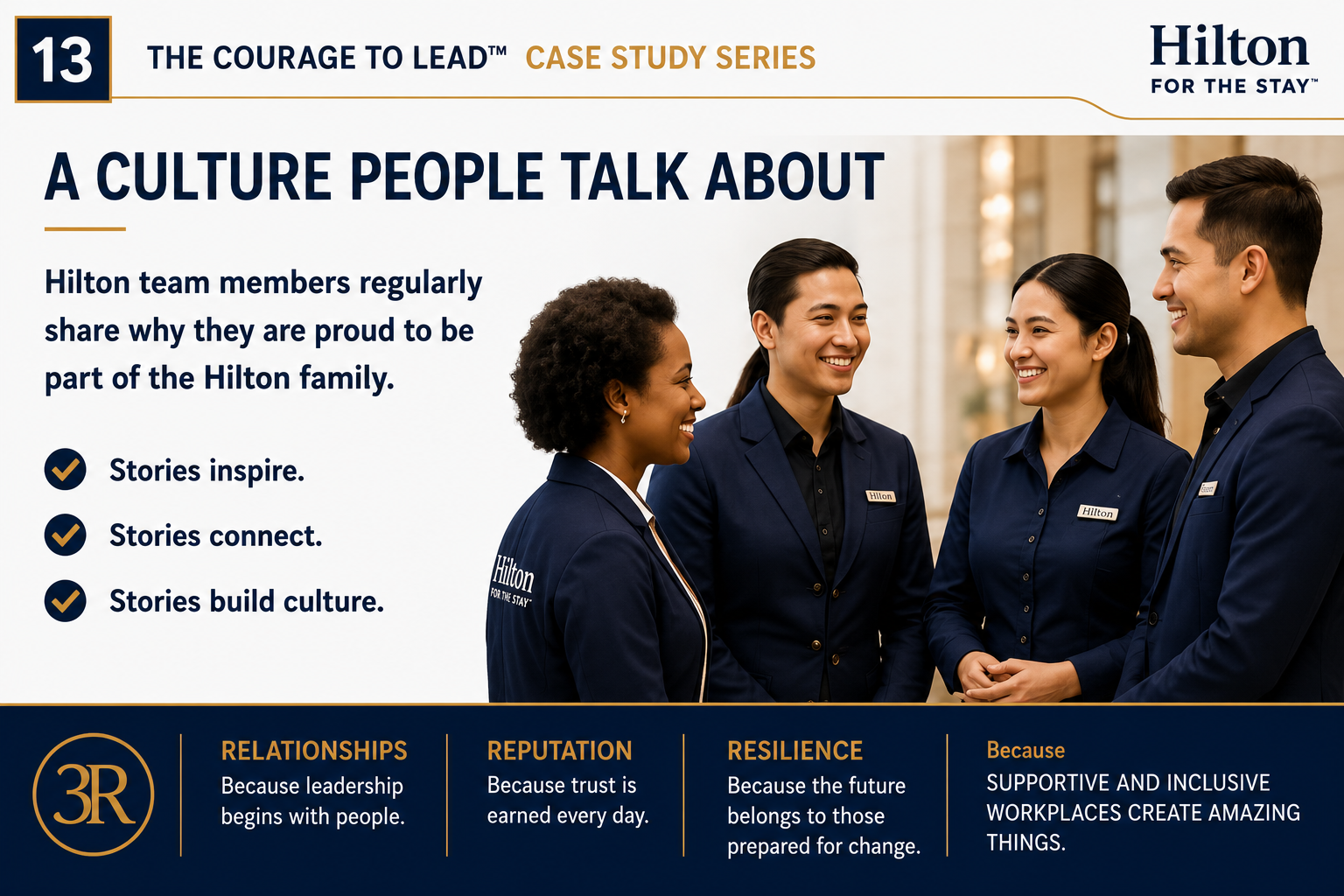
Hilton deliberately shares stories.
Stories recognise people.
Stories reinforce values.
Stories connect leaders with employees across countries and cultures.
Culture grows stronger when people see themselves reflected in the organisation’s purpose.
Stories inspire.
Stories connect.
Stories build culture.
One of the most rewarding aspects of hosting The Courage to Lead Interview Series has been discovering that many exceptional leaders, across very different industries, share remarkably similar philosophies.
Several guest leaders immediately come to mind:
Hugh Brasher (Episode 79) and Wayne Larden (Episodes 1 & 64), the CEOs of the London Marathon and Sydney Marathon respectively, demonstrate how stories unite communities, celebrate ordinary people achieving extraordinary things, and remind us of our similarities rather than our differences.
Danny Doherty (Episode 73) highlights the importance of authentic leadership, meaningful relationships and creating environments where people genuinely feel they belong.
Mike Wassing (Episode 92) reinforces that leadership is ultimately about developing people, empowering others and creating cultures where individuals can thrive and become leaders themselves.
Although their industries differ, their message is remarkably consistent with Hilton’s philosophy:
Stories inspire. Stories connect. Stories build culture.
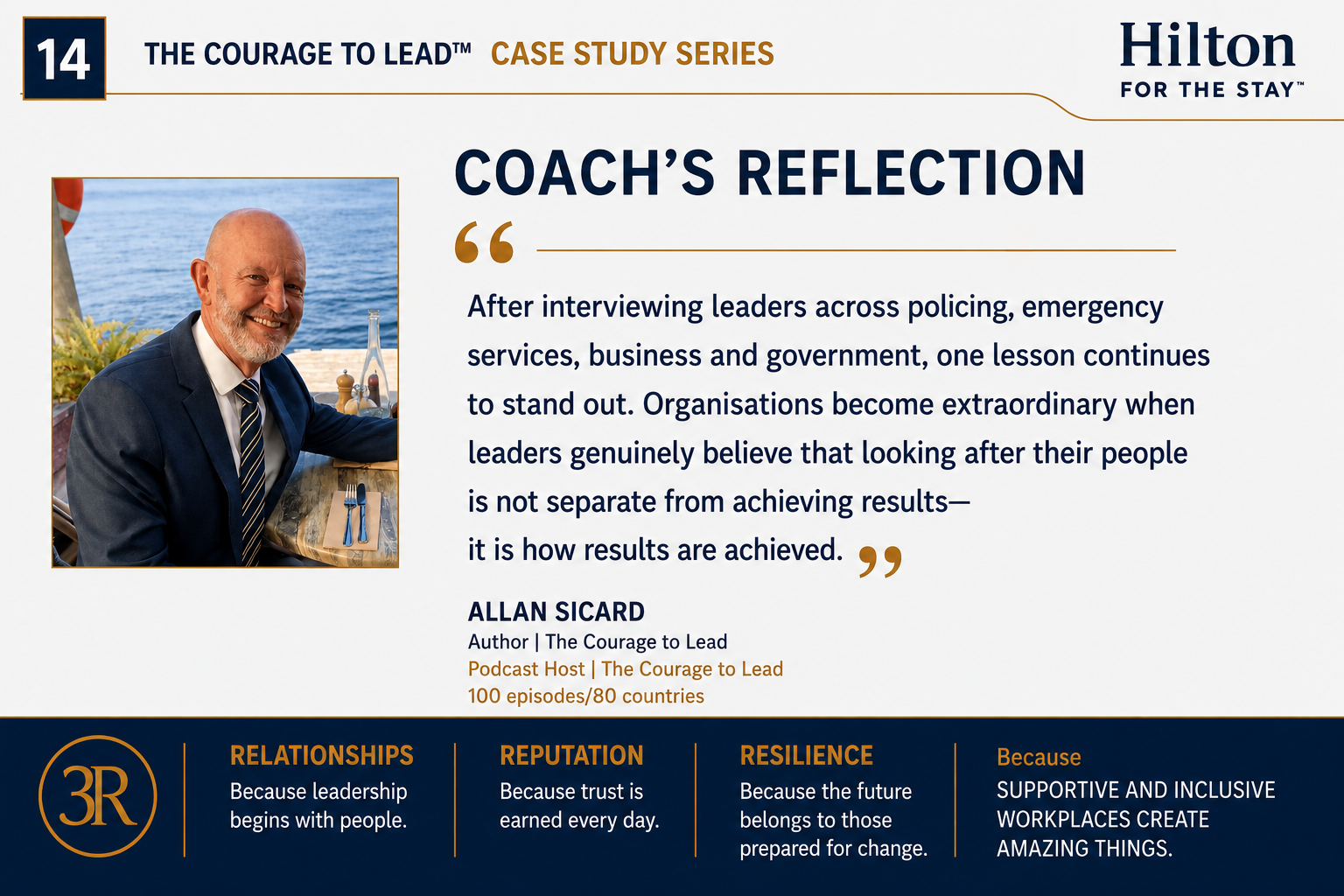
COACH’S REFLECTION – Hilton Leadership Case Study
After interviewing leaders across policing, emergency services, business and government, one lesson continues to stand out. Organisations become extraordinary when leaders genuinely believe that looking after their people is not separate from achieving results—it is how results are achieved.
Hilton demonstrates that caring for people and achieving outstanding business performance are not competing priorities. They are inseparable.
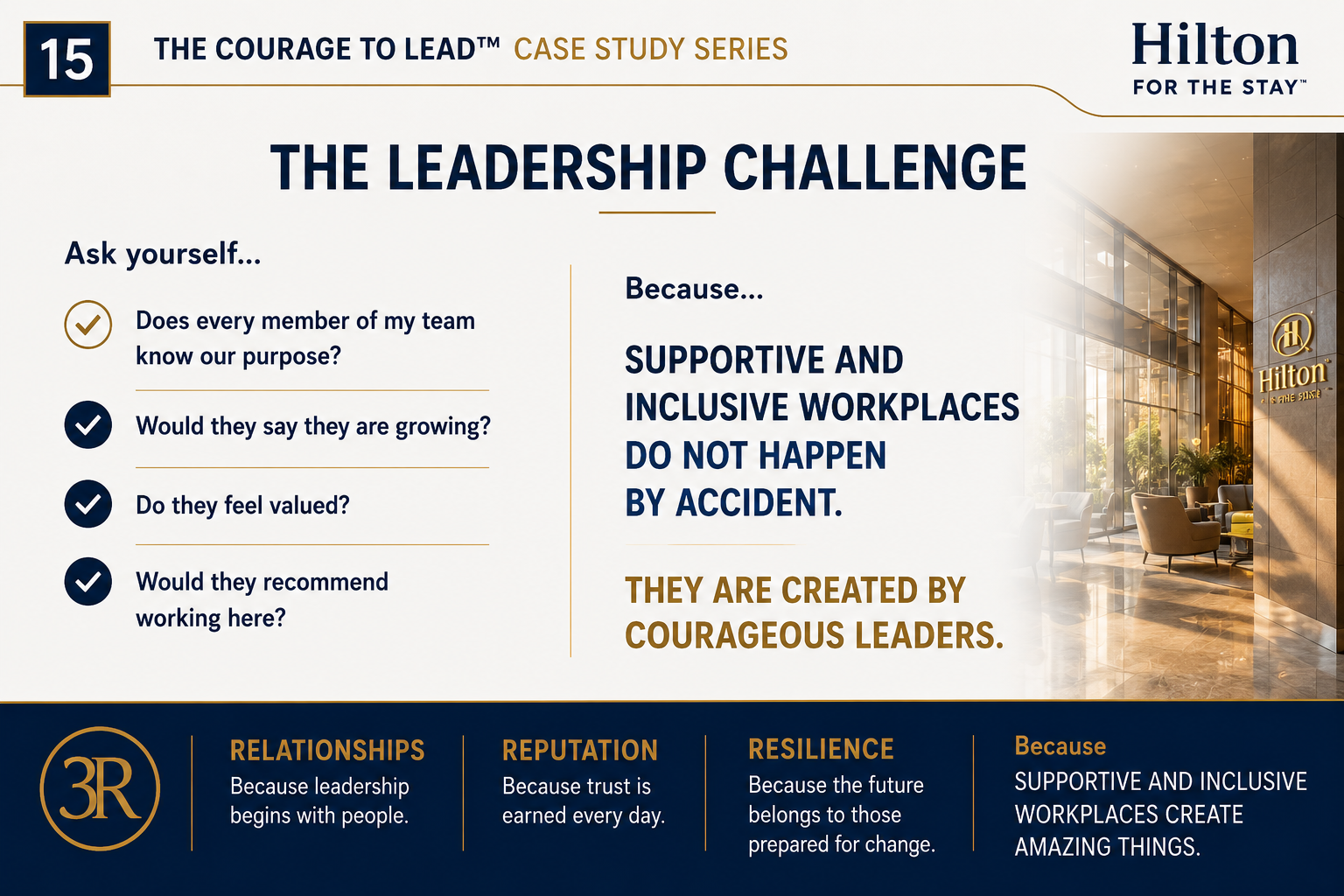
THE LEADERSHIP CHALLENGE – Hilton Leadership Case Study
Hilton’s story demonstrates that extraordinary workplace cultures are not created by chance. They are built deliberately through purpose, trust, investment in people and leaders who remain visible when it matters most. Across this case study we have explored three independent frameworks:
Self-Determination Theory reminds us that people thrive when they experience belonging, autonomy and mastery.
Great Place To Work® measures whether employees experience trust, respect, fairness, pride and camaraderie.
The Courage to Lead™ 3Rs provide a practical leadership framework for creating those experiences every day through Relationships, Reputation and Resilience.
Although developed independently, they all arrive at the same conclusion.
People perform at their best when they know they belong, are trusted and continue to grow.
The challenge for every leader is not whether these principles work. The challenge is whether we choose to practise them consistently.
Ask yourself:
Relationships – Do my people genuinely know that I care about them as individuals?
Reputation – Have I built the trust that allows people to follow me through uncertainty and change?
Resilience – Am I creating opportunities for people to learn, recover, grow and become better than they believed possible?
Finally, ask one question that sits above them all.
If someone wrote a case study about my organisation ten years from now, what leadership story would they tell?
Would they describe a workplace where people simply came to work?
Or would they describe a workplace where people belonged, were trusted, continued to grow and achieved amazing things together?
Because supportive and inclusive workplaces do not happen by accident.
They are created by courageous leaders who understand that leadership is ultimately about creating an environment where people can do their best work, become their best selves and help others do the same.
DOWNLOAD HILTON LEADERSHIP CASE STUDY