
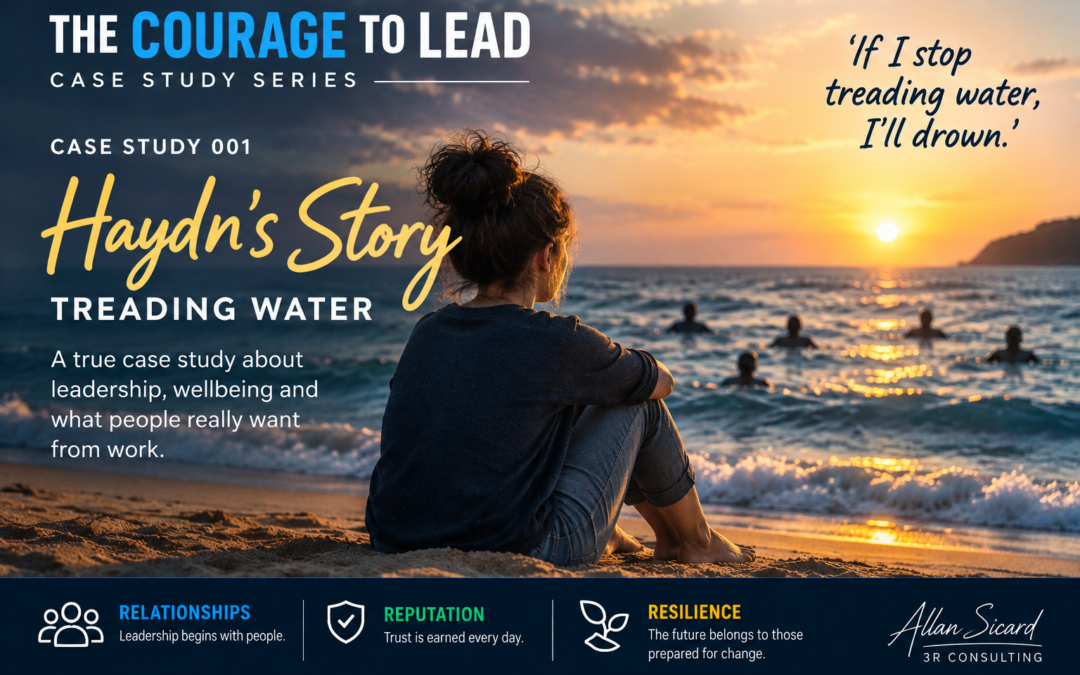
Haydn’s Story – Treading Water
Supportive Workplace Culture
CASE STUDY 001

A true case study about leadership, wellbeing and what people really want from work
Executive Summary
Supportive Workplace Culture
Before we begin, this is a true story about the search for a Supportive Workplace Culture. Some details have been changed to protect the identity of an exceptional individual, but the leadership lessons remain authentic. We will call our protagonist Haydn. Haydn could be a man, woman or non-binary person. That is intentional. This story belongs to anyone who has ever gone to work wanting to make a difference but slowly found themselves becoming disconnected from the very organisation they once believed in. Haydn’s story is not about one workplace. It is about leadership. It is about culture. It is about the human cost of organisations that lose sight of the people who make them successful.
The Human Story
A search for a Supportive Workplace Culture
A few years ago, I sat down with Haydn over coffee in a busy café in Sydney’s CBD. As we talked, I expected to hear another story about career progression, workplace challenges and professional success. Instead, I heard one of the most powerful descriptions of workplace culture I have ever encountered. Haydn didn’t begin by talking about money. Or promotion. Or job titles. Haydn talked about survival. Throughout our conversation, one image kept returning. “I feel like I’m constantly treading water.” The words stayed with me long after we finished our coffee.
Workplace One – The Government Department
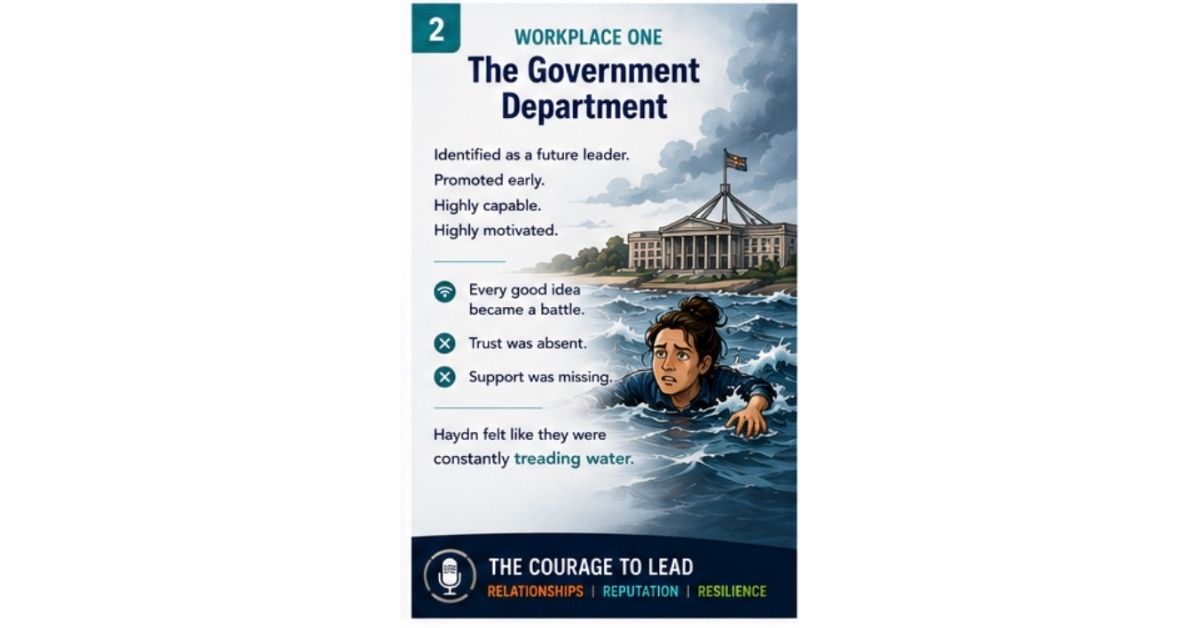 Haydn began their career in a large Australian government organisation working in a specialist technology and cyber security role. This was someone with genuine capability. Leadership potential had been recognised early. Professional development opportunities followed. Outside work, Haydn invested additional time developing leadership skills through volunteer organisations because they genuinely wanted to become a better leader. Everything suggested a promising future. When Haydn identified emerging cyber risks, practical solutions accompanied every recommendation. The expertise existed. The willingness existed. The commitment certainly existed. Unfortunately, the organisational culture struggled to respond. Recommendations that should have taken a single day often required six months before action occurred. In some cases, the very risks Haydn had identified became reality before approval processes had even finished. Innovation was slow. Initiative was discouraged. Trust was limited. Autonomy was almost non-existent. Haydn described feeling technically respected but organisationally constrained. Over time, something began to change. The enthusiasm that had once defined Haydn slowly became frustration. A supportive workplace culture was not present.
When Leadership Loses Connection
A supportive workplace culture is not present.
As the years passed, Haydn watched people promoted into leadership positions who possessed little understanding of the work they were now responsible for leading. Technical expertise appeared less important than networks and relationships. Many leaders seemed focused on their next promotion rather than developing their people. Support became increasingly difficult to find. Trust became increasingly difficult to earn. Care became increasingly difficult to feel. Haydn was no longer simply performing a job. Haydn was surviving one.
Treading Water
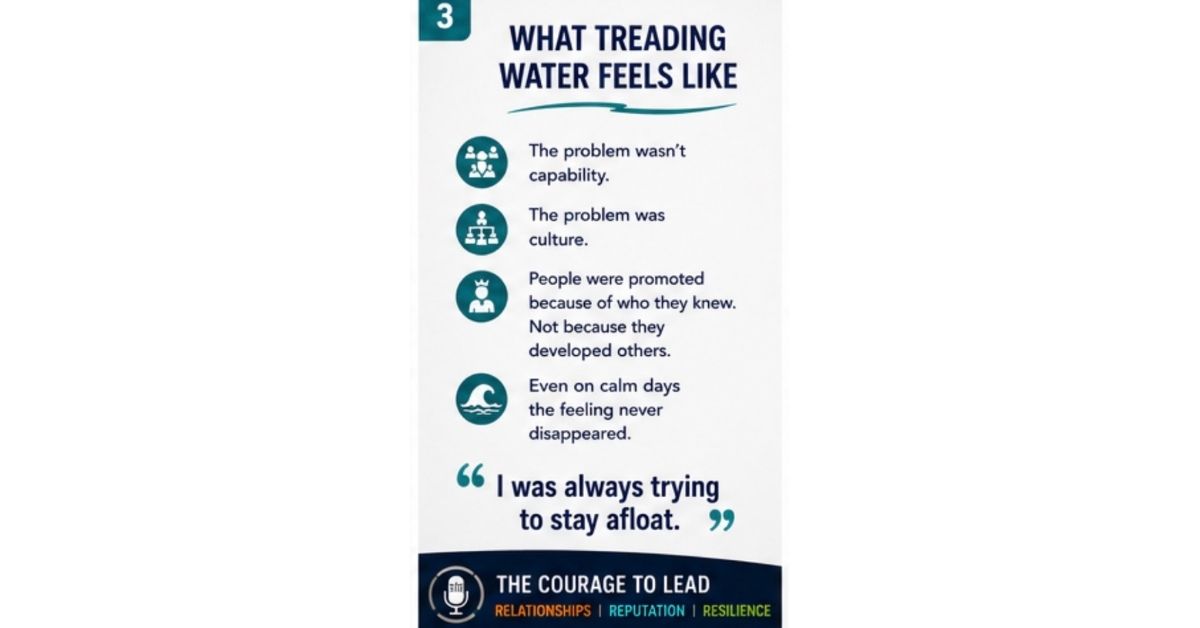 Eventually I asked Haydn to explain what all of this felt like. The answer has become the foundation of this entire case study. “Imagine standing alone in the middle of the ocean.” “The weather changes.” “Sometimes there are storms.” “Sometimes there are waves.” “Sometimes the sea is calm.” “But no matter what happens, I’m always treading water.” “If I stop treading water…” “I drown.” That single metaphor captured years of accumulated frustration. The exhaustion wasn’t caused by occasional crises. It came from the relentless effort required simply to stay afloat. Even when nothing was wrong, everything required energy.
Workplace Two – Prestige Without Peace
A supportive workplace culture is not present.
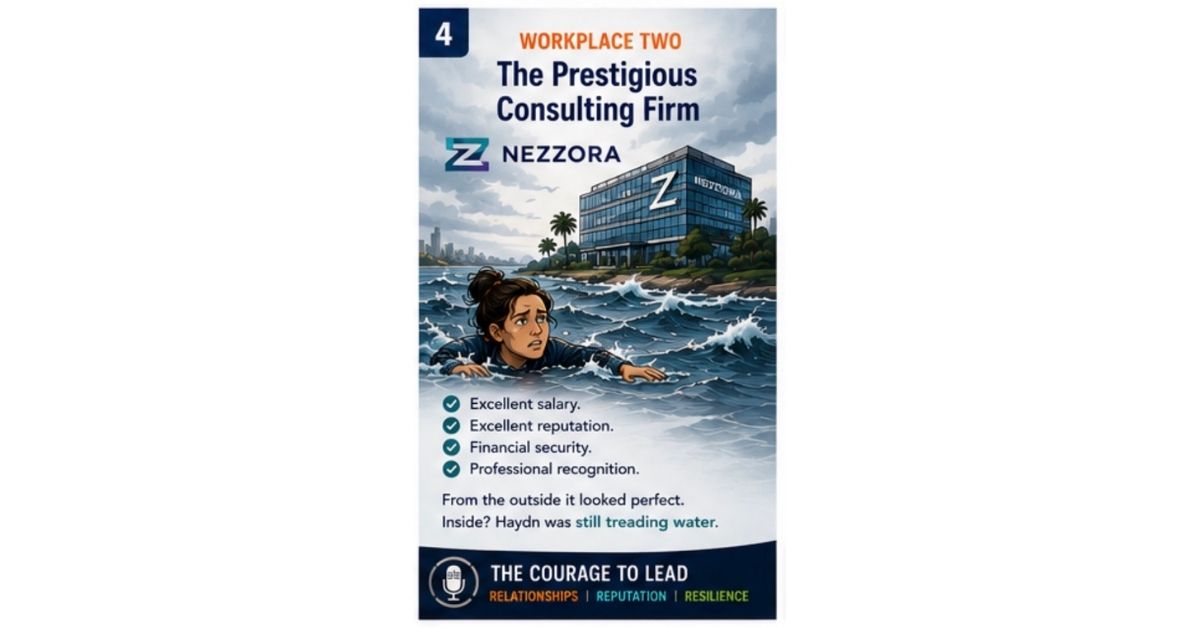 Eventually Haydn accepted a voluntary redundancy. Friends congratulated the decision. The financial package was generous. Shortly afterwards, one of the world’s leading consulting organisations sought Haydn’s expertise. From the outside, the move appeared transformational. Professional reputation increased. Financial security improved dramatically. Haydn’s expertise was recognised and highly valued. Yet something unexpected happened. The feeling remained. Different organisation. Different salary. Different office. Same ocean. Haydn was still treading water. A supportive workplace culture was not present.
Workplace Three – The Dream Job
A supportive workplace culture is not present.
 The next opportunity appeared to be everything professionals aspire to achieve. A globally recognised technology organisation. Outstanding remuneration. Exceptional conditions. Prestige. Influence. Opportunity. People described it as a dream job. Haydn described it differently. “I was still in the ocean.” The waves looked different. The logo had changed. The office was impressive. But the absence of genuine connection remained. Prestige had changed. Purpose had not. A supportive workplace culture was not present.
Workplace Four – Finding the Beach
Supportive Workplace Culture is found.
 Then Haydn made a decision many people could not understand. The next role involved less money. Less prestige. Less status. Smaller responsibilities. Friends questioned the decision. Some assumed Haydn had lost ambition. The opposite was true. Haydn had discovered what success actually meant. The new organisation trusted people. Leaders listened. Support was genuine. Wellbeing mattered. People were encouraged to contribute. Hadyn wanted a Supportive Workplace Culture and they found it. For the first time in years, Haydn no longer felt like they were treading water. They were finally sitting on the beach. Watching the ocean. Watching others still struggling to stay afloat. Realising that success had never been about the size of the organisation. It had always been about the quality of leadership.
The Children
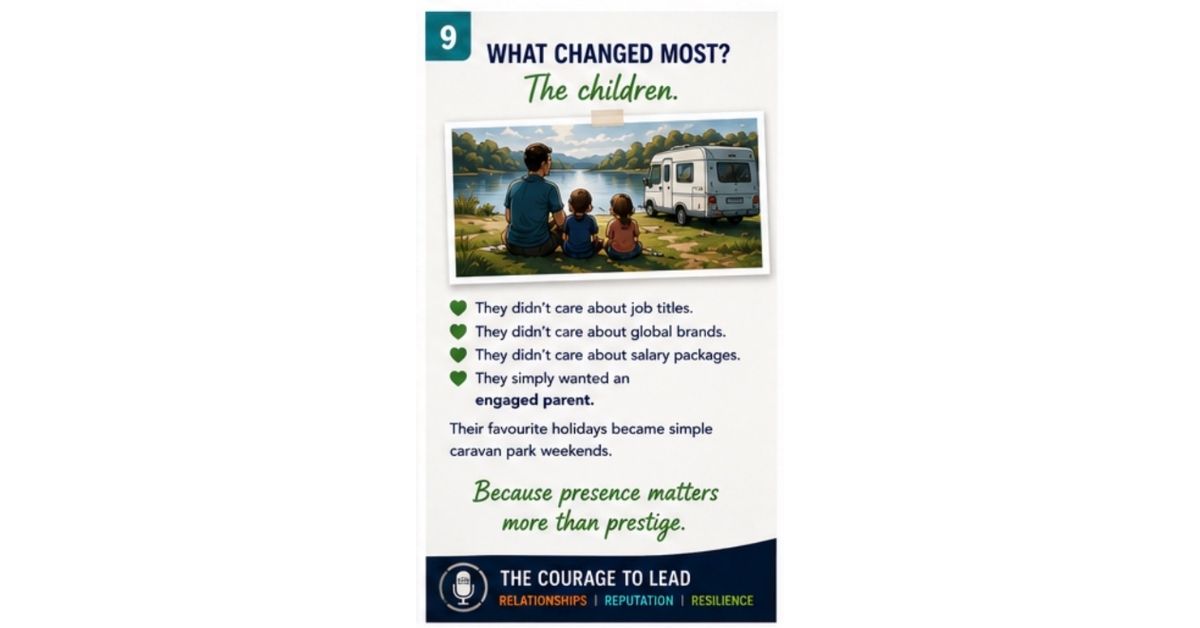 Towards the end of our conversation, Haydn shared the part of the story that affected me most. The greatest beneficiaries of the career change were not Haydn. They were the children. The children never cared about the prestigious employer. They never cared about the salary. They never cared about the impressive job title. They cared about having an engaged parent. The favourite holidays became simple weekends at a caravan park a couple of hours from home. There were no luxury resorts. No expensive overseas trips. Just time together. Presence. Connection. Joy. The career had become smaller. Life had become much bigger. A Great Place to Work who have had 3 guests on The Courage to Lead Interview Series, asserts that when workers are truly working in a great place that supports, includes and trusts them their wellbeing thrives, and through that families and communities benefit, they have a happy and contented human coming home to them, not someone who is drowning.
Leadership Reflection
Supportive Workplace Culture
Haydn’s story raises uncomfortable questions for every leader.
Do you know what your people actually want?
Do you know who is quietly treading water?
Do you know who appears successful on the outside while slowly becoming exhausted on the inside?
Do your people feel trusted?
Do they feel supported?
Do they believe you genuinely care?
Because leadership is rarely judged by what happens during organisational success. Leadership is revealed through the everyday experiences of ordinary people trying to do extraordinary work.
Haydn’s Story Is Not Unique
One of the reasons I chose to begin The Courage to Lead Case Study Series with Haydn’s story is because it reflects themes emerging across leadership research from around the world. While Haydn’s experience is deeply personal, the questions it raises are being explored by researchers, workplace psychologists and organisations committed to creating healthier workplaces.
For example:
Great Place to Work Australia
Rebecca Moulynox and the team at Great Place to Work Australia consistently argue that psychological safety, trust and supportive leadership are the foundation of great workplaces. Their work shows that organisations where people feel safe, trusted and valued experience stronger engagement, better retention and improved organisational performance. Haydn’s story demonstrates what can happen when those foundations are absent.
Gallup
Gallup’s global workplace research has repeatedly shown that employee engagement is primarily influenced by managers and workplace culture—not simply salary or benefits. Disengaged workplaces are associated with lower wellbeing, higher stress and poorer organisational performance.
Haydn’s decision to leave highly prestigious organisations despite attractive remuneration highlights that meaningful work and supportive leadership often outweigh status alone.
Psychological Safety
A growing body of research demonstrates that psychologically safe workplaces reduce burnout and enable people to contribute more openly, learn more effectively and perform at higher levels. Throughout Haydn’s journey, the absence of trust and psychological safety became far more significant than the work itself.
Building Thriving Workplaces
Australian workplace wellbeing research consistently concludes that mentally healthy workplaces are created through everyday leadership practices, supportive relationships and organisational culture—not isolated wellbeing initiatives. This reinforces one of the central messages of this case study:
People rarely leave because of one difficult day. They leave after experiencing hundreds of ordinary days where they no longer feel trusted, supported or valued.
Two (2) Final Sources from The Courage to Lead
The Courage to Lead – Resilience and Compassion in Police Command
The Courage to Lead – Resilience and Compassion in Police Command
Chapters 18 – Support (2015-2020)
Chapter 20. Building a Supportive and Inclusive Workplace (2016-2020)
Chapter 21 – Buidling Connections (2016-2020),
provide real life examples of how to show you care as a leader.
The Courage to Lead Interview Series
Matt Lahood – looking for black clouds
Michelle O’Keeffe – putting people first
Conclusion
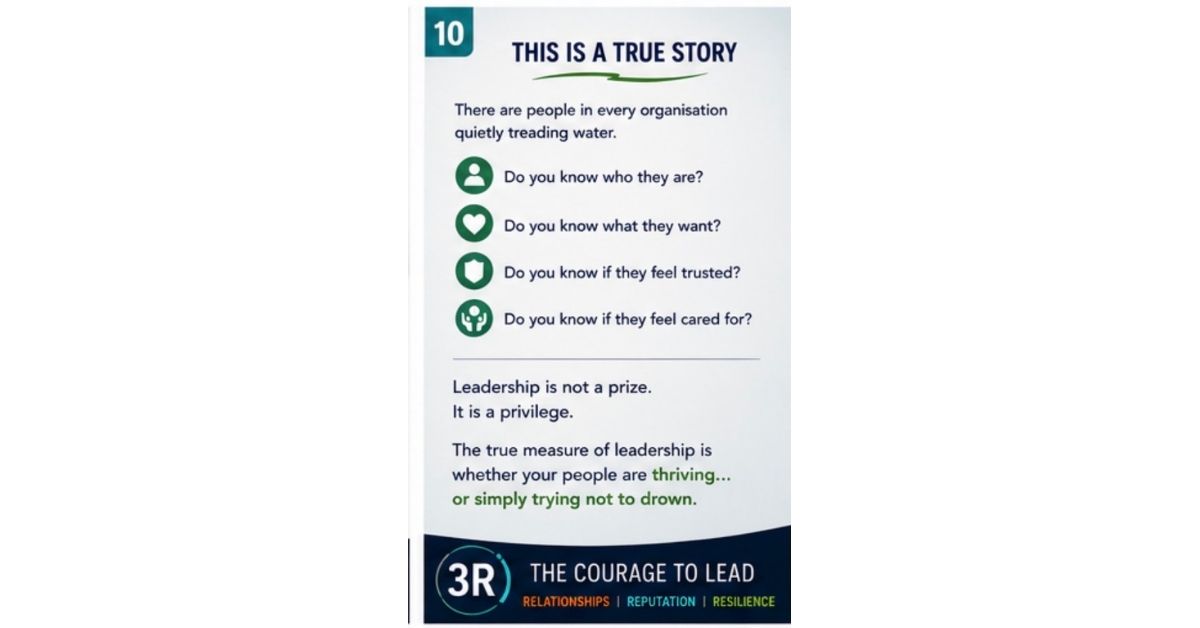 Haydn’s story is not unique. Every organisation has people quietly treading water. Some eventually leave. Some remain and slowly disengage.Some continue performing while privately exhausting themselves. The question is not whether those people exist. The question is whether leaders recognise them before it is too late. This case study is not about one organisation. It is not about one industry. It is not about one leader. It is about a challenge facing workplaces everywhere.
Haydn’s story is not intended to criticise any organisation or suggest there is a single solution to workplace culture. Rather, it reminds us that behind every employee survey, wellbeing statistic, retention challenge or cultural review is a person trying to do meaningful work. Whether we call it psychological safety, employee engagement, organisational trust or workplace wellbeing, the underlying question remains remarkably simple:
Do our people know that we genuinely care?
How do we create supportive and inclusive workplaces where amazing things happen? That journey begins with three enduring leadership principles:
Relationships – Because leadership begins with people.
Reputation – Because trust is earned every day.
Resilience – Because the future belongs to those prepared for change.
Leadership is not a prize. It is a privilege. And perhaps the true measure of leadership is whether the people entrusted to our care leave work each day feeling like they are still treading water……or finally able to sit peacefully on the beach.
For more real life examples of Leadership stories from real leaders who empower others to create supportive and inclusive workplaces where amazing things happen check out The Courage to Lead Podcast Series.