
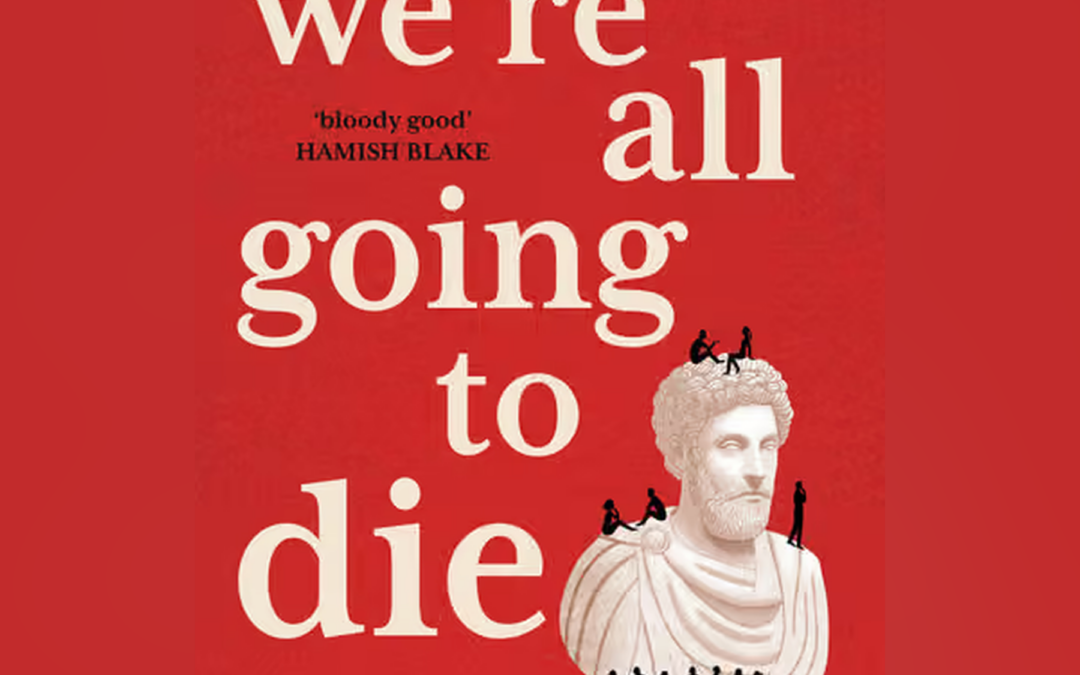
What can a former Australian SAS Commanding Officer teach us about happiness, purpose and making the most of life? Quite a lot, as it turns out. In this episode of The Courage to Lead Interview Series, I welcome back Ben Pronk, former Australian Army Special Forces officer, leadership consultant, educator and author of We’re All Going to Die: Practical Happiness for the Time You Have Left.
Having spent 24 years in the Australian Army, including commanding the SAS, Ben Pronk has experienced leadership, pressure and adversity at extraordinary levels. Today, through his work in crisis management, leadership development and resilience, Ben helps others navigate uncertainty, develop their capabilities and find meaning in what they do. But this conversation explores something even more fundamental. What actually makes us happy, and are we making the most of the time we have?
Ben Pronk on Leadership, Mentorship and Creating Other Leaders
One of the most interesting aspects of my conversation with Ben Pronk was his reflection on how his understanding of leadership has evolved. During his military career, leadership was a formal responsibility. Today, Ben finds enormous satisfaction in developing others through his work with the Australian Graduate School of Management (AGSM) at UNSW.
Rather than being the person responsible for making every decision, he now helps emerging leaders develop the knowledge, confidence and capabilities to lead themselves. This resonates deeply with my own leadership philosophy: The true measure of a leader is how many other leaders they create.
Ben spoke generously about two people who had a profound influence on his transition from the military. Dr Michele Roberts, a senior academic leader, recognised his potential and encouraged him into postgraduate education and ultimately leadership teaching. His business partner, Tim Curtis, provided another important source of mentorship as Ben moved into the unfamiliar world of commercial business.
These relationships demonstrate something I have observed repeatedly throughout my leadership career. Great leaders recognise potential in others, sometimes before those individuals recognise it in themselves. They create opportunities, provide encouragement and empower others to take on challenges they may previously have considered beyond their capabilities.
Finding Purpose When Everything Changes
One of the central themes of Ben Pronk’s book is the ancient Greek concept of telos — having a purpose or something meaningful to work towards. For much of his adult life, Ben’s purpose was closely connected to military service. He spent 24 years in uniform, including significant involvement in the Afghanistan conflict. When that chapter ended, he faced a challenge familiar to many people transitioning from long careers.
Who are you when the role that has defined you is no longer there?
Ben describes how further education, building a business, mentoring emerging leaders and developing new skills helped him establish a different sense of purpose. Importantly, he challenges the idea that everyone needs one enormous, world-changing life mission.
Purpose can come from learning something new, improving a skill, helping others or working towards a personal goal. As Ben explained during our conversation: “I don’t think there’s any happiness without struggle.” His point is that personal growth, meaningful challenges and overcoming difficulties are important parts of a fulfilling life. It is not necessarily about making life easier. It is about finding something worthwhile to work towards.
Ben Pronk on Gratitude and Finding Happiness in Small Moments
One of my favourite sections of We’re All Going to Die explores gratitude. Ben Pronk readily admits that he was initially sceptical about practices such as gratitude, mindfulness and meditation. They seemed somewhat removed from the tough, practical environments in which he had spent his military career. However, researching the science behind these techniques encouraged him to reconsider.
He began deliberately practising gratitude, initially focusing on significant things such as safety, family and the comforts of everyday life. Over time, he discovered something unexpected. He started noticing smaller moments that had always been present but that he had previously overlooked. A cool breeze on his face. A stranger showing kindness. A smile at the supermarket. Even a pigeon on a Perth railway platform discovering a crumb of food.
These might seem like insignificant observations, but Ben explains how deliberately noticing such moments changed the way he experienced everyday life. Rather than constantly focusing on problems and threats, he began recognising more of the positive things happening around him.
For leaders, this provides an important reminder. We can become so focused on deadlines, performance and the next challenge that we overlook the positive contributions and small acts of kindness occurring within our teams every day. Sometimes better leadership begins with simply noticing.
The Importance of Awe: Learning to Look Up
Another fascinating discussion involved the emotion of awe. Ben Pronk describes how remarkable experiences do not always require extraordinary circumstances. Sometimes awe can be found in nature, architecture, the design of a building or something we pass every day without noticing. His suggestion is beautifully simple. Look up. We spend so much time looking down at phones, concentrating on tasks or rushing between appointments that we overlook much of the world around us.
Ben describes looking upwards in train stations, airports and city streets and discovering details in the architecture that he had never previously appreciated. It is a reminder that our surroundings can offer moments of wonder if we make the effort to observe them. And perhaps the same principle applies to leadership. When we become absorbed in immediate problems, we can overlook the bigger picture, the capabilities of our people and the opportunities emerging around us.
Resilience, Meditation and the Power of Breathing
Despite Ben Pronk’s considerable experience in high-pressure military environments, he openly acknowledges that he still experiences nervousness, self-doubt and imposter syndrome. Even after years of presenting to executives and leadership groups, he can still feel anxious before speaking. What has changed is how he responds.
Ben describes meditation, controlled breathing, journaling, physical exercise and creative activities as practical tools he has incorporated into everyday life. He explains that meditation has helped him become slower to anger and better able to manage stressful situations. Controlled breathing is another technique he learned during military service and continues to use before presentations. Rather than presenting these practices as miraculous solutions, Ben describes them as small improvements that accumulate over time. This is an important distinction.
Resilience is not about pretending we are unaffected by pressure. It is about developing the skills and habits that help us respond more effectively when pressure arrives. It also challenges the perception that effective leaders must always appear confident, certain and in complete control. Ben’s willingness to acknowledge his own doubts demonstrates that vulnerability and capability are not mutually exclusive.
Comparison: The Thief of Joy
Another compelling part of our conversation with Ben Pronk concerned our tendency to compare ourselves with others. Social media has made this increasingly difficult to avoid. We see other people’s achievements, careers, lifestyles and successes, frequently without seeing the difficulties behind them.
Ben captures this beautifully: “We’re seeing their highlights reel, we’re living our bloopers reel.” He shares a practical technique for managing envy. When he finds himself wishing he had something another person possesses, he asks himself whether he would exchange his entire life for theirs. Not simply their success, wealth, fitness or possessions. Everything. Their relationships, challenges, responsibilities, difficulties and circumstances.
He explains that this perspective helps him appreciate what he already has. It is also a valuable leadership lesson. Comparison can be useful when we observe a skill or behaviour we would like to develop. But constantly measuring our lives against an idealised version of somebody else’s can undermine our confidence, gratitude and sense of purpose.
Ben Pronk on Making Time for the People Who Matter
Perhaps the most emotional part of our conversation came when Ben discussed the finite amount of time we have with the people closest to us. He shared the story of a Spanish advertisement in which lifelong friends were asked how frequently they saw each other. Their answers were then compared with estimated remaining life expectancy. For some, the calculation suggested they might spend only a surprisingly small number of hours together for the remainder of their lives.
It is a confronting thought. We often assume that our closest friends and family will always be there. We tell ourselves that we will catch up next month, next year or when things become less busy. But the clock continues ticking. Ben’s book draws upon the Stoic principle of memento mori — remembering that we will die. Not as something intended to frighten us, but as a reminder to live more deliberately. To make the phone call. To organise the catch-up. To appreciate the relationships that give our lives meaning. For me, this was one of the most powerful reminders in the entire interview. Relationships should not continually be postponed in pursuit of things that may ultimately matter far less.
Building Better Habits Through Deliberate Practice
Ben Pronk also discusses the importance of routines and deliberate practice. Whether it involves physical exercise, meditation, drawing or developing professional capabilities, he believes meaningful progress comes from making improvement part of everyday life. Ben describes morning exercise with his wife, using train journeys to practise drawing, and setting personal artistic goals that give structure to his development.
He also discusses his recognition through the Napier Waller Art Prize and his continuing interest in creating artwork. What stands out is that these pursuits are not simply hobbies to fill spare time. They give him challenges, opportunities to improve and an ongoing sense of purpose. This brings us back to one of the central messages of the conversation. Happiness is not necessarily something waiting for us at the end of an achievement. It can be found in the process of learning, practising, improving and overcoming challenges along the way.
The Most Important Question: Are You Living the Life You Want?
Towards the conclusion of our conversation, Ben Pronk returned to an idea he explores at the beginning of his book. The ancient philosophical principle that an unexamined life is not worth living. He encouraged listeners to reflect on several important questions.
What genuinely makes you happy? What does success mean to you? Where do you find purpose? And perhaps most importantly, does the way you are living actually reflect those answers?
Without taking time to examine these questions, Ben suggests we risk allowing other people, social expectations or commercial influences to define success for us. We may spend years pursuing the next promotion, a bigger house or greater material success without considering whether those achievements will genuinely improve our lives. For leaders, this raises another important question. Are we creating workplaces where people can find meaning, grow their capabilities and enjoy being part of something worthwhile? Because leadership should be about far more than simply achieving targets. It should also be about helping people thrive.
Final Reflections: What Ben Pronk Teaches Us About Living and Leading
What struck me most about this conversation with Ben Pronk was not his extraordinary military career, the success of his business or his considerable academic knowledge. It was his humility, curiosity and humanity. Here is someone who has operated in some of the most demanding leadership environments imaginable, yet openly acknowledges that he continues to learn, experiences self-doubt and deliberately practises the techniques he recommends to others.
His message is not that he has discovered the secret to a perfect life. It is that we can all make our lives better through small, deliberate choices. By finding purpose. By appreciating the ordinary. By developing meaningful relationships. By continuing to learn. And by remembering that our time is limited. That is a message worth reflecting upon.
Thank you, Ben Pronk, for another wonderfully engaging conversation and for reminding us that there is much more to leadership — and life — than achievement alone.
The Courage to Lead Interview Series
Shining a light on leaders who empower others to create supportive and inclusive workplaces, environments and communities.