
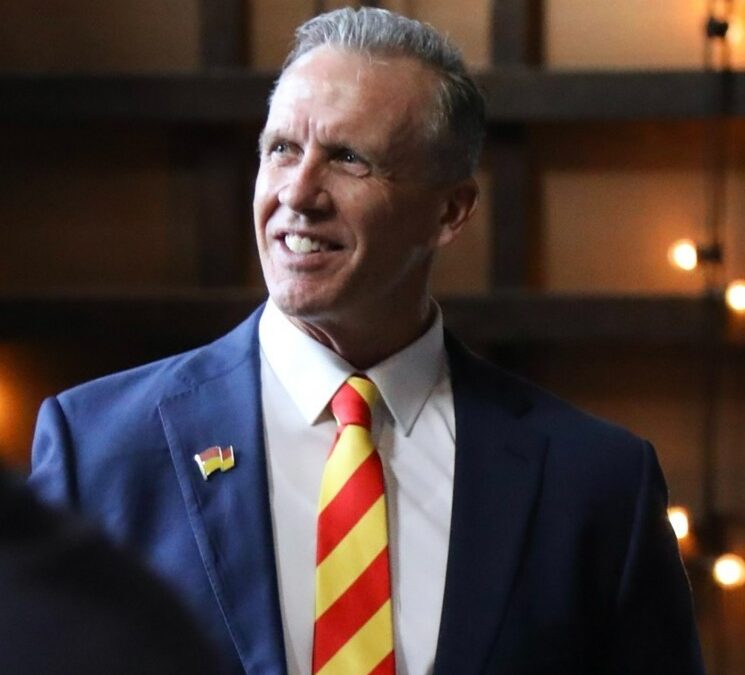
I have been trying to get Steven Pearce onto The Courage to Lead Interview Series since Episode 1. He finally agreed — on one condition. He would be Episode 100. And having now had this conversation, I can’t think of a more appropriate guest to mark the milestone.
I’ve known Steven Pearce for many years. During my time running leadership development programs in the NSW Police, he was one of my go-to guest presenters. He was always one of the standouts. But even after knowing someone for that long, a good conversation can still surprise you. This one certainly surprised me.
Leadership Isn’t Always Loud
Steven Pearce went back to 1985 when I asked him about his first real experience of leadership. He had just joined what was then the NSW Fire Brigades, alongside some of the first female firefighters entering an environment that was overwhelmingly male. Their treatment wasn’t always good.What stayed with Steven wasn’t simply the behaviour itself, but the actions of one relatively quiet male firefighter who stepped forward and challenged it.
Steven’s reflection more than 40 years later was simple: You don’t need to be the biggest person in the room. You don’t need rank. You don’t need to be loud or gregarious. Sometimes leadership is simply doing the right thing in the right moment. That thought could almost summarise this entire interview.
Steven Pearce on Giving Your People Permission to Fail
Steven Pearce continually redirects the conversation towards the people around him when asked about his achievements as CEO of Surf Life Saving NSW. His philosophy for building what I call a formidable team is refreshingly straightforward. Empower people. Trust them. Delegate. Give them permission to fail. Let them have a crack.
That last part matters. Innovation cannot happen in an organisation where people are frightened of getting something wrong. Steven describes an environment where people can bring forward ideas that he sometimes initially thinks are ridiculous — only to change his mind, give them the opportunity and watch those ideas become enormously successful.
His mantra? Don’t tell me why we can’t do it. Tell me why we can.
That philosophy has helped Surf Life Saving continue to evolve far beyond the traditional image many of us grew up with of the bronzed lifesaver standing between the red and yellow flags. Today its capabilities extend across emergency response, flood support, first aid, event safety and one of the world’s most significant coastal drone surveillance programs. That doesn’t happen because one CEO has every answer.
It happens because people throughout an organisation are empowered to find answers.
When the Glass Gets Too Full
Steven Pearce provided one of the most powerful moments of the interview when he spoke about the personal cost of leadership. Some of the most memorable moments across 100 episodes have occurred when accomplished leaders stop talking about leadership theory and talk about what leadership actually costs.
Following the Bondi Beach terrorist attack, lifesavers found themselves responding to circumstances nobody joining a surf club could ever have imagined. Steven describes the extraordinary leadership shown by local club leaders as they put their own lives and businesses aside to support their members. He also describes the impact on himself. He became so invested in looking after everybody else that eventually, in his own words, “the glass got too full.” His people noticed. They told the boss that he needed to step away. And eventually he listened.
There is a significant leadership lesson in that.
We spend a lot of time telling leaders to look after their people. We spend far less time teaching them to recognise when they need to allow their people to look after them. A formidable team doesn’t only operate when the leader is strong. A formidable team is strong enough to tell the leader: “We’ve got this.”
Steven Pearce and the Leadership Lesson of Playing the Long Game
Steven Pearce’s career has not been one continuous rise. He speaks openly in this interview about a period when his career and reputation were devastated by a highly public investigation. The temptation when we believe we’ve been wronged is to retaliate. Steven deliberately chose another path.
He refused opportunities to publicly attack people. He refused to burn bridges. He concentrated instead on what he could control. His reputation. His relationships. His capability. His future. He calls it playing the long game.
Eventually another opportunity emerged and he rebuilt. That lesson resonates strongly with one of the three Rs I continually talk about in leadership:
Reputation.
Trust is earned every day. But reputation is also tested when circumstances are at their worst. There is something particularly powerful about the next chapter of Steven’s story. After enduring a period in which his reputation had been seriously challenged, Surf Life Saving NSW later approached him because the organisation needed someone who could help rebuild trust and reputation.
The very leadership qualities that had been tested became some of the qualities required for his next opportunity.
There Is a Role for Everyone
Steven Pearce describes one of the parts of Surf Life Saving’s transformation that he is most proud of — creating a genuinely more inclusive organisation. The old stereotype was obvious. Young. Fit. Male. Bronzed. Strong swimmer. Steven describes something very different today. People of different religions. Different sexualities. Different cultures. Older volunteers. People with disability. People who may never swim a metre but possess skills the organisation desperately needs.
His message is wonderfully simple: There is a role and a function for everyone.
That is what inclusion should look like. Not an annual statement. Not a poster. Not a policy sitting on an intranet. An organisation recognising that people bring different capabilities and then creating the environment where those capabilities matter. It also brings Steven’s leadership story almost full circle.
His first memorable example of leadership was watching someone stand up for women entering a traditionally male workplace. Decades later, he is helping lead an organisation that intentionally opens its doors to people who might once have thought there was no place for them.
Steven Pearce on Energy, Support and Vulnerability
Steven Pearce had three clear themes when I asked what someone wanting to follow a leadership path like his would need.
Energy. Support. Vulnerability. Then he added another consideration: Sacrifice.
Leadership isn’t effortless. Being visible somewhere usually means you aren’t somewhere else. Serving an organisation can cost family time, personal time and sometimes your own wellbeing. Steven also makes another important distinction. Support doesn’t simply mean having people working for you. It means building a great team around you and, where you are fortunate enough to have it, having strong family support around you as well.
And vulnerability isn’t weakness. It is being brave enough to let other people see that you don’t always have every answer. That you sometimes need support yourself. That perhaps explains one of the strongest themes running through this entire interview. The further Steven progressed as a leader, the less the story became about Steven and the more it became about the people around him.
Why This Is Episode 100
Steven Pearce says something towards the end of our conversation that could almost summarise the first 100 episodes of The Courage to Lead Interview Series: “It’s not about you. It’s all about the team.”
After 100 episodes, I have had the privilege of speaking with extraordinary people from emergency services, defence, business, community organisations, sport and countless other fields. Different careers. Different experiences. Different personalities. But a common theme keeps appearing. The leaders I most admire don’t spend much time telling you how good they are. They talk about their people. Steven does that throughout this interview. Build the team. Trust them. Give them permission to fail. Let them challenge you. Look after them. And occasionally, allow them to look after you.
After 100 conversations about leadership, that’s not a bad place to land. The Courage to Lead Interview Series exists to shine a light on leaders who empower others to create supportive and inclusive workplaces where people can do amazing things. Steven Pearce’s story is exactly that. And that is why I’m delighted he finally said yes. Even if it took 100 episodes.