
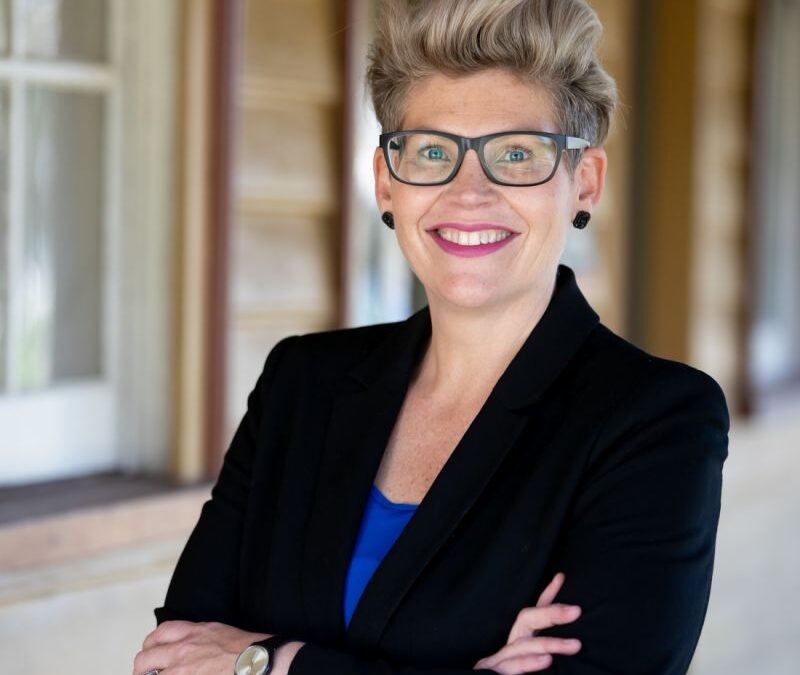
Rebecca Pinkstone began her career as a youth worker in Western Sydney.
Today, Rebecca Pinkstone is the Chief Executive Officer of Homes New South Wales, leading an organisation of approximately 3,500 people during one of the most significant housing and homelessness crises Australia has experienced.
This was Rebecca Pinkstone’s third appearance on The Courage to Lead Interview Series. I have known and worked with Rebecca Pinkstone for many years, particularly through our involvement in the homelessness sector.
I have always admired Rebecca Pinkstone’s intelligence, her deep knowledge of housing and homelessness, and her commitment to the people affected by the decisions governments and organisations make.
What became clear during this conversation, however, was that Rebecca Pinkstone’s leadership is not built on expertise alone.
It is built on relationships, empathy, evidence, adaptability and a belief that high performance and genuine care are not competing leadership philosophies.
They belong together.
Leadership Is Not About Your Position – Rebecca Pinkstone
Rebecca Pinkstone believes leadership can exist at every level of an organisation.
Being appointed CEO may provide authority and responsibility, but it does not make leadership the exclusive responsibility of the person at the top.
Every employee influences the culture through the decisions they make, the responsibilities they accept and the way they interact with others.
In an organisation of 3,500 people, Rebecca Pinkstone cannot personally influence every workplace interaction. Her task is therefore to create a cascade of leadership throughout the organisation.
Every interaction can contribute positively or negatively to the workplace culture.
The responsibility of a senior leader is to create the systems, expectations and environment that encourage positive leadership to occur everywhere.
Experience and Expertise Still Matter
There was a period when organisations often assumed that a senior leader could move into almost any field without detailed knowledge of the work.
Rebecca Pinkstone believes that view is changing.
Some leadership positions require a deep understanding of the people, systems and challenges involved.
Rebecca Pinkstone began on the frontline as a youth worker. She has worked in government, the community sector and community housing. Before joining Homes New South Wales, she spent more than eight years with Bridge Housing, including serving as its CEO.
That experience means Rebecca Pinkstone understands the housing and homelessness system from several perspectives.
It also allows her to reach the real issues more quickly.
Leadership still requires humility, curiosity and a willingness to learn. But kindness alone is not enough. Leaders also need to understand the work and be capable of performing it.
The Personal Story Behind the Purpose – Rebecca Pinkstone
Rebecca Pinkstone’s connection to public housing is not only professional.
Her grandmother left a violent relationship, moved from the country to Sydney and eventually secured public housing.
After years of instability and upheaval, that home provided safety and security.
Rebecca Pinkstone understands what a stable home can mean because its impact has been part of her own family’s story.
That experience helped shape her belief that empathy must extend beyond the people we know personally.
It is relatively easy to care about our immediate family and the people we see every day. Leadership requires us to also consider people we may never meet and circumstances we may never personally experience.
A person’s past does not have to determine their future.
Leadership can create possibility, stability and hope.
There Is No Perfect Balance – Rebecca Pinkstone
Rebecca Pinkstone also spoke honestly about turning 50 while raising children, supporting ageing parents and leading a major public organisation.
She rejects the idea that people can create a perfect equilibrium between work and family.
It is not a balance.
It is a juggle.
Sometimes work will require more attention. At other times, family responsibilities must come first. Every decision involves compromise, adaptation and an acceptance that we cannot perform every role perfectly at the same time.
Rebecca Pinkstone’s advice is to stop searching for an impossible balance and concentrate on doing the best you can in the circumstances in front of you.
That perspective also influences how she leads others.
Employees do not leave their families, worries and personal circumstances at the door when they arrive at work.
They may be caring for children or ageing parents. They may be facing financial pressure, illness or relationship difficulties. Some may have family members living in overseas conflict zones and may have spent the night wondering whether those people are safe.
Leaders cannot solve every problem their people experience.
They can, however, create a psychologically safe environment in which people can speak honestly, be seen as whole human beings and receive reasonable support.
High Performance and Care Are Not Opposites
Homes New South Wales has significant responsibilities.
Rebecca Pinkstone referred to commitments involving $6.6 billion and the delivery of 8,400 homes, alongside homelessness reform and investment in crisis and temporary accommodation.
These commitments require discipline, accountability and performance.
But Rebecca Pinkstone does not believe performance must come at the expense of people.
An organisation can make commitments, monitor results and hold people accountable while still treating its employees with empathy and care.
In fact, Rebecca Pinkstone argues that caring for the people responsible for delivering the work is how sustainable performance is achieved.
A caring culture does not remove accountability.
It creates the conditions in which people are more capable of meeting it.
Leading a Team of Teams – Rebecca Pinkstone
Leading a smaller organisation allowed Rebecca Pinkstone to regularly interact with most employees and directly influence the culture.
Leading 3,500 people requires a different approach.
Homes New South Wales has been establishing clearer strategies, business plans, performance indicators and professional development processes.
Rebecca Pinkstone also separates performance conversations from personal development conversations.
One discussion might focus on projects, targets and deliverables.
A separate conversation asks:
How are you going?
What is happening within your team?
What support do you need?
Where do you want your career to go?
Combining every conversation into a discussion about performance can prevent leaders from understanding their people.
Separating those conversations creates room for honesty, development and trust.
Rebecca Pinkstone describes the organisation as a team of teams.
For those teams to flourish, they require three things:
Climate: A positive and professional environment in which people respect and understand one another.
Capability: Confidence that team members possess, or are being helped to develop, the skills required to do the work.
Clarity: A clear understanding of each person’s role, the outcomes expected and how their contribution connects with the organisation’s purpose.
Culture is not created only through corporate statements.
It is created through the everyday climate, capability and clarity experienced within individual teams.
Diagnose Before You Act
Rebecca Pinkstone has extensive technical knowledge of housing and homelessness.
One of her greatest leadership challenges has been recognising that complex problems do not always require familiar technical solutions.
When Homes New South Wales examined why some service areas were performing better than others, the initial assumption might have been that the stronger areas simply had more resources.
The data showed that this was not necessarily the case.
Other factors were influencing performance, including the way specialist expertise was organised and whether managers had an achievable number of people reporting to them.
Some managers had spans of control that were simply too large to allow them to properly support their people.
The lesson was clear: leaders must diagnose the problem before deciding upon the solution.
That requires evidence, data, different perspectives and the humility to accept that previous experience may not provide the complete answer.
Creating Permission to Try – Rebecca Pinkstone
Large reforms take time.
Rebecca Pinkstone believes leaders can still create practical improvements while working towards a longer-term objective.
Homes New South Wales has trialled modern methods of construction, developed specialist centres of excellence, rebuilt mechanisms for tenants to have a voice and introduced simpler ways for community housing providers to work with government.
The organisation has also introduced a maintenance application that allows tenants to report repairs and track their progress.
Not every trial will produce the desired result.
That is the purpose of testing, learning and adapting.
People will not innovate when they believe every unsuccessful attempt will result in blame or retribution.
Leadership must create permission for people to try sensible ideas within clear professional and governance frameworks.
An enabling culture says:
It is okay to try.
It is okay not to get everything right.
What matters is what we learn and what we do differently next time.
Technology Should Create More Human Contact
Rebecca Pinkstone does not see technology as a way of removing people from housing and homelessness services.
She sees it as a way of freeing them.
Many employees spend significant time completing paperwork, entering the same information into multiple systems or managing slow administrative processes.
Technology should reduce that burden so people can return to the work that creates the greatest difference: meeting tenants, understanding communities, visiting estates and building relationships.
The objective is not less human contact.
It is more meaningful human contact.
Strong relationships with tenants and clients are the “magic” that Rebecca Pinkstone wants the organisation to protect.
Technology should support those relationships rather than replace them.
Do Not Bunker Down During a Crisis – Rebecca Pinkstone
Rebecca Pinkstone described the present demand for housing and homelessness support as a tsunami.
Frontline workers are making extremely difficult decisions every day. They believe everyone deserves a safe, secure and affordable home, while knowing that the available resources cannot immediately meet every person’s needs.
The instinct during a crisis can be to retreat into organisational silos and concentrate only on individual responsibilities.
Rebecca Pinkstone believes the opposite is required.
During a crisis, organisations must open themselves to greater collaboration.
Housing, homelessness services, community housing providers, health, corrections and other government agencies must work together rather than blame one another.
No organisation can resolve a complex social crisis alone.
Relationships and collaboration are not secondary considerations. They are essential operating requirements.
The collective objective is to make homelessness rare, brief and not repeated.
Replace Blame With Learning
Homes New South Wales will not always get everything right.
Rebecca Pinkstone is open about that.
The organisation is scaling rapidly. It has moved from delivering only a few hundred homes annually to delivering 1,700 in the previous year discussed during the interview.
When something goes wrong, Rebecca Pinkstone asks whether it reveals a broader systemic problem.
Was there a gap in training?
Were people adequately supported?
Was the policy clear?
Were resources allocated appropriately?
Did the system contribute to the mistake, or did an individual simply have an unusually difficult day?
The first question should not be, “Who can we blame?”
It should be, “What can we learn?”
Blame encourages people to conceal problems.
Learning encourages them to identify problems, discuss them and improve the organisation.
This approach also builds resilience.
Rebecca Pinkstone reminds her people to look at the complete picture. Despite the pressure and criticism, the organisation helps provide safe and secure housing to thousands of people each year.
The problems still matter.
But so does the positive difference being made every day.
Protecting Her Own Resilience
Rebecca Pinkstone begins her day early, exercising and creating time to clear her mind before work and family responsibilities begin.
At the end of the working day, she often uses her public-transport commute to listen to a meditation or mindfulness application.
That creates a small but important separation between her professional responsibilities and returning home to her children.
It does not always work perfectly.
Work and home sometimes overlap, as they do for most people.
Rebecca Pinkstone is supported by her husband, Tom, their family and a strong network of long-term friends.
Those relationships keep her grounded.
So does seeing the impact of the work.
Meeting tenants whose lives have been transformed by secure housing reminds Rebecca Pinkstone why the difficult days matter.
Just Do It, Be Authentic and Remain Adaptable – Rebecca Pinkstone
I concluded the interview by asking Rebecca Pinkstone for three recommendations for anyone aspiring to become a leader.
Her answer was:
Just do it.
Do not wait for a position or title. Accept responsibility, contribute beyond your immediate task and demonstrate leadership where you are.
Be authentic.
Understand your own style, acknowledge your challenges and allow people to see the whole person behind the role.
Remain adaptable.
Bring your knowledge and experience, but stay open to evidence, alternative perspectives and lessons from other industries.
Rebecca Pinkstone is leading during an extraordinarily difficult period for housing and homelessness in New South Wales.
She does not pretend to have achieved perfection.
Rebecca Pinkstone speaks instead about trying, learning, improving and creating an organisation in which people are expected to perform while knowing their leaders care about them.
That may be one of the most important lessons from this conversation.
Great leadership is not choosing between performance and care.
It is creating an environment in which care enables people to perform at their best.