
Empowering others to Lead
Creating Other Leaders Before You Need Them
A true story about leadership coaching, compassionate leadership and building a culture where people support one another.
Executive Summary
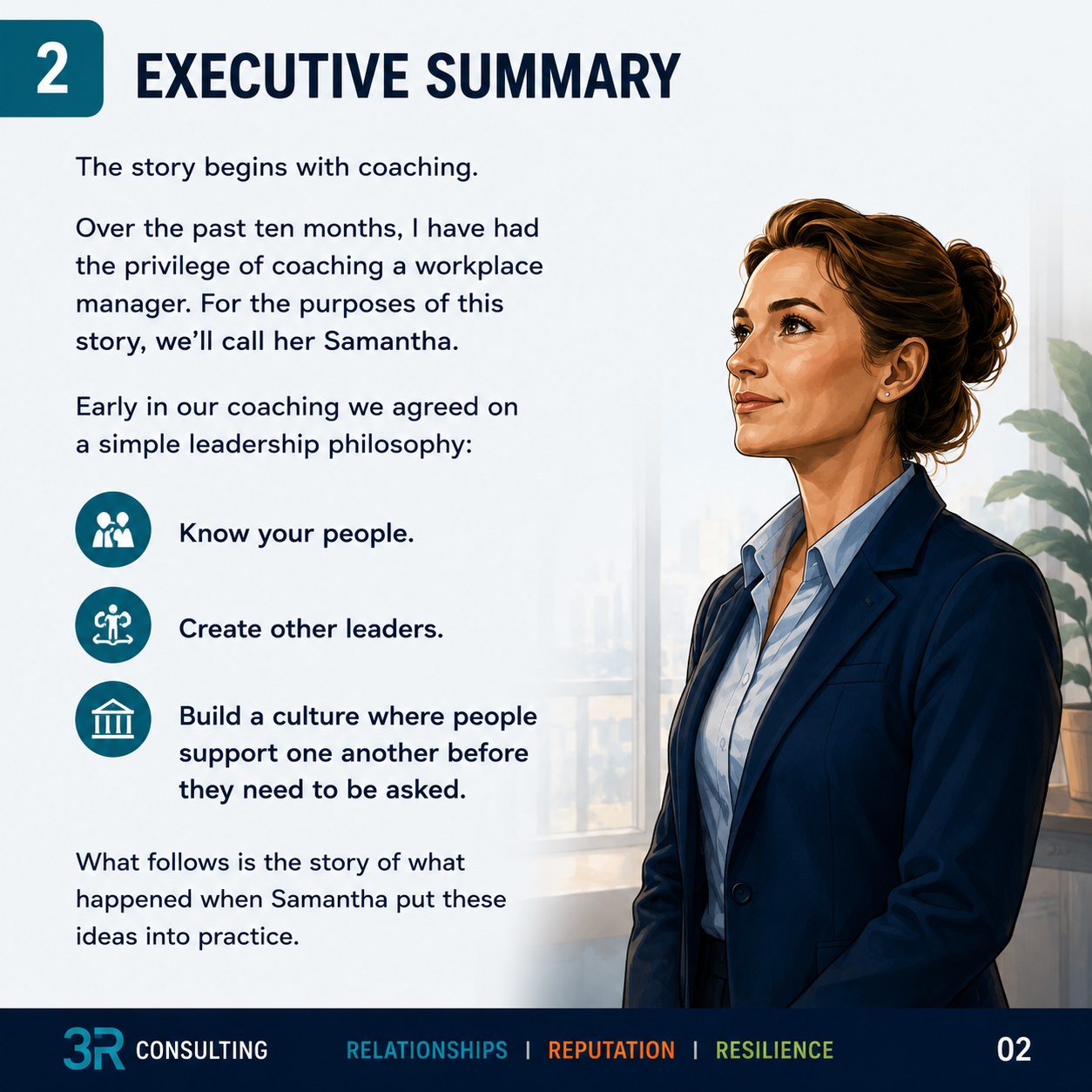
Over the past ten months, I have had the privilege of coaching a workplace manager. For the purposes of this case study, we’ll call her Samantha. Early in our coaching, we agreed on three simple leadership principles.
Know your people.
Create other leaders.
Build a culture where people support one another before they need to be asked.
Neither of us imagined how quickly those principles would be tested. This case study shares what happened when life unexpectedly challenged one member of Samantha’s leadership team—and how a supportive culture responded without the need for formal direction. It is a story about compassion, trust and the quiet power of creating leaders.
Organisational Background
Every workplace experience pressure.
Deadlines.
Competing priorities.
Limited resources.
Changing expectations.
Many leaders assume that building culture happens after the work is finished.
The opposite is true.
Culture is what enables the work to be done.
Over several coaching conversations, Samantha committed herself to understanding her people more deeply, creating greater ownership within her leadership team and helping others develop their own leadership capability.
The first step was deceptively simple.
She asked three questions.
Three Questions That Changed Everything
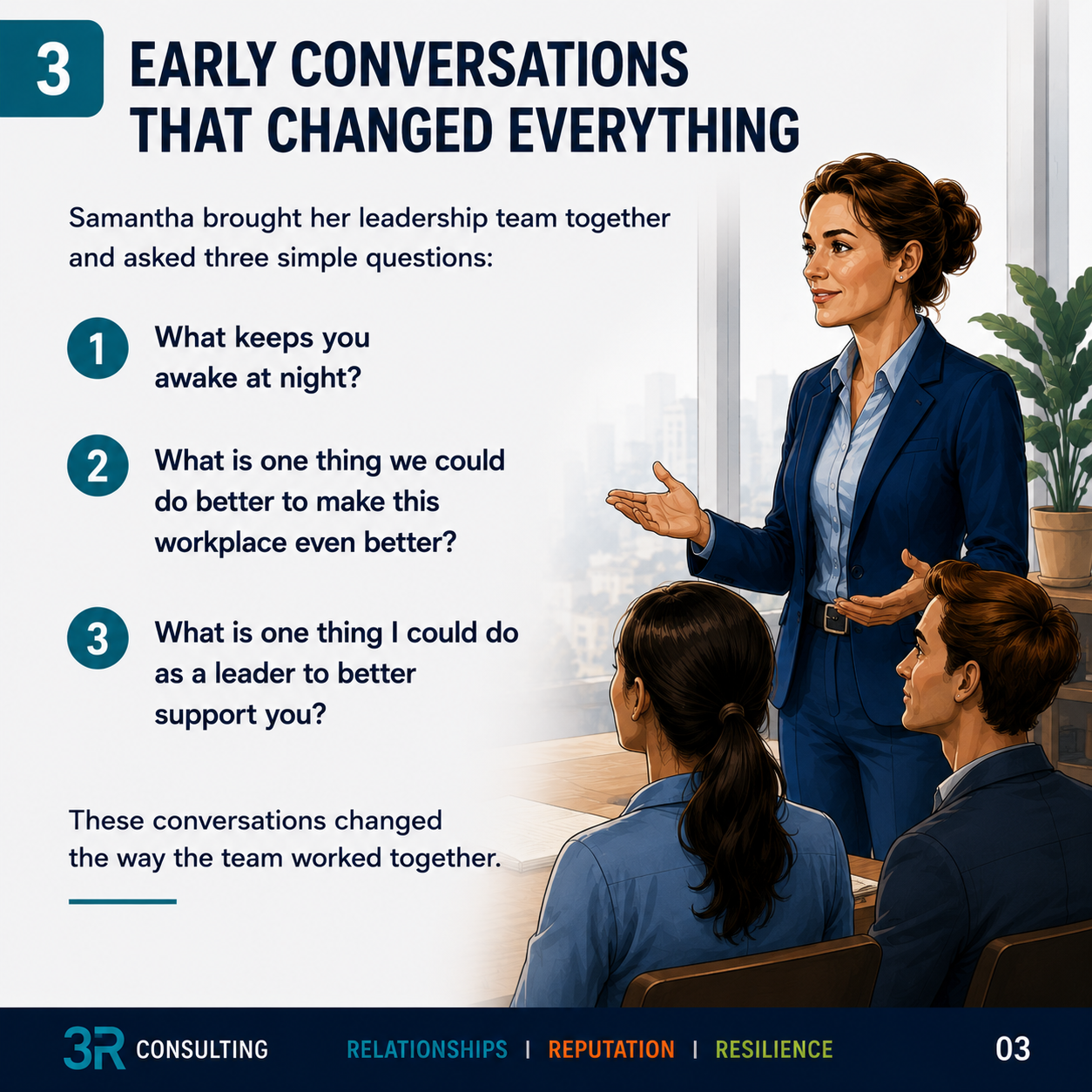
Samantha brought her leadership team together and asked:
What keeps you awake at night?
What is one thing we could do better to make this workplace even better?
What is one thing I could do as a leader to better support you?
At first, they appeared to be ordinary questions. In reality, they changed the conversations taking place inside the team.
People became more open. More honest. More connected.
Most importantly…Samantha began to truly know her people.
When Life Happens
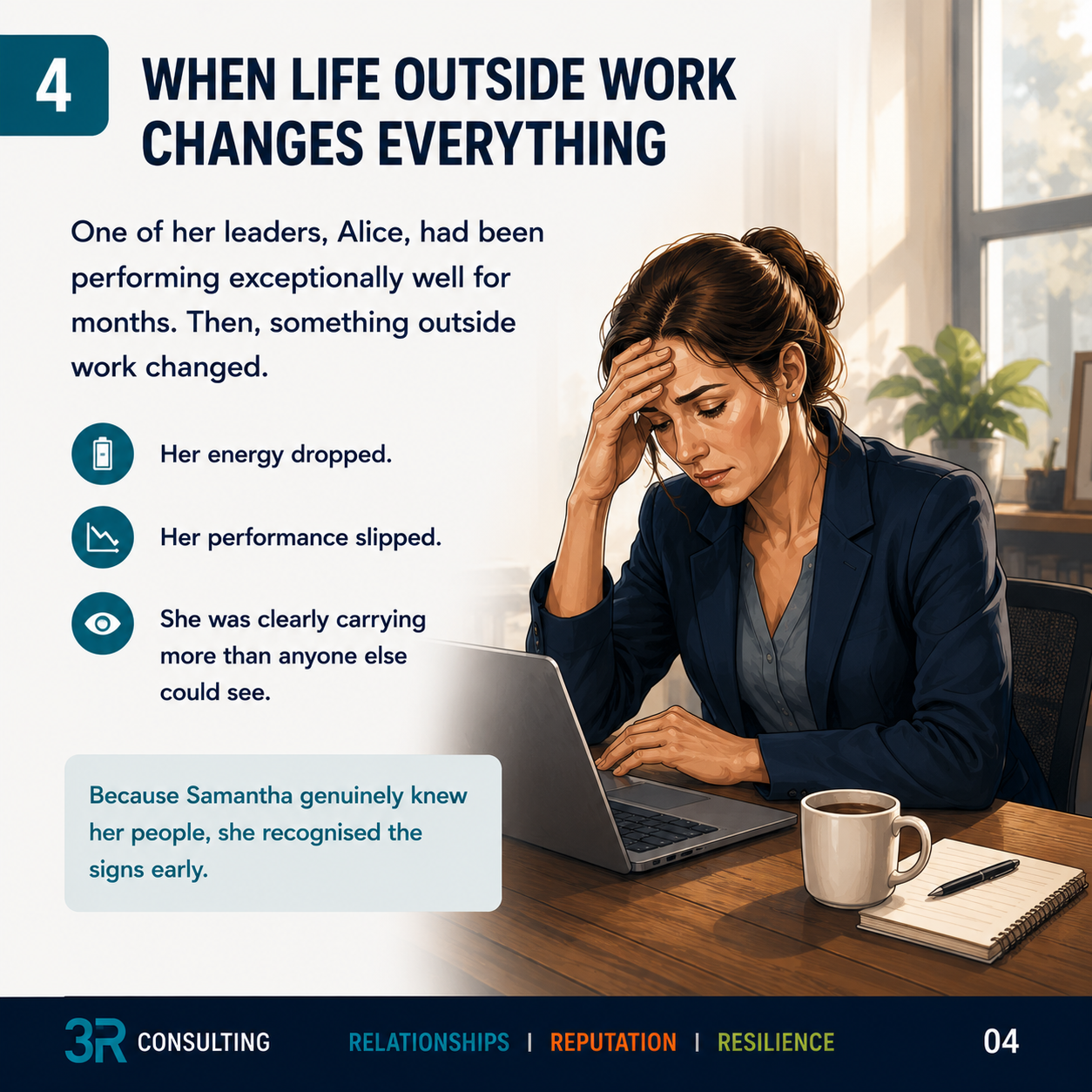
One of Samantha’s leaders—who we’ll call Alice—had consistently performed at a very high level.
Reliable. Trusted. Respected. Then something changed. Not at work. At home. Her energy dropped. Her confidence faded. Her performance reflected someone carrying a burden that nobody else could see.
Samantha didn’t know the details. She didn’t need to. She simply recognised that someone she knew well was no longer themselves.
That observation changed everything.
Compassion Before Criticism
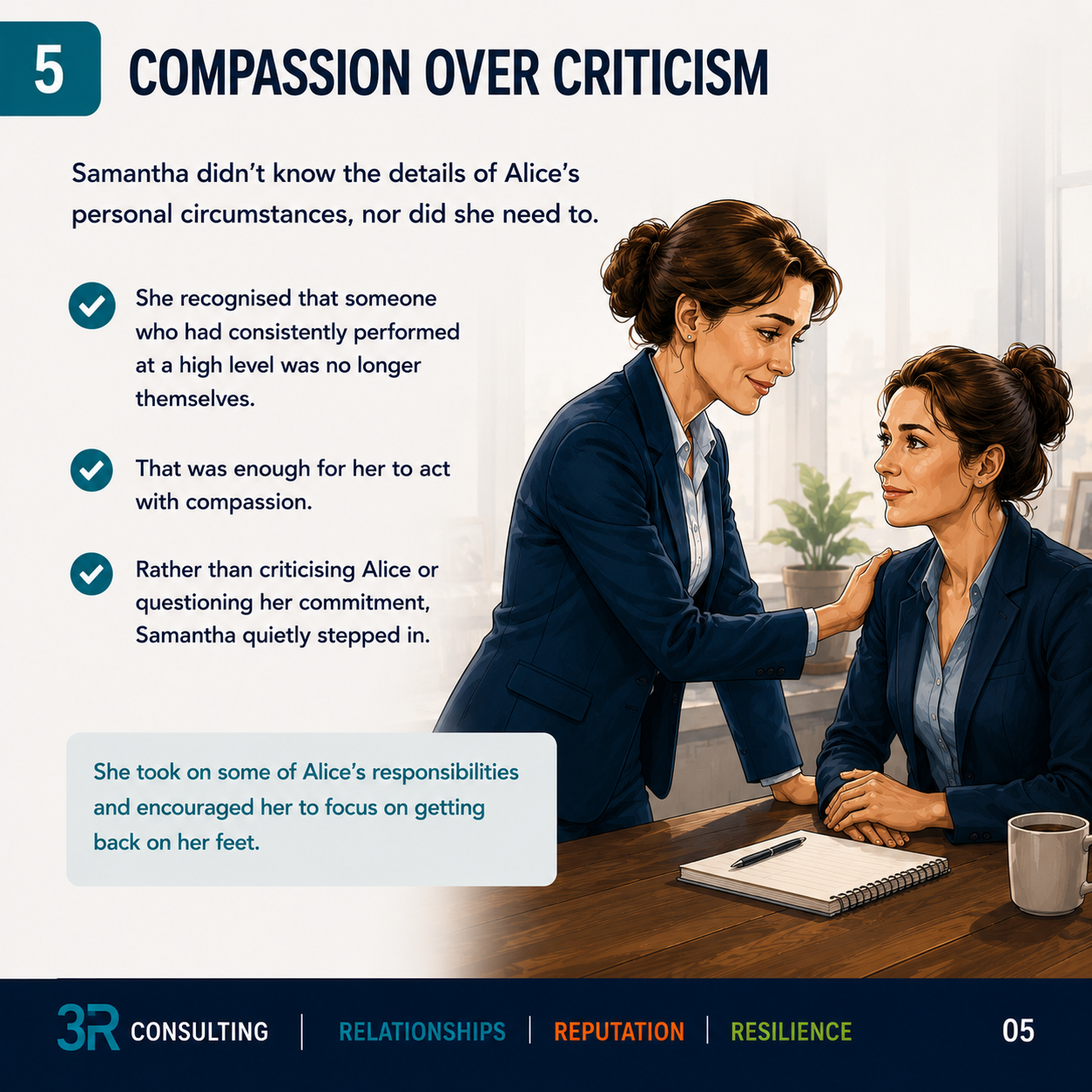
Many workplaces immediately move towards performance management.
Samantha chose something different. She quietly reduced Alice’s workload. She checked in. She created space. She offered support without demanding explanations.
Rather than asking, “What’s wrong with your performance?”
she asked, “What do you need from me?”
That single decision protected both Alice and the trust within the team.
A Leadership Challenge
Compassion created a new challenge.
Samantha couldn’t carry two leadership roles indefinitely.
Eventually someone else would need to step forward.
Not because they were instructed to.
Because they wanted to.
Rebecca Steps Forward
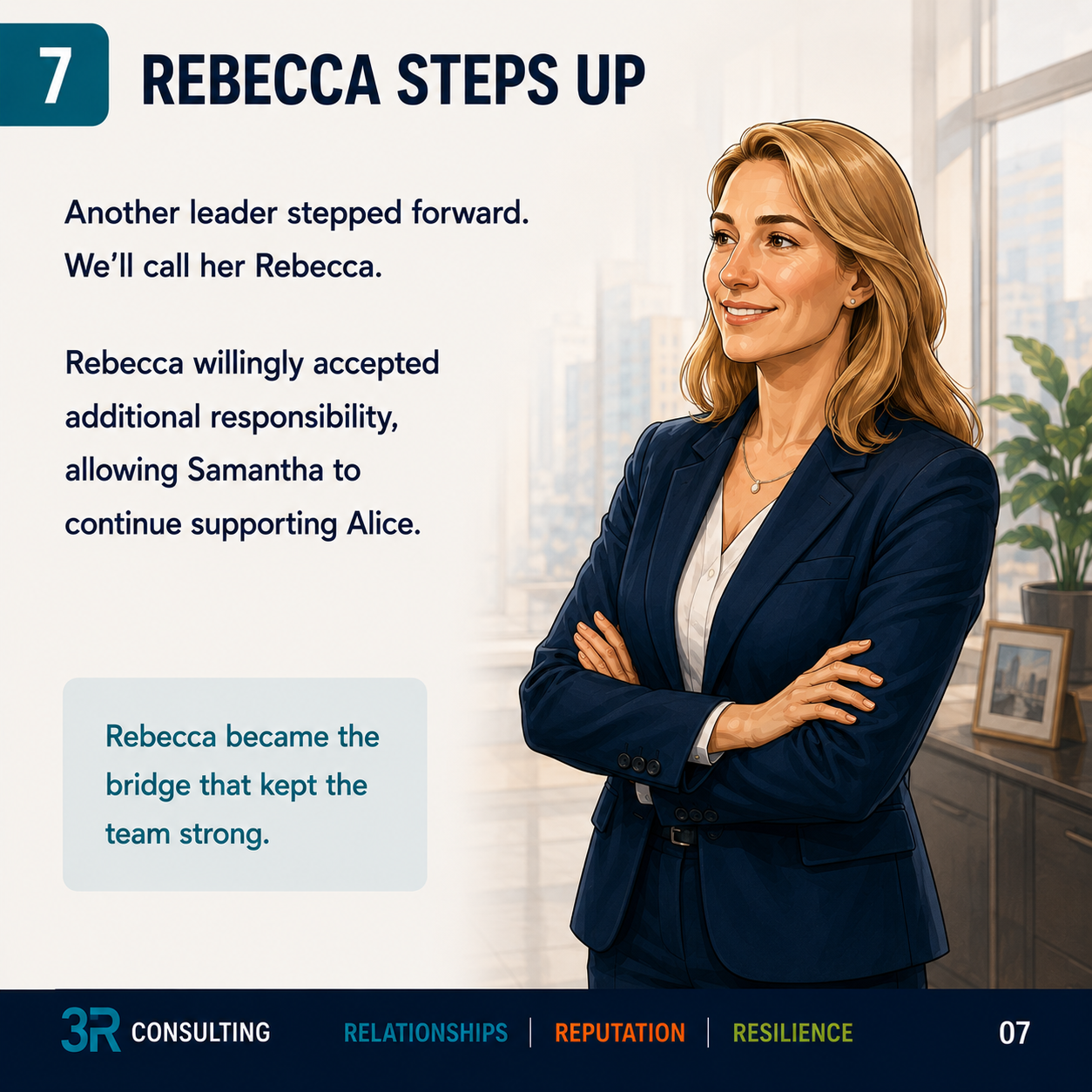
One member of the leadership team—we’ll call her Rebecca—volunteered.
She willingly accepted additional responsibility so Samantha could continue supporting Alice.
There was no announcement.
No formal promotion.
No organisational restructure.
Just someone choosing to help another leader.
The Ripple Effect
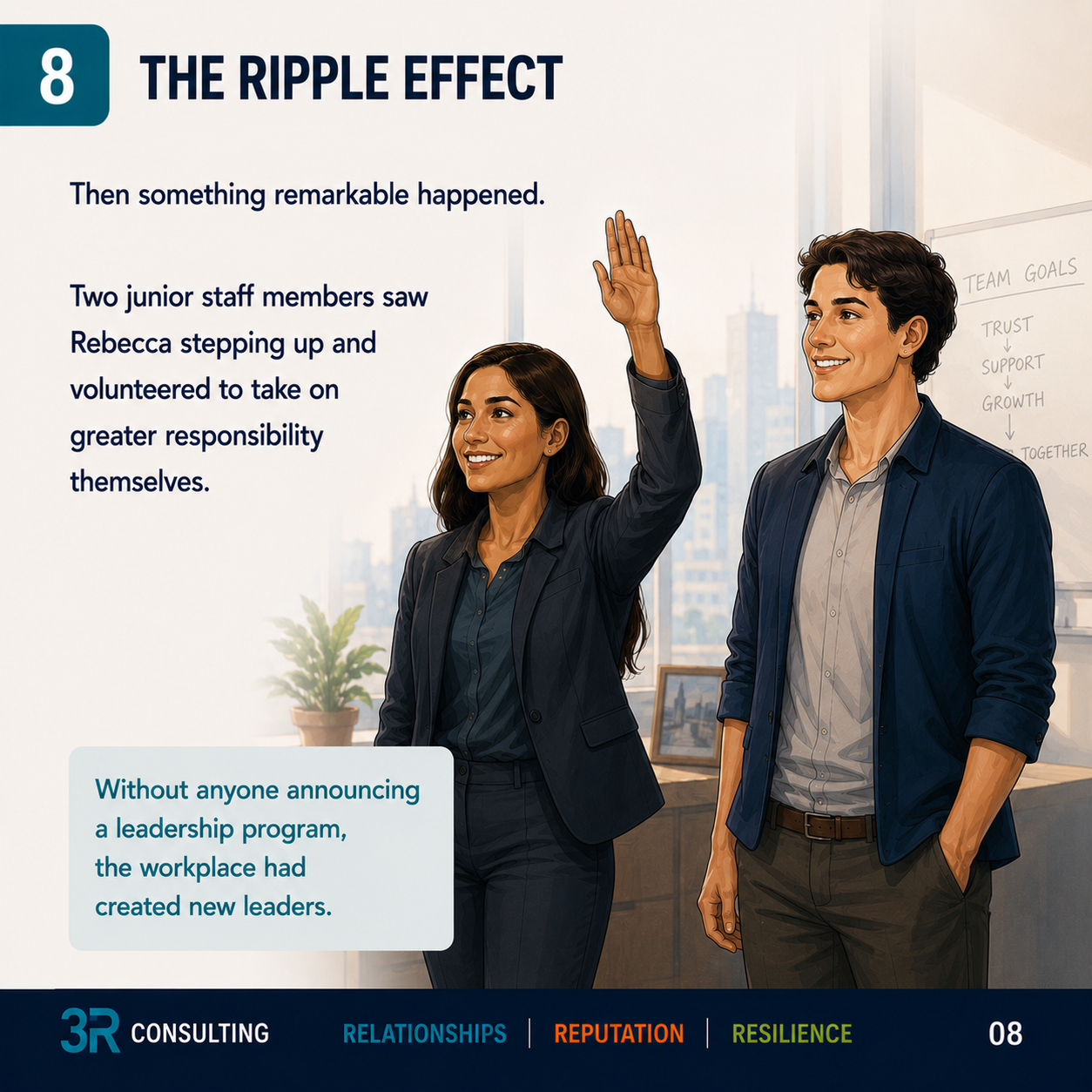
Then something unexpected happened.
Two junior staff members watched Rebecca. They saw leadership in action.
They volunteered to take on additional responsibility themselves. Without anyone launching a leadership program…new leaders emerged.
Support became visible. Ownership spread.
The Culture Became Stronger
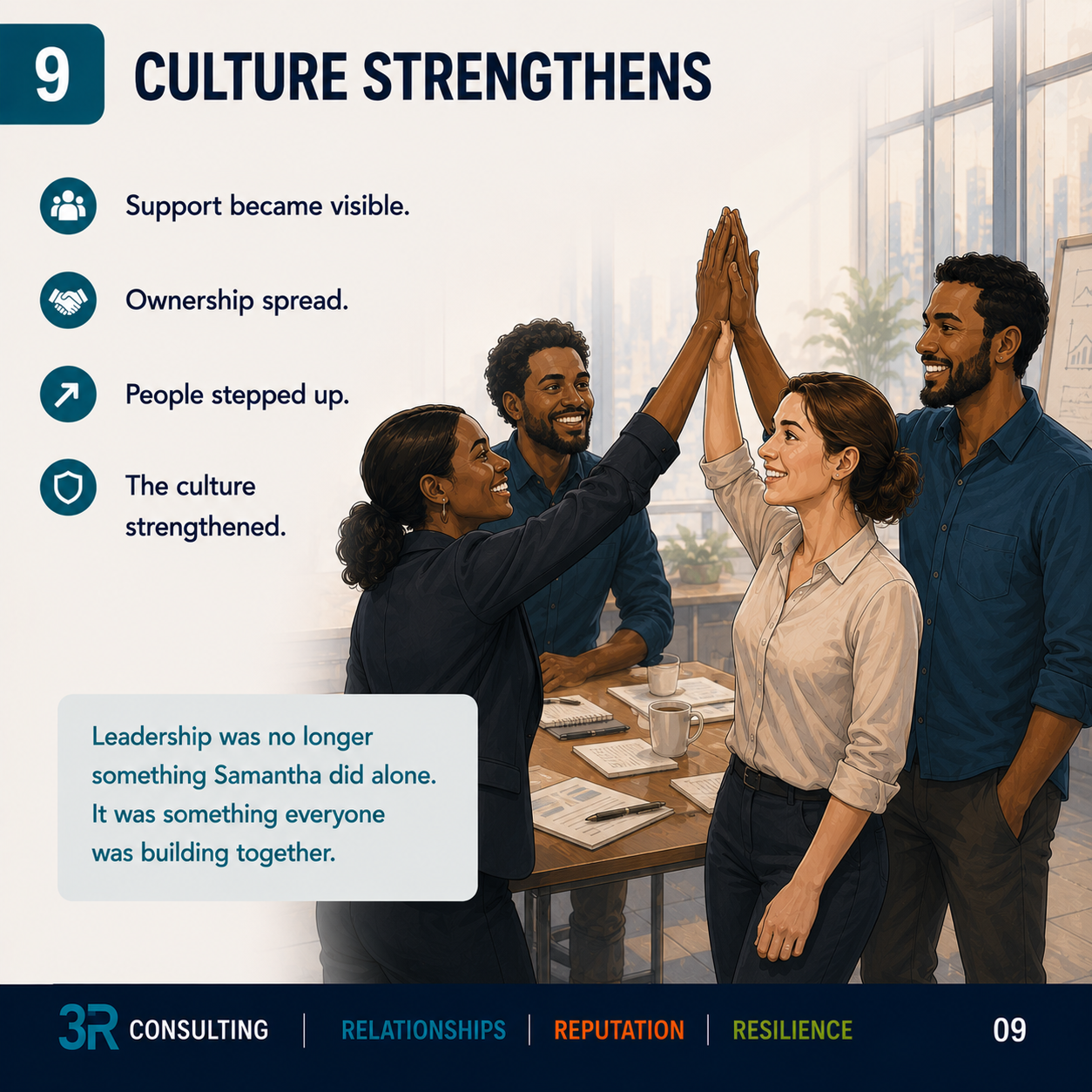
Leadership was no longer something Samantha did on her own. The whole team had learnt that leadership was something they did collectively together, by supporting each other, and having the confidence and trust to step up and do things that benefitted the whole team.
Alice Returns
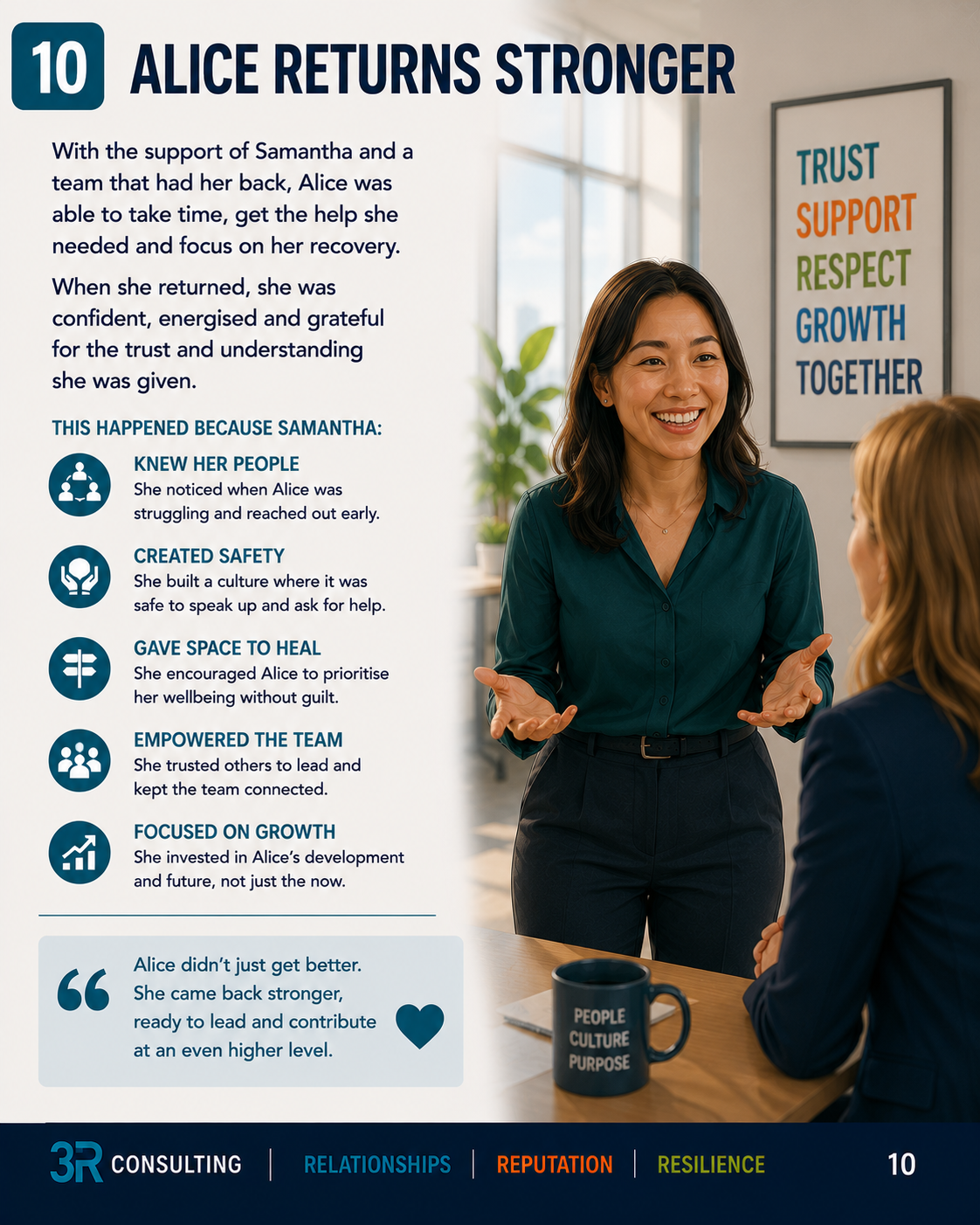
Three months later, Alice returned to her usual high standard. But something had changed. The workplace now had more leaders than it had before the challenge began. What started as a difficult period had strengthened the team. That is what supportive cultures do. In her first month back at work, Alice was nominated for Employee of the Month. Interestingly, Alice protested that she did not deserve the award or recognition but insistence through her team ensured she ultimately accepted the recognition.
Leadership Through the 3Rs
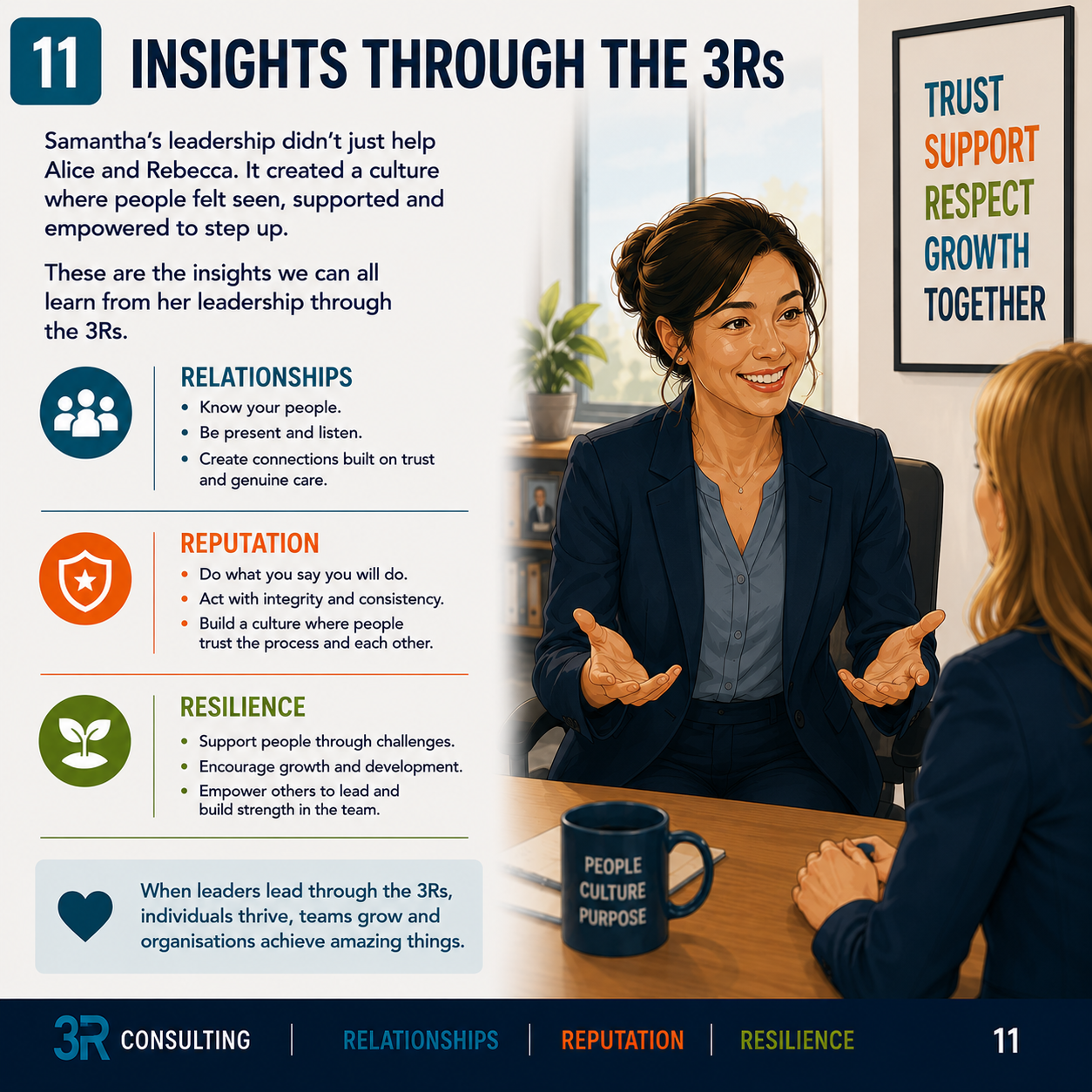
Samantha genuinely knew her people. Because she invested in relationships before the crisis, she recognised when something had changed. Reputation: Rather than blame, she chose compassion. That decision strengthened trust across the entire team. People learned that asking for help was safe. Resilience: Rebecca stepped forward. Junior staff stepped forward. Leadership capacity increased. The workplace became stronger because leadership had been shared. Reflection: As you think about your own workplace, consider these questions:
- Who keeps your workplace functioning quietly every day?
- Who may be carrying a burden that nobody else can see?
- Who is ready to step into greater leadership if you create the opportunity?
- What conversations could you start this week that might change your culture?
Coach’s Reflection
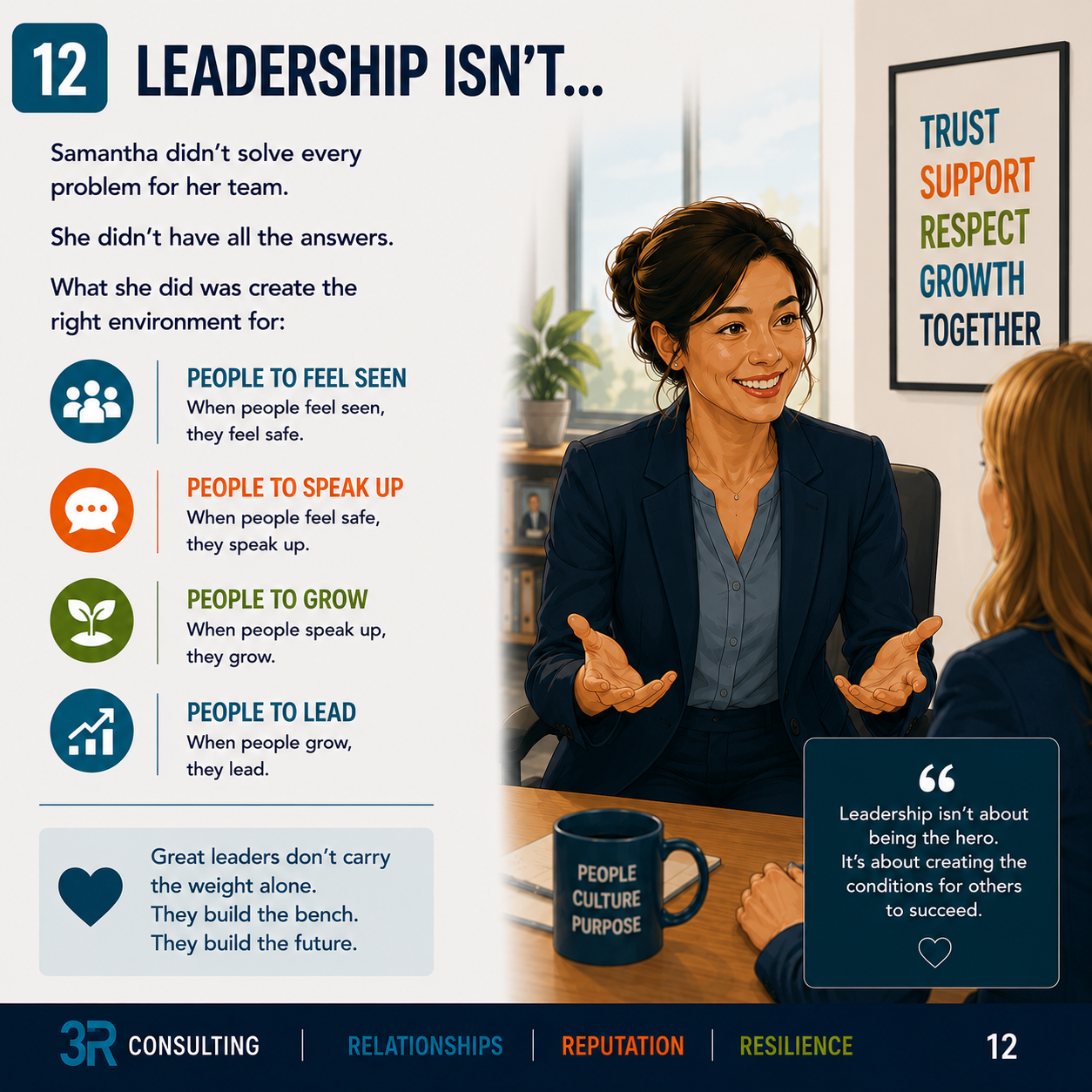
Coaching isn’t about giving people the answers.
It’s about helping leaders recognise the strengths that already exist within their teams. Samantha didn’t become successful because she followed a script. She became successful because she consistently applied simple leadership principles, trusted her people and created opportunities for others to lead.
The result wasn’t simply that Alice recovered. Rebecca grew. Two junior staff members grew. The leadership team grew.
The culture grew.
That is the true measure of leadership.
Not how many followers we create…but how many leaders we create.
Reflection Question for Leaders
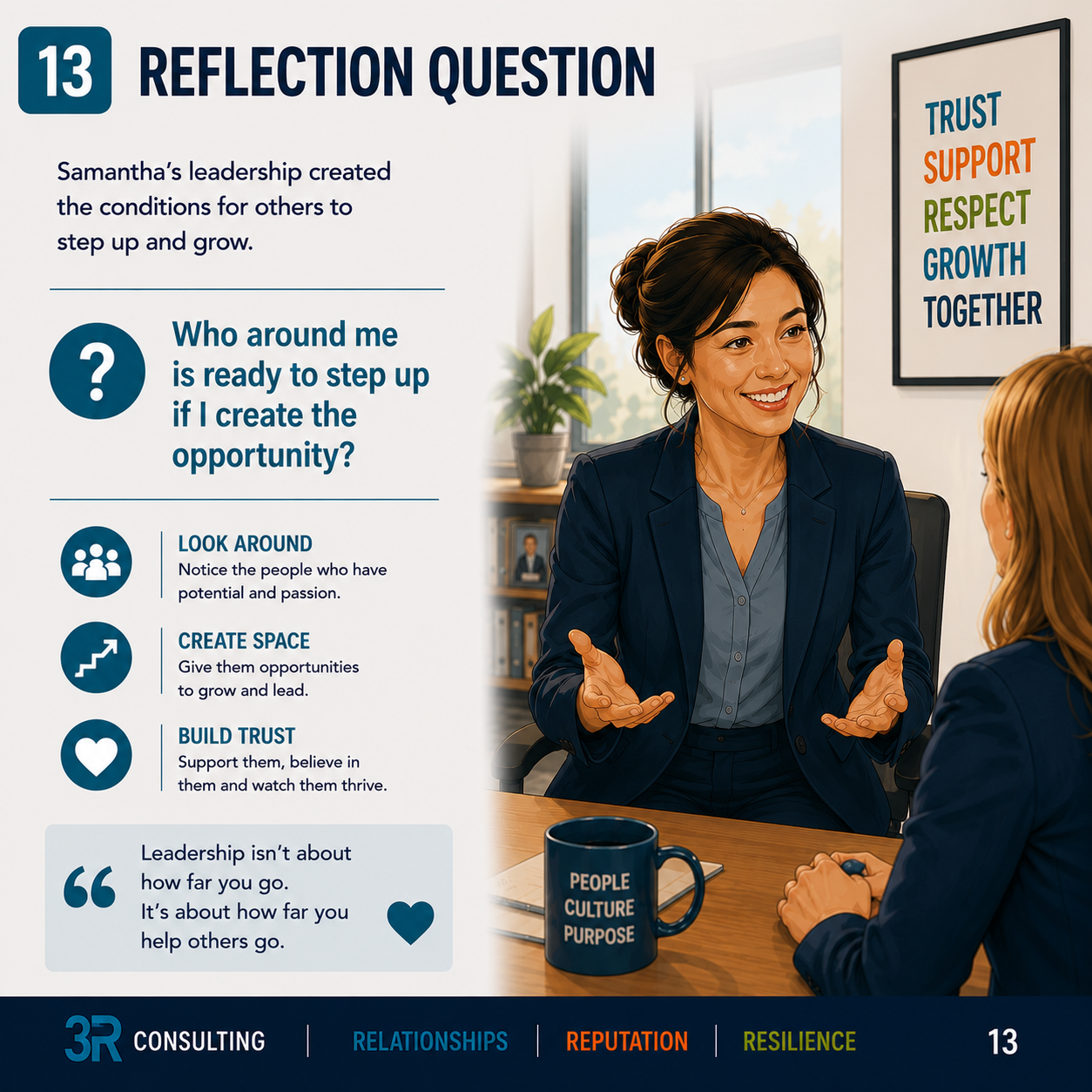
Leadership is not about having all the answers. It is about creating the environment for people to do their best and come up with the answers collectively because that is the space we have created.
Who around you are ready to grow, if you as the leader creates the environment for them to do amazing things, because you empower them, because you trust them, and because they know you trust them?
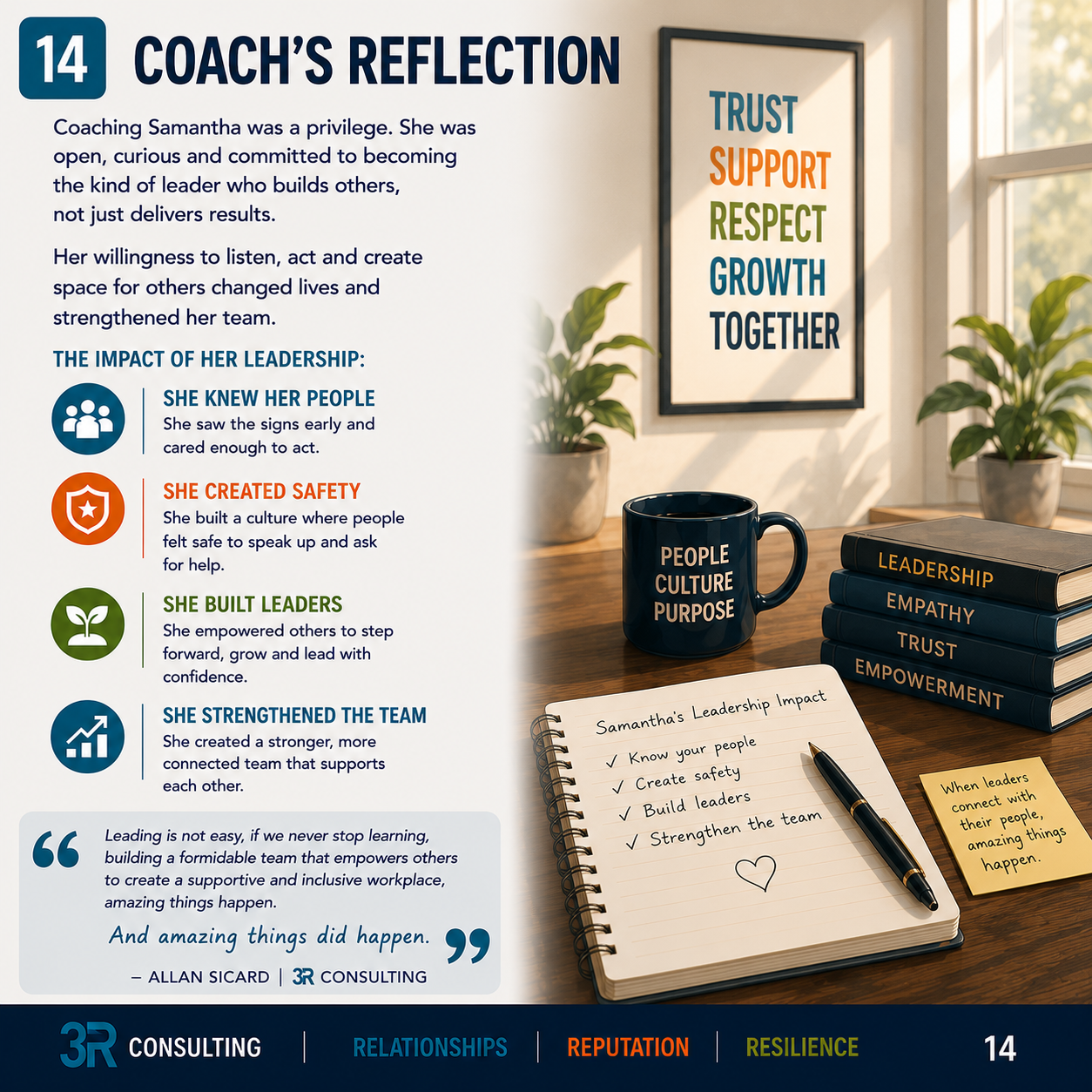
After 40 years of Policing in leadership roles, writing The Courage to Lead – Resilience and Compassion in Police Command, and hosting nearly 100 episodes of The Courage to Lead Interview Series this personal quote sums up this gig called Leadership.
“Leading is not easy. If we never stop learning, build a formidable team that empowers others to create supportive and inclusive workplaces amazing things will happen.”
Samantha, Alice and Rebecca made amazing things happen. This is a true story it just happened in the last three months because Samantha changed the way she approached leadership and made it a team thing not a singular journey.
Leadership insights
Where did the 3 questions in slide 3 come from?
Leadership is a learning thing.
Question 1: What keeps you awake at night.
This question’s origin came from The Courage to Lead Interview Series Episode 61 with Mark Coyne. Mark is the former captain of the winning Queensland State of Origin Rugby League Team, and former CEO and current Executive Leader within EML a national Workers Compensation organisation. EML had just placed in the Great Place to Work Rankings for Australia in 2025. I asked Mark if he would come on the show and tell their story. Mark shared that as the CEO he often felt removed from the people doing the work on the front line so he adapted the following strategy.
When he attends any worksite he sits down with his staff, one on one and asks one question, “Can I help you with something that you cannot solve?” or similar. One answer to this question was for Mark to get a Queensland Rugby League Jersey cherished by one of his staff signed by Mal Meninga, the champion coach of that winning side. Within 24 hours Mark Coyne had this done.
My question 1 is a variation of Mark Coyne’s question but it is a good eye opener to what is going on in our people’s lives.
Matt Lahood in his interview considers most people have 3 levels of problems, Money, Health or Relationships. If you listen to their stories, we as leaders, can at least offer a level of referral or follow up.
Question 2. What is one thing we could do better to make this workplace even better?
This is a variation of the question outlined by Deb Wallace in Episode 83 of The Courage to Lead Interview Series. The question posed by Deborah Wallace to her Gangs Squads staff when she stood in front of the whole team from Constables through to Inspectors and said,
“I know nothing about Outlaw Motorcycle Gangs, what is important to them and how do you think we can shut them down.”
The rest is history, Deb Wallace wrote down all the points that her team said to shut the outlaw motorcycle gangs and implemented them, or her team did and she just stepped in when they need her level of leadership chutzpa and oomph. This will be expanded on in Case Study 3 which will be all about Deb Wallace.
When you do what Deb Wallace did in that question to her Gangs Squad team, you are openly admitting that you as the leader do not possess all the answers but you the team, do know. What do we need to do and let’s do it together?
Question 3. What is one thing I could do as a leader to support you?
This has come from my own experience and the works of Marshall Goldsmith, author of the book, “What got you here will not keep you here.” I so wish I knew about that book when I first made the rank of Superintendent in 2005.
MG asserts that a lot of leaders can improve their outcomes by doing less rather than doing more. I can relate to that. My natural inclination is to do more but the more I do less, and empower the people around me to do their best ,by creating a good workplace, the better things become. Andrew Colvin described this as his own Achilles heel in his interview on The Courage to Lead Interview Series Ep: 25 & 26. One thing I have learned is that some people will always be scorpions.
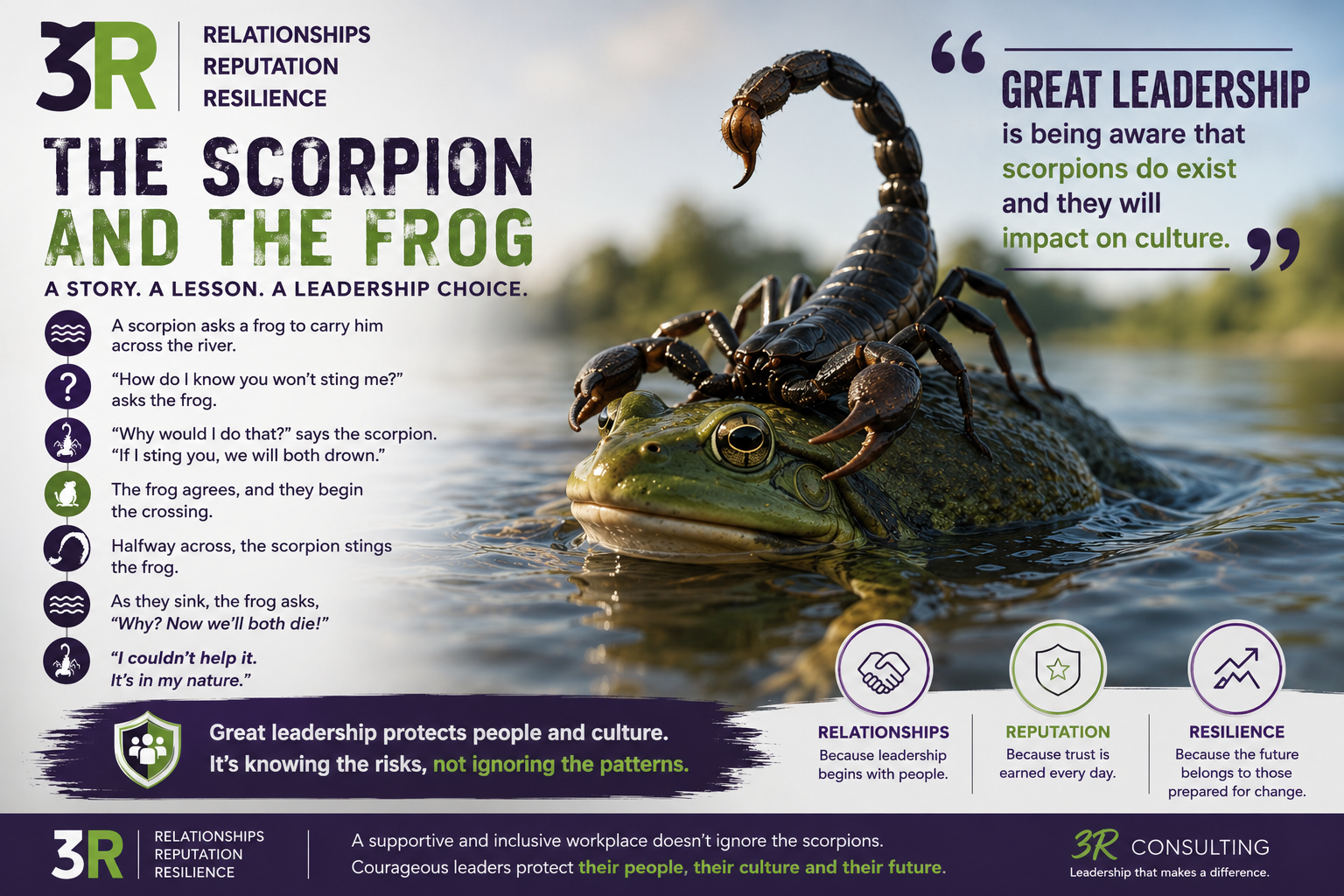
As leaders we must be on the lookout for scorpions. In my 15 years at the rank of Superintendent – Police Commander, I met 3 scorpions. They mask who they are well and the last one I met nearly ruined our whole command. I blamed myself for not seeing it, and the treachery caused by the scorpion. Once I saw it, I advised them they no longer had my trust or that of the team, and they should move on. They did. I felt so accountable for missing what the scorpion had done to our workplace that I volunteered to the rest of the leadership team to step down as their leader and seek another workplace. They asked me to stay.
That team asked me to do less and let them do more. That turns out to be the most common answer by teams to their leaders, for the leader to do less and let the team do more.
Try it, it does work when we as leaders step out of the way and let our people work their magic because we trust them but remember always keep an eye out for scorpions.