
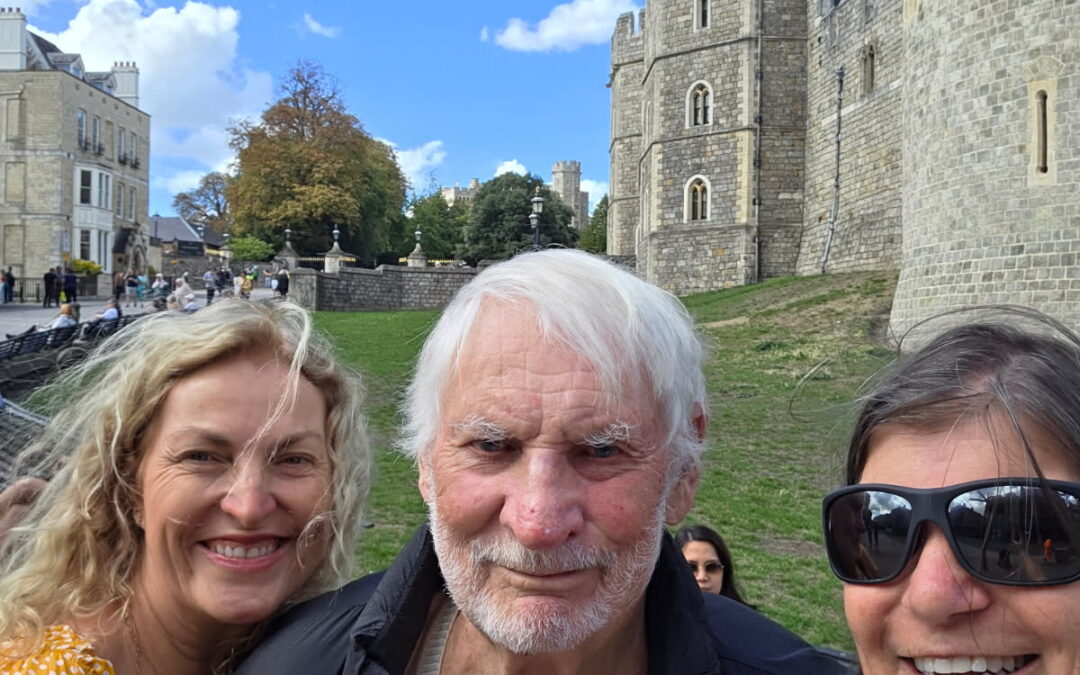
Peter Cook – a life well lived:
Over the last four years I have interviewed nearly one hundred leaders on The Courage to Lead Interview Series.
CEOs.
Police Commissioners.
Military commanders.
Olympians.
Authors.
Community leaders.
People who have led thousands of others through crisis, challenge and change.
Yet one of the most profound conversations I have ever had took place recently with a man sitting in a chair in Coffin Bay, South Australia.
My father-in-law, Peter Cook.
A week before our interview Peter Cook was diagnosed with pancreatic cancer that had already spread to his liver and lungs. The doctors were honest. The road ahead would be measured in months, not years.
When most people receive news like that, they naturally focus on themselves.
Peter Cook focused on everyone else.
Peter Cook organised his own funeral so his family would not have to make difficult decisions later. He began putting his affairs in order. He thought about his daughters. His grandchildren. His friends. He thought about the people he might still be able to help.
That response tells you almost everything you need to know about the man.
As we spoke, I found myself reflecting less on Peter Cook’s diagnosis and more on the remarkable life that had brought him to this moment.
Peter Cook grew up in Melbourne in an era when life seemed simpler but was often harder. He inherited a love of sport from his father Mac, a talented woodcarver, artist and footballer whose handcrafted furniture still sits proudly in homes throughout the family today.
Sport became Peter Cook’s first great passion.
He was a talented wicketkeeper who represented Victoria Under-21s and later travelled to England in the 1960s to play cricket. Listening to him tell stories about village cricket grounds with thatched-roof pavilions, facing the legendary West Indian fast bowler Wesley Hall in the nets, and wandering through England as a young Australian adventurer, I realised something.
Peter Cook never merely visited life.
He participated in it.
That became a recurring theme throughout his life.
Whether it was standing alongside Aboriginal activists during the Tent Embassy movement in Canberra, travelling the world, building lifelong friendships across six decades, volunteering at libraries, mentoring recovering alcoholics or simply helping a neighbour, Peter Cook never sat on the sidelines.
He got involved.
He always got involved.
Like many people of his generation, however, Peter Cook’s story was not without its struggles.
What started as social drinking eventually became alcoholism.
Not the romantic version often portrayed in movies.
The real version.
The painful version.
The lonely version.
The version where you hate what alcohol is doing to your life but cannot see a way out.
During our conversation Peter Cook spoke honestly about reaching a point where alcohol had complete control over him. He described the self-loathing, the repeated attempts to stop and the feeling that he simply could not beat it alone.
Then something extraordinary happened.
At seventy-nine years of age, when many people have given up trying to change, Peter Cook decided he wasn’t finished yet.
With the support of a caring doctor and Alcoholics Anonymous, he rebuilt his life. Not overnight. Not easily. But completely.
Five and a half years later Peter Cook remains one of the people others turn to when they need help.
That may be the most remarkable chapter of his story.
Not that he recovered.
But that he transformed his recovery into service.
Even as we conducted this interview, Peter Cook spoke about another local man struggling with alcohol whom he intended to visit and support. Here was a man recently diagnosed with terminal cancer, struggling to walk twenty metres without losing his breath, yet still thinking about someone else’s wellbeing.
I found that incredibly moving.
Leadership is a word we use frequently.
Perhaps too frequently.
Most people associate leadership with positions, authority, titles or organisational charts.
Peter Cook has reminded me that some of the best leaders never hold formal leadership positions at all.
They simply make the lives of others better.
One conversation at a time.
One friendship at a time.
One act of kindness at a time.
As our conversation drew to a close, I found myself thinking about legacy.
Not the kind of legacy measured by money, status or achievements.
The kind measured by stories.
The kind measured by friendships that endure sixty years.
The kind measured by daughters who adore their father.
The kind measured by the people who become better because they met you.
The kind measured by whether your life mattered to others.
When I think about Peter Cook, I don’t think about cancer.
I think about cricket grounds in England.
I think about wine bottling parties in Canberra.
I think about friendships that survived six decades.
I think about helping strangers.
I think about resilience.
I think about laughter – listen to the cut thumb joke at the end, It is seriously very funny and no one tells it better than Peter Cook.
I think about courage.
Most of all, I think about gratitude.
Because not everybody gets to meet someone who shows them what a life well lived looks like.
I did.
His name is Peter Cook.
And I am proud to call him family.
“This episode is dedicated to Peter Cook. Thank you for the stories, the laughter, the lessons, and for showing all of us what courage looks like when life becomes difficult.”
<